

A stainless steel candle holder solves two problems most decorative holders ignore: tarnish and heat damage. The S-Curve SS-238 from Apexerahomelife is a mirror-polished 304 stainless steel candelabra holding two taper candles, sold in three sizes (6×16 cm, 7×20 cm, 8×24 cm) and two finishes at $147. This guide covers what 304 steel actually means in practice, which size suits which table, how to style a sculptural holder without blocking sightlines, and how to keep a mirror finish from going cloudy.
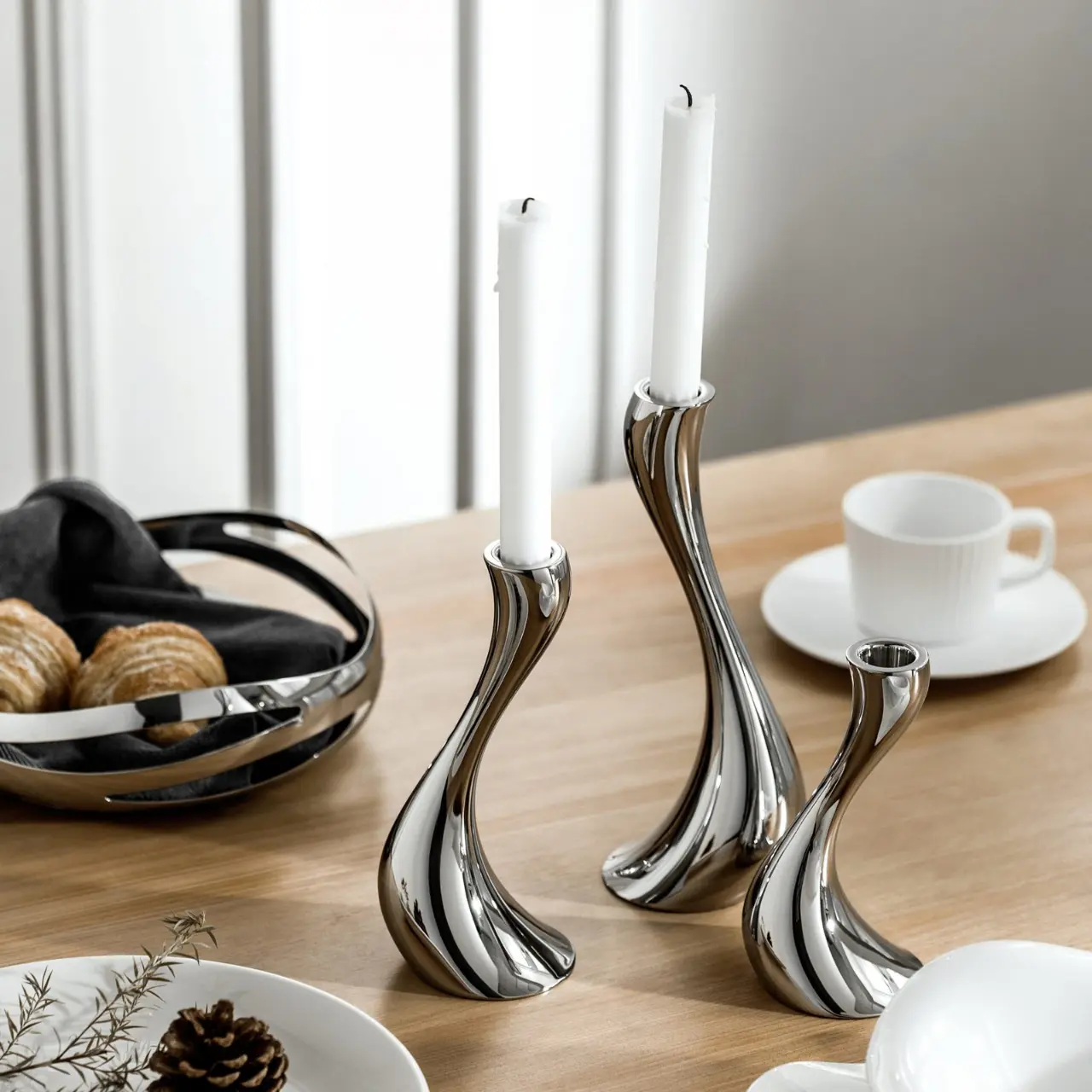
The SS-238 in its large size (8×24 cm), mirror-polished finish.
Why the material matters more than the shape
Material determines whether a candle holder looks the same in five years. Shape only determines whether you like looking at it now. For a piece you light weekly, stainless steel outperforms brass, glass, and ceramic on every maintenance axis.
Material | Heat behaviour | Tarnish / oxidation | Upkeep | Realistic lifespan |
304 stainless steel | Unaffected at candle temperatures | Non-oxidising, rust-resistant | Dry microfibre wipe; occasional polish | Decades |
Brass | Unaffected, but lacquer can discolour | Tarnishes within months | Polish every 2–3 months | Decades with care |
Glass | Risk of thermal shock cracking | None | Wipe; wax removal can scratch | Years — fragile |
Ceramic | Unaffected, but glaze can craze | None | Wipe; chips on impact | Years — chips |
The practical takeaway: candle flames reach roughly 800–1,000 °C at the tip, but the holder body stays far cooler — heat is not the real enemy. Wax, fingerprints, and airborne grease are. Stainless steel is the only common holder material that shrugs off all three.
What “304 stainless steel” actually means
304 is the austenitic stainless alloy used in commercial kitchen equipment, food-preparation surfaces, and architectural trim. It is the right choice for a candle holder, and the reason is specific rather than marketing.
- Composition:roughly 18% chromium and 8% nickel.
- Why that matters:the chromium forms a passive chromium-oxide layer on the surface. When you scratch it, the layer reforms using oxygen from the air. This is why stainless steel is self-healing in a way that lacquered brass is not.
- Corrosion resistance:304 resists oxidation from indoor air, wax, and cleaning water without any coating.
- On the “medical-grade” label:you will see 304 described as surgical or medical-grade in retail copy. That is loose language. 304 is food-grade; the alloy actually specified for surgical implants is 316L, which adds molybdenum for chloride resistance. For a candle holder kept away from saltwater, 316’s extra cost buys protection you will never use.
Where this becomes a genuine limitation: 304 is not immune to salt air. If you want a holder for a coastal balcony or a bathroom with heavy humidity, expect surface pitting over time and choose 316 instead.
S-Curve SS-238: the specifications that matter
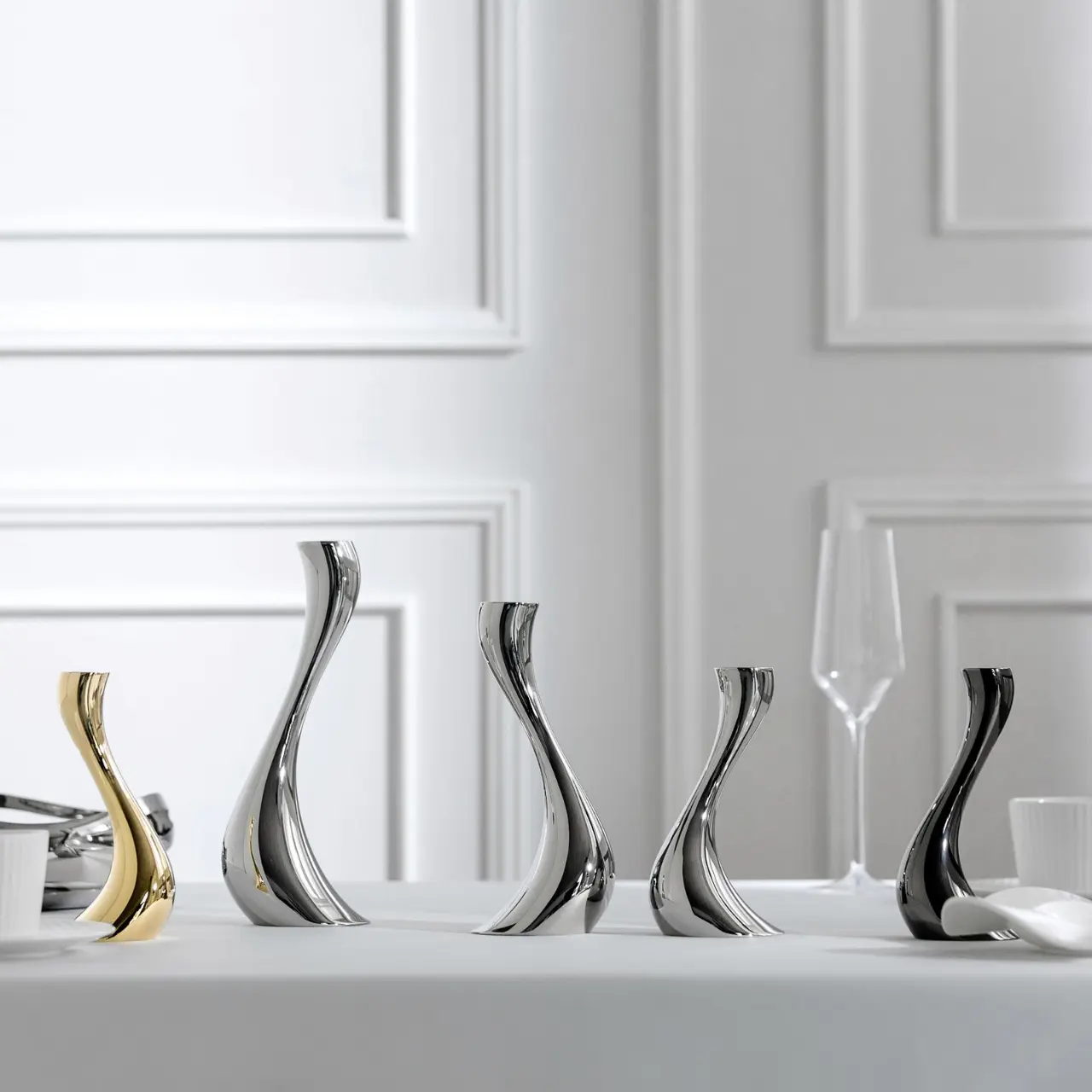
The continuous S-form is cut from a single unbroken line — no visible joins.
Specification | Value |
Material | 304 stainless steel |
Finish | Mirror polished — silver or golden |
Candle capacity | 2 taper candles |
Small | 6 × 16 cm |
Medium | 7 × 20 cm |
Large | 8 × 24 cm |
Price | $147 |
The defining feature is the form: a continuous serpentine curve that carries two tapers at different heights rather than holding them level. This is what separates it from a standard two-arm candelabra. The asymmetry means the piece reads as a sculpture when the candles are unlit — which matters, because most candle holders spend 95% of their life unlit.
Choosing a size: which SS-238 fits your table
Size selection should follow the surface, not the room. A holder that is too large crowds a table; too small and it disappears.
- Small (6 × 16 cm)— bedside tables, powder rooms, or one per place setting at a formal dinner. Works in clusters of three.
- Medium (7 × 20 cm)— a dining table seating four, a console, or a mantel with low clearance.
- Large (8 × 24 cm)— a dining table seating six to eight, or standing alone as a sculptural object on a sideboard.
Rule of thumb: a centre candle holder should occupy roughly one-sixth to one-eighth of the table’s width, and sit below 25 cm in height so diners can still see each other. All three SS-238 sizes clear the sightline test; only the large size approaches the width limit on a narrow four-person table.
How to style a sculptural candle holder
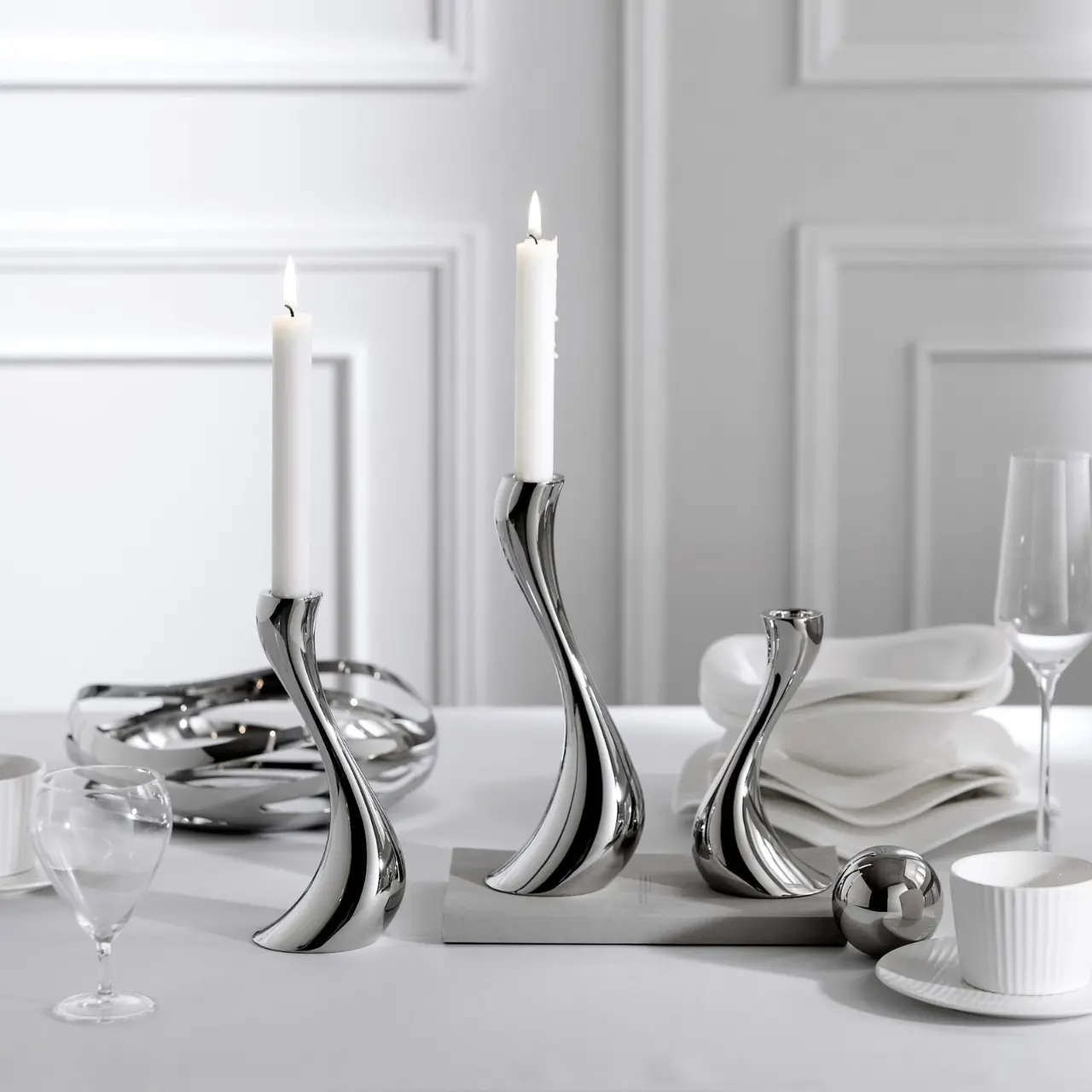
Pairing mirror steel with warm wood keeps the piece from reading as cold.
Four approaches that work with a reflective, asymmetric piece:
- Anchor it against a warm material.Mirror steel on a walnut or oak surface reads as intentional. The same piece on a white lacquer table can look clinical. The dark wood and steel tissue box solves the same problem in a smaller footprint.
- Group by height, not by material.Cluster the SS-238 with objects of graduated height rather than matching metals. The Steel UFO Vase at 348 is a useful taller companion.
- Use the reflection deliberately.A mirror finish doubles the visual weight of candlelight. On a dark table this is the whole effect; on a glossy white table it disappears.
- Keep the rest of the table matte.One reflective object is a focal point. Three competing reflective objects is a showroom.
For more on placing steel objects in a room without the space going cold, see our guide to fluidity in steel design.
Care: keeping the mirror finish from going cloudy
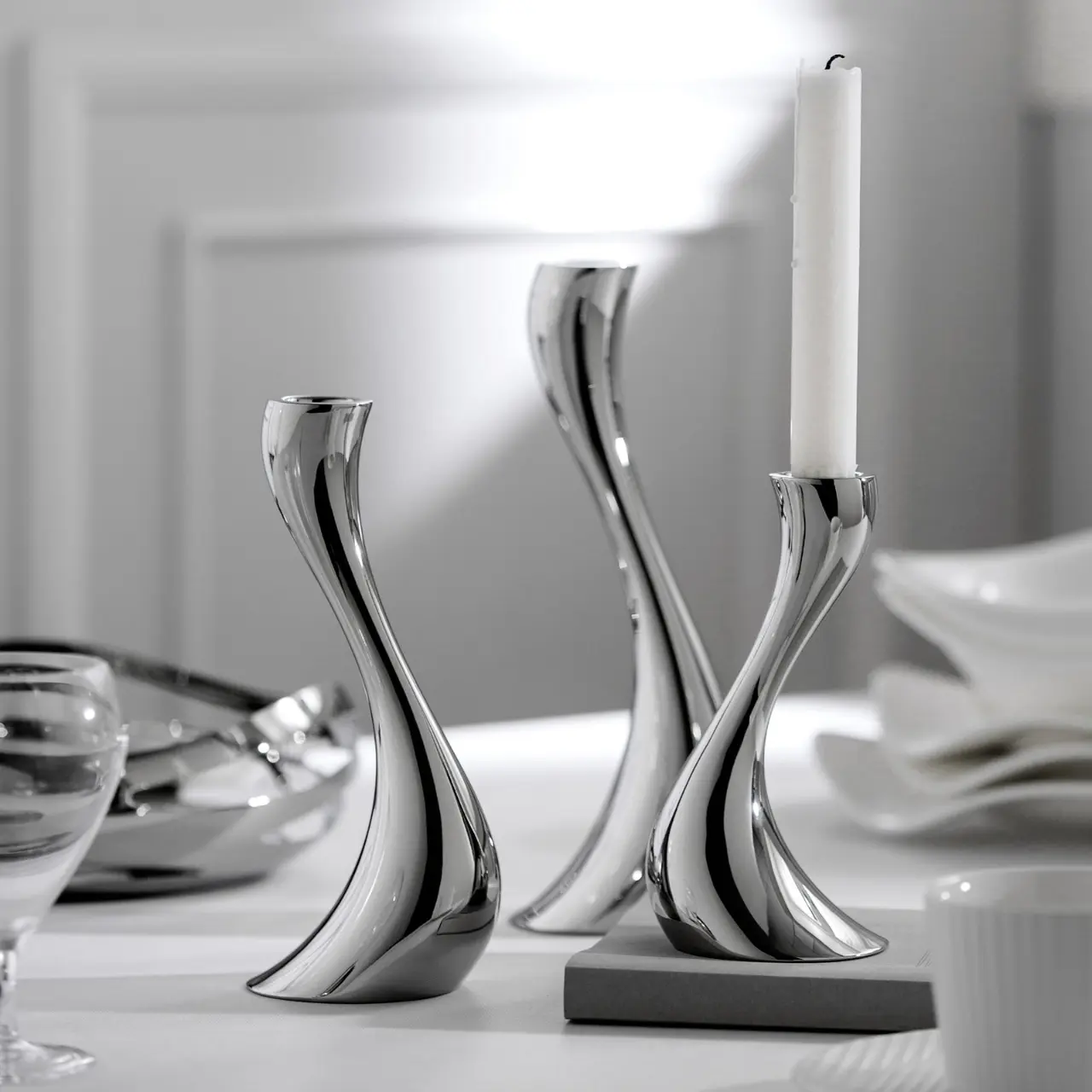
The mirror finish is the reason to buy this piece — and the reason it needs specific care.
A mirror finish shows everything. That is the trade you are making, and it is manageable with the right routine.
- After every use:let wax cool completely, then lift it off. Never scrape warm wax — it smears and takes the polish with it.
- Routine clean:dry microfibre cloth. This removes fingerprints, which are the main day-to-day issue.
- Stubborn wax:warm water with a drop of mild dish soap, then dry immediately with a second cloth. Water spots are more visible on mirror steel than on brushed steel.
- Restoring shine:isopropyl alcohol on microfibre, wiped in one direction.
- Never use:steel wool, abrasive pads, or cream cleaners containing abrasives. These leave permanent scratches that a mirror finish will show from across the room.
- On the golden finish:avoid vinegar and acidic cleaners. The colour is a surface treatment, not solid metal, and acid will dull it.
Frequency: a dry wipe after each use, a proper clean monthly if used weekly. That is genuinely the whole maintenance schedule.
Who this is for — and who should skip it
Being blunt about this saves returns.
Buy it if you want a candle holder you will still be using in ten years, you are furnishing a hospitality setting where pieces get handled daily, or you are buying a gift that needs to feel substantial at the $147 price point.
Skip it if you want something for outdoor or coastal use — 304 will pit in salt air and you should be looking at 316. Skip it too if fingerprints on a mirror surface will bother you, or if a candle holder above roughly $50 is not a priority. At $147, the SS-238 costs more than a comparable brass candelabra, and what you are paying for is that it will never need polishing.
If the price is the sticking point, the Steel Textured Platter at $68 is the entry point to the same 304 construction.
Frequently asked questions
Does a stainless steel candle holder get hot enough to damage a table?
No. The candle flame is roughly 800–1,000 °C at the tip, but steel conducts heat away from the base quickly and the holder body stays well below the scorching point of wood finishes. As a precaution, avoid placing any candle holder directly on untreated or waxed softwood.
Is 304 stainless steel the same as surgical steel?
Not precisely. 304 is food-grade and is the alloy used in commercial kitchen equipment. Surgical implants use 316L, which adds molybdenum for chloride resistance. Retail copy often calls 304 “medical-grade,” but for indoor decorative use the two perform identically.
Will the mirror finish scratch?
Yes, if you use abrasives. The chromium-oxide layer on 304 reforms after light scratches, so superficial marks are less of a corrosion risk than they look — but on a mirror finish they remain visible. Use microfibre only.
What size candle does the SS-238 take?
Standard taper candles. The holder carries two at different heights. Because the arms are open rather than socketed, taper candles with a slightly wider base will sit more securely than very thin ones.
Can I use it outdoors?
Not long-term. 304 resists indoor corrosion well but will pit in salt air or under constant rain exposure. For a coastal balcony, look for 316 stainless.
How do I remove wax without damaging the finish?
Let the wax cool and harden completely, then lift it off in one piece. If residue remains, use warm water with mild dish soap and dry immediately. Never scrape wax off a mirror-polished surface with anything harder than a fingernail.
Does the golden finish wear off?
The golden finish is a surface treatment rather than solid coloured metal, so it can dull with acidic cleaners or heavy abrasion. Cleaned with a dry microfibre cloth and mild soap, it holds up for years of normal use.
Is $147 reasonable for a candle holder?
It is at the upper end, and the justification is maintenance rather than appearance. A brass candelabra at half the price looks similar on day one but needs polishing every two to three months. Over ten years, the SS-238 costs nothing beyond a cloth.
Where to see it
The S-Curve Candle Holder SS-238 is available in three sizes and two finishes at $147. Browse the full stainless steel home collection for companion pieces.
