

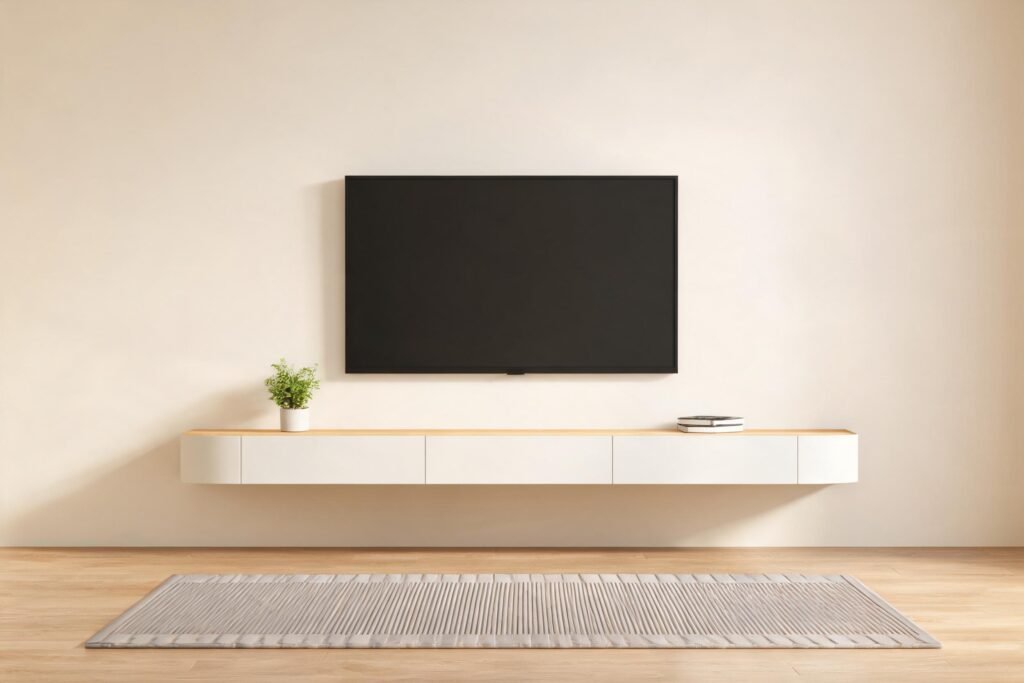
A 65 inch television is measured corner to corner, so the screen that lands on the wall is about 57 inches wide and 32 inches tall. That one correction decides most of what follows: a tv stand for 65 inch tv needs a surface run somewhere between 63 and 75 inches, the middle of the screen wants to sit roughly 42 inches off the floor, and the wall behind both pieces has to accept real fixings rather than a pair of plasterboard plugs. Take those three measurements in order and the rest of the shopping list for a tv stand for 65 inch tv falls into place.
How Wide Should a TV Stand for 65 Inch TV Be?
Plan for 63 to 75 inches of console length, and treat 70 to 72 inches as the sweet spot. That range leaves at least three inches of surface past each edge of the screen, which is what stops a large panel from looking as though it is overhanging its base.
The arithmetic behind the rule is simple on any tv stand for 65 inch tv. A 65 inch screen measures 65 inches on the diagonal, and on a 16:9 panel that works out to about 56.7 inches of width against 31.9 inches of height, because the diagonal figure describes how display size is quoted rather than a physical edge. A console that stops at 57 inches reads as exact and top heavy. One at 71 inches gives the wall a base line, with room left for a soundbar, a lamp or a stack of books at either end.
| Screen diagonal | Actual screen width | Length for a tv stand for 65 inch tv |
|---|---|---|
| 50 inch | 43.6 in | 48 to 56 in |
| 55 inch | 47.9 in | 53 to 62 in |
| 65 inch | 56.7 in | 63 to 75 in |
| 75 inch | 65.4 in | 72 to 84 in |
How much air the ends need
Three inches of visible surface past each screen edge is the minimum for a balanced look, and six inches each side suits a wide wall where nothing else frames the unit. Against a return wall the limit changes: leave about four inches of clearance so an end drawer can open and the finish does not get knocked by the corner. Run a tape along the wall at skirting height and again at 40 inches, then use the smaller number, because plaster and skirting rarely agree with each other and a tv stand for 65 inch tv cannot be re-cut to fit once it is out of the box.
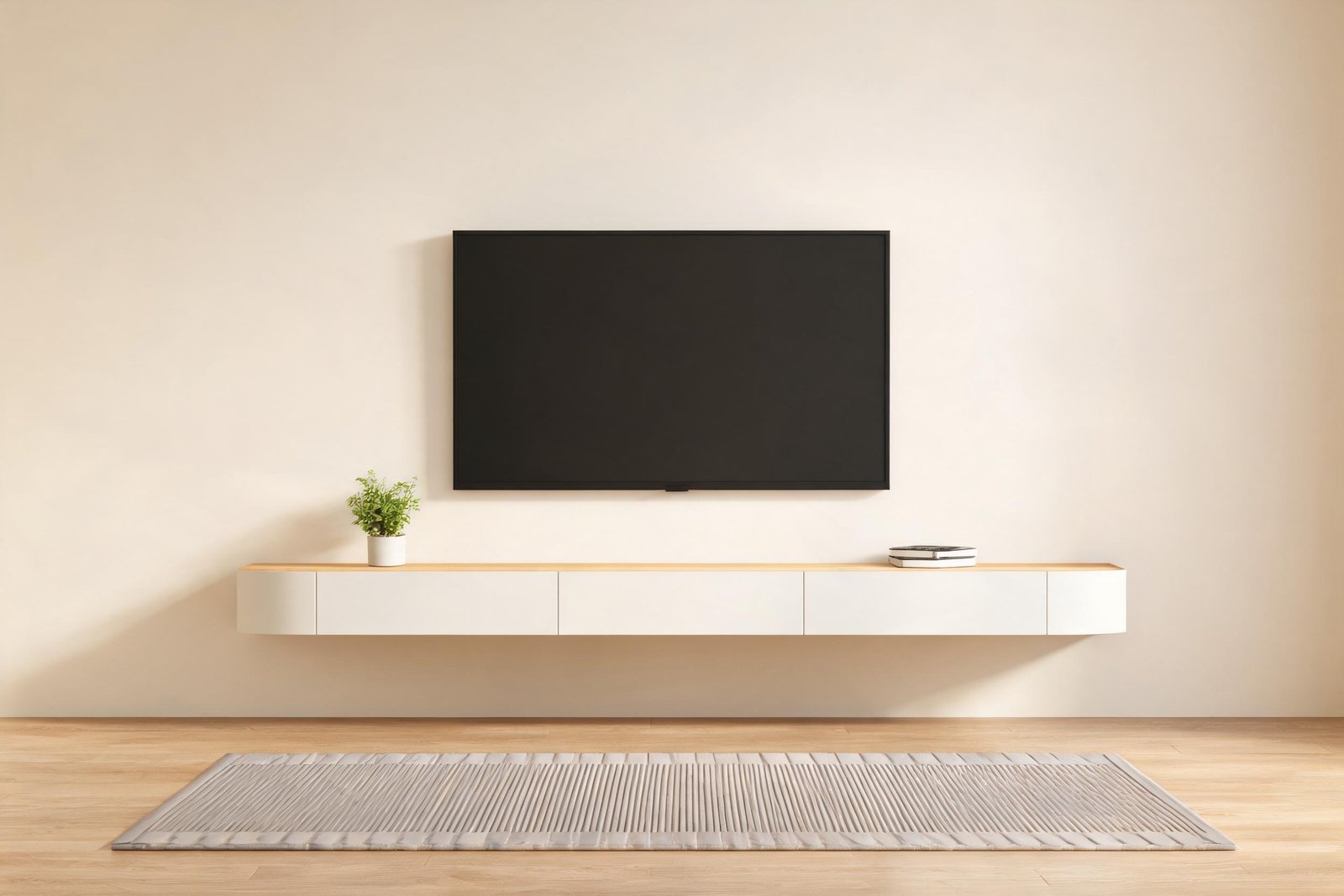
A tv stand for 65 inch tv that measures 71 inches will fit most walls that already suit a 65 inch screen, since the panel itself sets a floor of about 57 inches of usable wall. See the 71 inch floating console built for this pairing here: it leaves three inches of surface each side of the screen and draws a horizontal line under the panel with a light wood top edge.
How High to Mount the Screen Above the Console
The comfortable figure for a 65 inch panel is 42 inches from the floor to the centre of the screen, which is where a seated eye line usually falls. Sit where you actually watch from, look straight ahead at the wall, and the point your gaze lands on is the centre. Seated eye height generally sits between 40 and 44 inches, so the exact number shifts with sofa depth, cushion height and how far back you recline.
The console sets the constraint underneath. This unit measures 180 by 25 by 30 cm, or 70.9 by 9.8 by 11.8 inches, so it is long, shallow and low. Hung with its underside 25 to 30 cm (10 to 12 inches) above the floor, the top edge lands at 55 to 60 cm, roughly 22 to 24 inches. Leave a hand’s width, four to six inches, between that top edge and the bottom of the screen, and the centre of a 32 inch tall panel lands at 42 to 44 inches. Raise the console to 16 or 18 inches off the floor for easier vacuuming and the same screen centre climbs to 46 or 48 inches. Floor clearance or eye line is the trade that every tv stand for 65 inch tv decision runs into, and at eight feet from a 65 inch screen the difference is visible.
Two details belong in the plan for a tv stand for 65 inch tv rather than in the aftermath. A soundbar on the console top adds its own height, usually 5 to 7 cm (2 to 2.7 inches), to the gap before the screen begins. And the panel should never rest on the console top: a wall hung arrangement with the screen sitting on its base reads as a floor cabinet that lost its legs.
Floating TV Stand for 65 Inch TV or a Floor Cabinet?
A wall hung console carries storage and proportion, not the screen. The television goes onto its own wall bracket, which is why a floating tv stand for 65 inch tv can stand just 30 cm tall and still sit correctly under a 65 inch panel. Floor clearance and an unbroken line along the skirting come free with the format, along with a floor that a vacuum can cross without being steered. The trade is the wall itself, and anyone renting who cannot drill should treat that as the deciding factor rather than a preference. See the full floating versus floor standing comparison here for the rest of the trade-offs.
A floor cabinet can take the screen on its own top if the top is deep enough. A 65 inch television on its factory feet spreads close to 40 inches across and wants 11 to 13 inches of depth so the feet sit safely back from the front edge. A shallow 9.8 inch unit like this one is storage only on a tv stand for 65 inch tv, and the screen belongs on the wall.
The Wall Behind: Studs, Brackets and Cables
A 65 inch panel with its bracket usually brings 18 to 25 kg (40 to 55 lb) to the wall, and that load has to reach framing rather than skim coat or plasterboard alone. Lag bolts into studs, or a mounting plate spread across two studs, is the standard answer. Plasterboard with a heavy duty toggle is a fallback for a light panel, not a solution for a 65 inch screen on a moving arm.
A tv stand for 65 inch tv has the same requirement in a milder form. A 71 inch wall hung cabinet needs at least two fixing points into framing to stay level and stay put, and the bracket supplied with a panel built unit assumes a flat, sound wall. Older plaster over lath, brick and tile each need their own fixing, which is worth knowing before the box arrives rather than after.
Then come the cables, the part of a tv stand for 65 inch tv plan that is easiest to postpone and hardest to add later. An outlet behind the console lets the screen, the console lighting and a media player share one wall, and a raceway or an in-wall rated kit keeps the vertical drop tidy. Read how to hide TV cables without opening the wall here if the room needs to survive a redecoration or a move. Keep the drawer closest to the screen for what moves: remotes, a games controller, spare batteries. Middle drawer for chargers and cables, end drawer for the things you touch twice a year. Soft close runners matter more than they sound in a room where one person is watching while another tidies up.
Three Drawers, Doors or Open Shelves
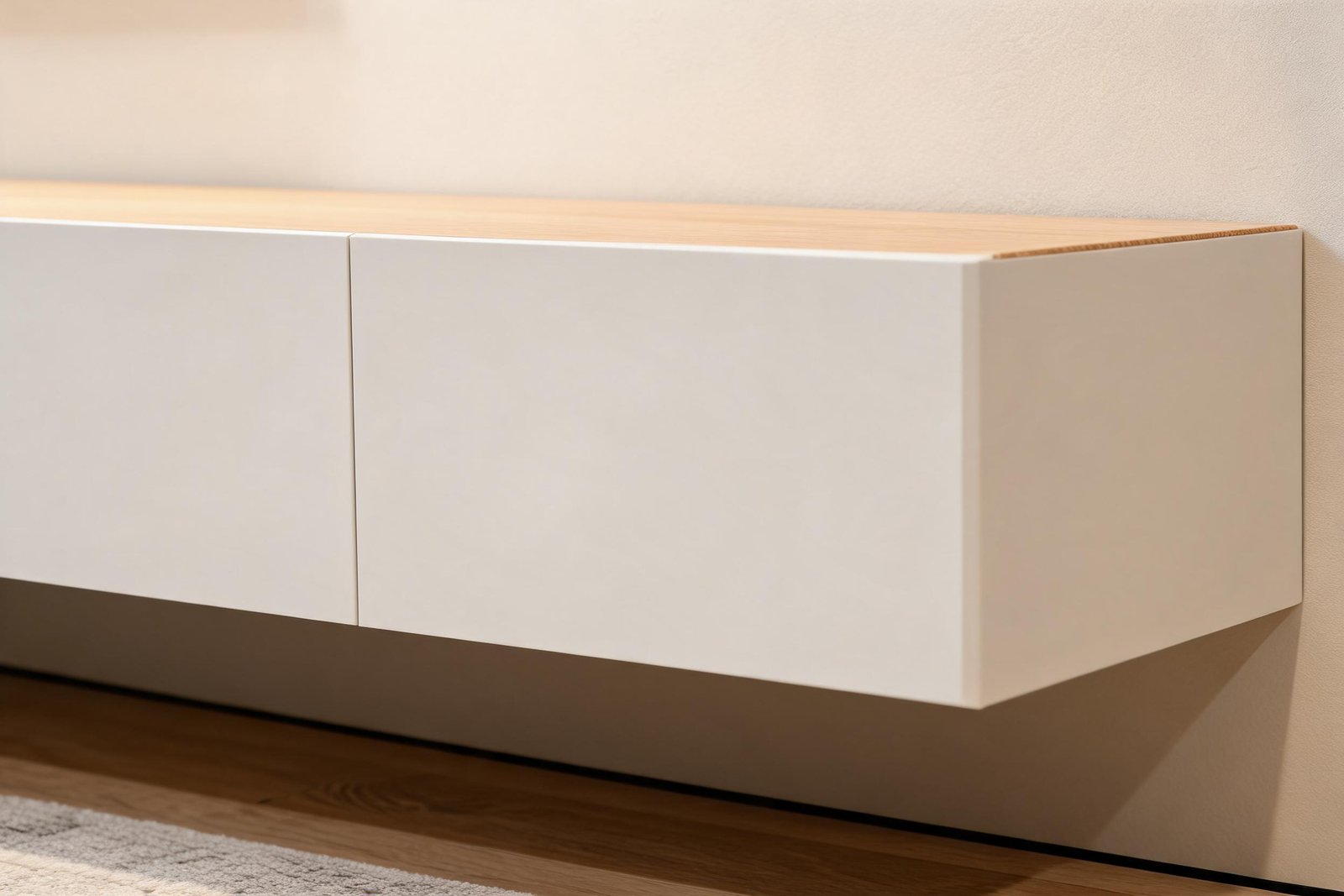
Drawers hide the small mess that gathers under a television, and they keep it dust free. That is the argument for three closed fronts over open shelving, and it is the argument this console is built around: a continuous matte white face, hidden handles that pull from the top edge of each front, and drawers deep enough for a soundbar remote, a spare console and a coil of cables, which is what a tv stand for 65 inch tv is actually asked to hold.
Open shelves are faster to style and slower to keep. Books and objects look considered for about a week and then collect dust, which is a fair trade on a display wall and a poor one under a screen that runs every evening.
Glass doors with lighting are the third option, and they suit a wall where the contents deserve showing. See the floating glass door console with LED lighting here: tempered glass fronts, a lit interior, a higher price and a power feed to plan for. The board behind all three formats is ENF grade engineered wood board, the strictest formaldehyde emission class in China’s national standard at no more than 0.025 mg/m³, which is stricter than the E0 class usually quoted by furniture sellers. It is a panel built unit rather than solid timber, which is what keeps a 71 inch span straight and stable.
White, wood grain or dark
White matte fronts disappear against a pale wall, so the console reads lower and the room reads wider. Wood grain adds warmth and shows dust differently. A dark finish anchors the wall, then makes a 30 cm deep unit look heavier in low evening light. Under a 65 inch screen with a light wall behind it, white keeps the proportions of a tv stand for 65 inch tv calm.
Where 71 Inches Is the Wrong Answer
For a 55 inch screen, or a wall that will not take a 71 inch run, the same construction appears as a 40 inch floating console with two drawers and three colour options at $283, which is the honest choice for a short wall. Anything narrower than 57 inches of surface looks undersized under a 65 inch television, and styling does not fix that. The other direction, a 240 cm unit for an 85 inch screen, belongs in a different room with a different budget, and sizing a tv stand for 65 inch tv down instead is the compromise most short walls force.
Measuring Your Wall in Four Steps
- Measure the clear width at three heights. Take readings at the skirting, at 40 inches and just below the ceiling, then use the smallest. Skirting, radiators, a door swing and a chimney breast all reduce the clear run.
- Tape the two target lines onto the wall. Mark the underside of the console, then the centre of the screen, and stand back to check the proportions before drilling anything.
- Locate the studs and note the wall build. A stud finder plus one look at the wall material tells you which bracket and which anchors are correct for that construction.
- Check the outlet and the delivery route. The outlet has to stay reachable, and the box arrives at roughly 71 by 10 by 12 inches, which passes a 32 inch doorway but needs a plan at a tight stair turn. Measure the route before ordering a tv stand for 65 inch tv, not after.
Frequently Asked Questions
What size tv stand for 65 inch tv should I buy?
Between 63 and 75 inches of length, with 70 to 72 inches ideal. A 65 inch screen is about 56.7 inches wide, so a tv stand for 65 inch tv in that range leaves visible surface past each end without wasting wall space.
Can a floating tv stand for 65 inch tv hold the screen?
No. A tv stand for 65 inch tv of this type carries storage only, and the television needs its own bracket fixed into framing. The console sets proportion and storage, while the bracket carries the 40 to 55 lb of panel and mount.
How much space should there be between the console and the television?
Four to six inches of clear air, which leaves room for a hand, a soundbar and a little ventilation. Measure the soundbar before fixing heights and add its full height to that gap.
Is a 71 inch console too wide for a 65 inch screen?
No. It is about four inches wider than the screen at each end, which sits inside the comfortable band. Any tv stand for 65 inch tv inside the 63 to 75 inch band works on a wall with more than about 80 inches of clear run, and only a shorter wall makes 71 inches the wrong size.
Do wall hung consoles need studs?
At least two fixings into framing, yes. Plasterboard alone will not hold a 71 inch cabinet level over time, and heavy duty toggles are a fallback rather than a substitute for framing.
Which Apexera Console Matches a 65 Inch Screen
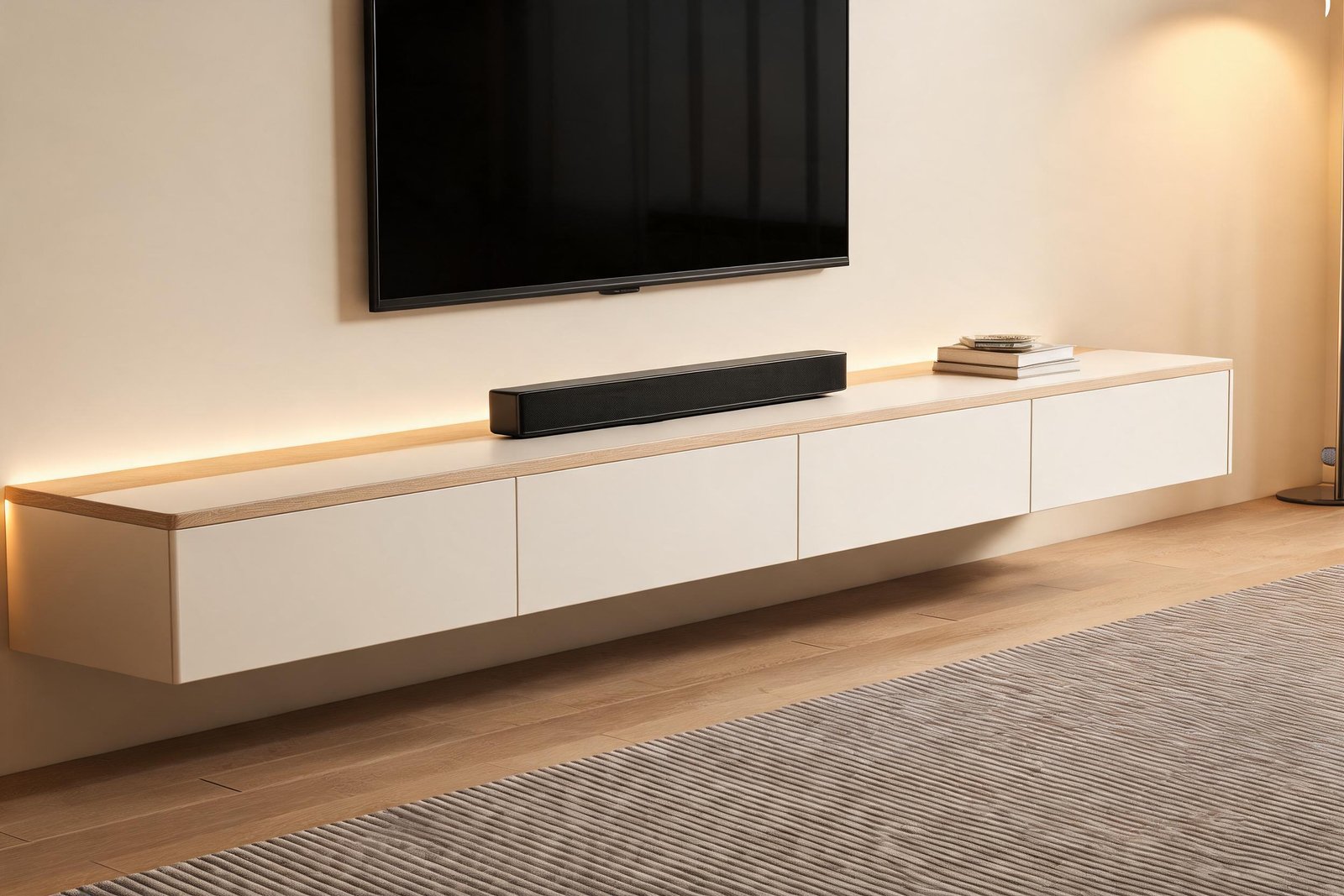
The short version: match the console to the screen width, then match the wall to the weight. Shop the Modern White Floating TV Stand (JX-TVC-043) here, the 71 inch three drawer console this guide is measured around. It is listed at $833, measures 70.9 by 9.8 by 11.8 inches, and hangs from a wall bracket with hidden handles and soft close runners. The product page carries the current price, the full specification and the care notes for the matte white finish, and nothing else on the wall changes what a tv stand for 65 inch tv has to do: set the proportions and hold the small things. Pair it with a bracket rated for the screen and the wall, plan the outlet before the last coat of paint, and the wall works out on the first attempt rather than the second. For a wider wall or a longer run, the full TV stand and media console range covers the same job at other depths and other prices.
