

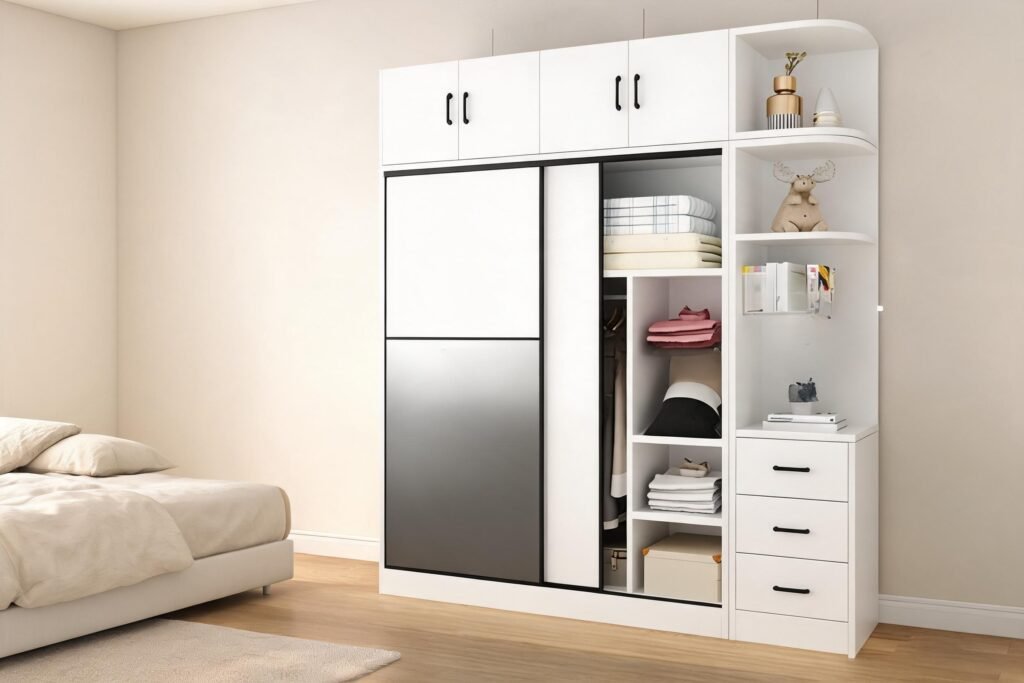
The wall is the constraint, not the wardrobe. A sliding wardrobe with drawers is bought on four measurements: the narrowest width of the wall, the depth the case will take, the ceiling height above the unit and the route the flat pack travels to reach the room. Get the first one wrong and the panels bind as they run. Get the last one wrong and the doors are unpacked in a hallway two days before the delivery slot was supposed to end. What follows is the measuring order for a 94.5 inch unit, and the numbers that decide whether a sliding wardrobe with drawers belongs in the room at all.
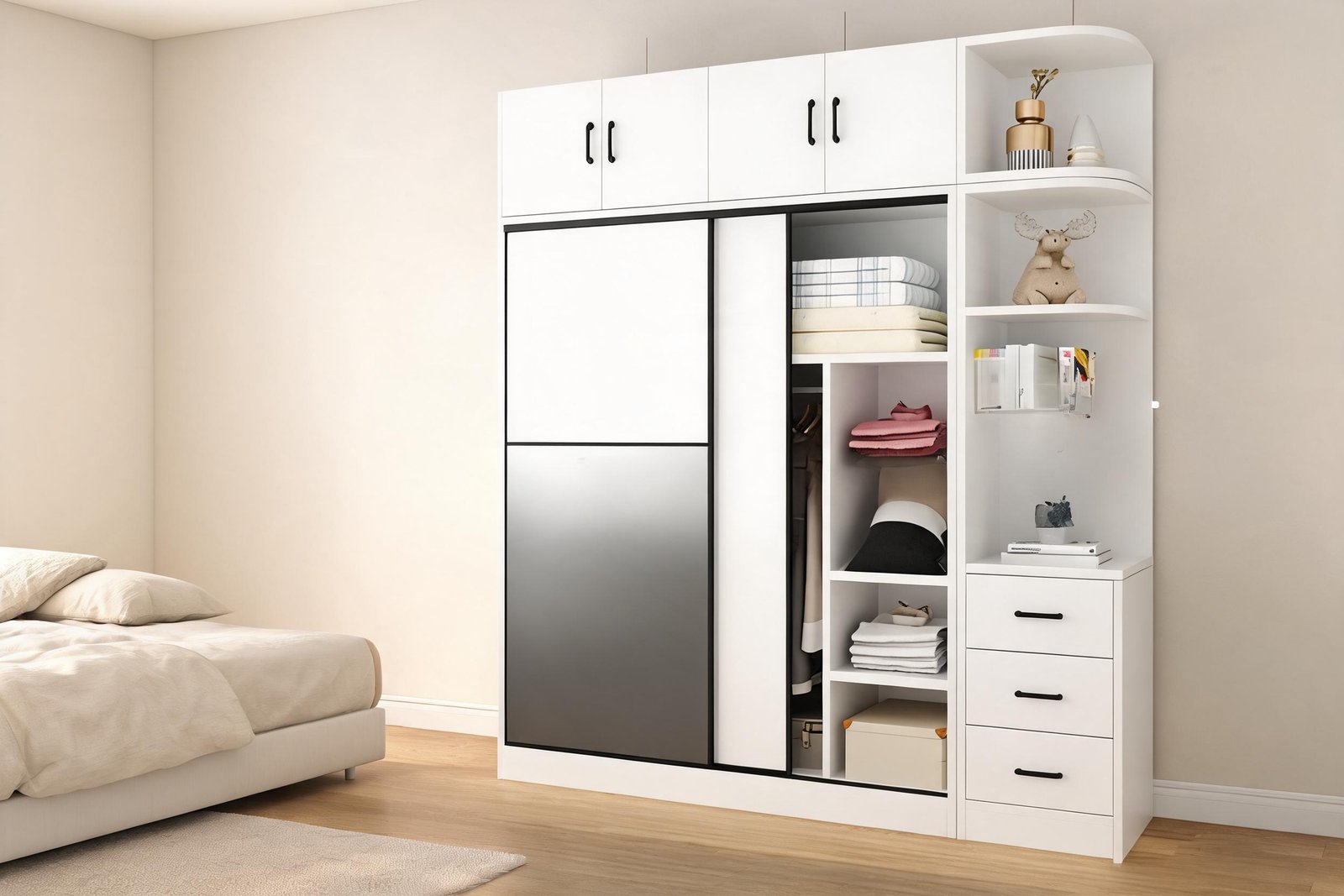
How to Measure for a Sliding Wardrobe With Drawers
Measure the wall at three heights, at the skirting, at waist height and just below the ceiling, then use the smallest reading and subtract one to two centimetres for tolerance. Plaster bows, skirting protrudes and door architraves steal width, and a wardrobe that is measured at its widest point will not sit flat.
That smallest reading decides the size you can order. This design runs from 120 cm to 250 cm wide (47 to 98 inches) and from 200 cm to 240 cm tall, with the 240 cm case at 94.5 inches. Widths of 120, 160 and 200 cm cover most bedrooms, and the versions from 150 cm upward can be ordered with a side column that carries open shelves and three drawers.
| What to measure for a sliding wardrobe with drawers | How to measure it | Why it decides the order |
|---|---|---|
| Clear wall width | Three heights, use the smallest, minus 1 to 2 cm | Door panels need a straight, parallel run to slide |
| Depth available | Wardrobe face to the nearest obstacle | Keeps a walking route and stops drawers hitting the bed |
| Ceiling height | Floor to ceiling, then check light fittings | A 94.5 inch case needs headroom to stand and lift |
| Delivery route | Interior door width, landings, stair turns | The longest panel box is 94.5 inches long |
The tolerance nobody leaves
Two centimetres sounds fussy until the unit is in place. A floor that runs out of level by 1 cm across a 2 m wall means the case sits with a gap at one end or a shadow line that no amount of adjustment will hide. Sliding panels are more sensitive than hinged doors because they run in a fixed channel: the case has to be level and square, or one panel drags for the next ten years. A sliding wardrobe with drawers is the one format where squareness is not cosmetic. If the wall is out of plumb by more than 1 cm, plan a filler panel at one end rather than pushing the case into the corner.
Sliding Doors or Hinged Doors: The 30 Inch Rule
Measure the clear space in front of the wardrobe face, then decide the door type against one number. A hinged door needs its own width plus standing room, so about 30 inches (76 cm) of clear space in front of the unit. Below 30 inches, sliding is the practical answer; above 36 inches, hinged doors open the whole bay at once and usually cost less. Both door types appear on a sliding wardrobe with drawers, so this single number does most of the deciding. Between the two figures, either type works.
The second half of that decision is access. Two sliding doors cover half the interior at a time: on a 190 cm case each panel is about 95 cm wide, so opening one panel exposes roughly half of the hanging space behind it. Hinged doors hand you the entire bay in one movement. Anyone who keeps everything on one side of a sliding wardrobe with drawers will notice this on the first morning. See the full comparison of sliding and hinged wardrobes here for the mechanism and cost side of the same choice.
How Deep Does a Sliding Wardrobe With Drawers Need to Be?
This case is 50 cm (19.7 inches) deep. A shirt hanger measures about 43 cm (17 inches) across the shoulders, so shirts hung face-on clear the doors without touching them. Suit jackets and coats on wide hangers reach 48 to 53 cm (19 to 21 inches), which means they hang slightly angled or sit off square in a 50 cm case. The usual standard for a wardrobe that takes coats face-on is 60 cm (23.6 inches), which is the number most listings for a sliding wardrobe with drawers leave out.
That is the honest limitation of a compact case, and it is also why 50 cm exists: it keeps a walking route beside a bed in a room where 60 cm would close the gap to nothing. If the wall can take the extra 4 inches and the budget allows, see the 55 cm deep all white wardrobe here at $853. If the room is small, 50 cm is the depth that keeps the room usable, and a rail with hangers set at a slight angle still holds a full wardrobe of shirts, knitwear and jeans, which is how most compact sliding wardrobe with drawers cases in apartments end up being used.
Living With a 94.5 Inch Tall Wardrobe in a Small Bedroom
A 94.5 inch (240 cm) sliding wardrobe with drawers fits under a standard 96 inch ceiling with about 1.5 inches to spare, and that allowance has to cover more than the unit itself. Check the ceiling rose, a pendant shade, a smoke detector and any crown moulding. Leave at least 2 inches of clear space above the case where possible, because the top row goes on with the body standing upright and the last panel needs room to be lifted into place. A pendant hanging directly over the wardrobe is the one fitting that makes the 240 cm version a bad idea.
Reach height decides what the top row is for. A standing reach for an adult of average height is around 78 inches, so the cabinet row above that line is a step stool zone: suitcases, spare bedding, out of season coats, the things that come out twice a year. The daily band sits between roughly 30 and 66 inches, which is where hanging rails, shelves and the drawer bank belong.
Making 94.5 inches of white sit quietly
A tall white case in a small room stops shouting when the wall behind it is the same white, so the unit reads as a wall plane rather than an object. Keep the plinth shadow line clear, since clutter stored under the case breaks the floating look, and let one panel break the mass: the gradient front on this model does that job, and a mirrored panel does it in darker rooms. A dark floor with a dark wardrobe and a light ceiling does the opposite, because the eye stops at the join between case and floor. Nothing about a sliding wardrobe with drawers has to be visually loud, and white is the easiest mass to quieten.
Internal Drawers or a Side Column?
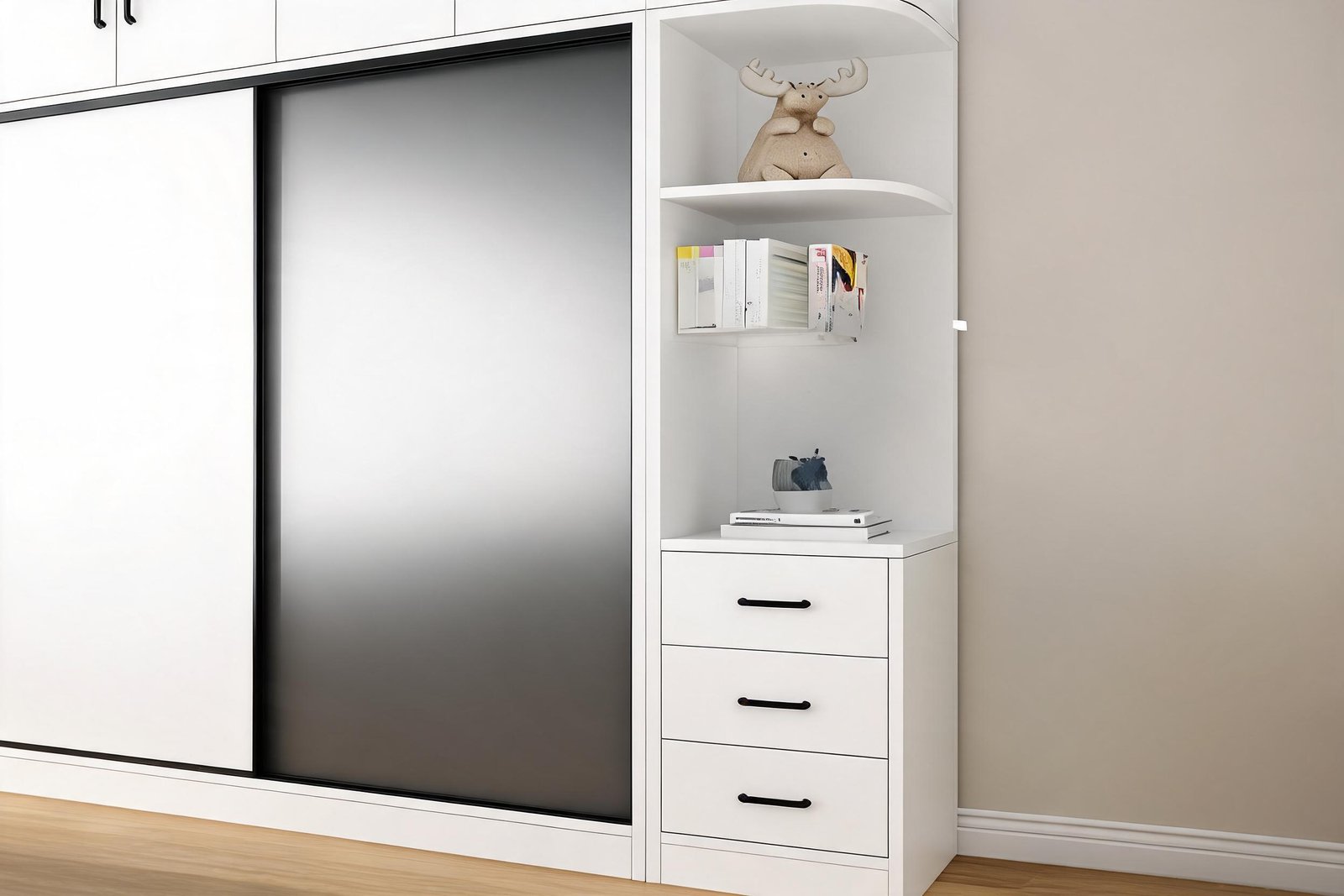
Where the drawers sit on a sliding wardrobe with drawers changes how often they get opened. An internal drawer bank lives inside the case, behind the sliding panels, so it is only reachable when the panel is slid clear of it. The three drawers in the side column of this design sit outside the sliding run, which means they open with both panels closed, and they hold what gets used every morning: socks, underwear, gym kit, folded knitwear. On a compact sliding wardrobe with drawers that difference is worth more than an extra 20 cm of hanging rail. That is also why the versions with a side cabinet and drawers start at 150 cm wide: the column needs its own footprint beside the sliding bay.
Rail, shelves and the middle band
A long hanging rail wants about 66 inches of clear height for dresses and coats, and a double hang setup wants two rails with roughly 40 inches each. A 94.5 inch sliding wardrobe with drawers can hold a long hang section, one or two shelves above it and still leave the top cabinet row for storage, which is how this model is arranged: two sliding panels across the full width, a top cabinet row above them, and shelves and rail divided inside.
Doors, Panels and the Track
Sliding systems on a sliding wardrobe with drawers run on either a bottom track or a top hung rail, and the difference shows up in maintenance rather than in looks. A bottom track collects grit from the floor, so the channel needs a vacuum every month or the panels start to grind. A top hung system keeps the floor line clear but transfers the whole load to the top rail, which makes the wall fixing the part that has to be right. Either way, sliding panels carry height adjusters: check that they run true in the first week and re-check after a month of settling, when a new floor and a new case have both stopped moving.
Door fronts on a sliding wardrobe with drawers take the wear. Wipe them with a damp cloth and a mild soap, keep abrasive pads and solvent sprays away from the panel edges, and never drag a panel sideways by its end while it is loaded. The board in this case is ENF grade engineered wood board, the strictest formaldehyde emission class in China’s national standard at no more than 0.025 mg/m³, and it is stricter than the E0 class usually quoted by furniture sellers.
Getting It Into the Room
This is the step that ruins an otherwise good order. A sliding wardrobe with drawers arrives flat packed, and the longest box on a 240 cm case measures about 94.5 inches. Measure three things before delivery: the narrowest interior door (commonly 30 to 32 inches), the landing width at each turn and the diagonal clearance at the tightest corner. A long box can pass a 30 inch door when it is pivoted within the hallway, but it will not turn a tight landing without being unpacked first. The alternative is the 200 cm (78.7 inch) height, which arrives in shorter panels and costs less.
Measuring Your Bedroom in Five Steps
- Measure the clear wall width. Three heights, smallest reading, minus 1 to 2 cm of tolerance for plaster and skirting. This reading decides which sliding wardrobe with drawers you can order.
- Measure the depth. Wardrobe face to the nearest obstacle, then leave enough room for a person to stand and for drawers to pull out.
- Measure the clear space in front of the unit. Compare it against the 30 inch rule and let that decide sliding or hinged doors.
- Measure the ceiling and note every fixture above the unit. A 94.5 inch case wants 2 inches of clear space where it can get it.
- Walk the delivery route with a tape. Door widths, landings and turns, measured once at the shop saves an unpacked box in a hallway.
Frequently Asked Questions
How much space do you need for a sliding wardrobe with drawers?
Leave the full case width of clear wall, about 30 inches of standing space in front for loading, and 2 inches above the case for assembly. The drawers in a side column also need their own depth clear of the bed or the door swing, and a sliding wardrobe with drawers needs that depth in front for loading.
Can drawers sit inside a sliding wardrobe?
Yes, but they are only reachable when the panel is slid clear of them, which is why internal drawer banks usually sit at the bottom of one bay. Drawers set in a side column outside the sliding run open at any time and take more daily use.
How deep should a sliding wardrobe be?
60 cm (23.6 inches) if coats hang face-on, 50 cm (19.7 inches) in a compact room where a walking route matters more. Shirt hangers clear 50 cm comfortably; wide coat hangers want the extra depth or a slight angle. Measure the wall first, then choose the depth of the sliding wardrobe with drawers.
Is 94.5 inches too tall for a bedroom?
Under a standard 96 inch ceiling it fits with about 1.5 inches to spare, so it depends on what else is up there. Clear pendants, ceiling roses and crown moulding first, then allow 2 inches where possible for the last panel to be lifted into place.
Is a sliding wardrobe with drawers a good choice for a small bedroom?
Usually yes, because the doors need no swing space and the case can run wall to wall. The trade is that half the interior is covered by a panel at any moment, so plan the layout around the side that opens most often.
Which Apexera Wardrobe Matches This Measuring Order
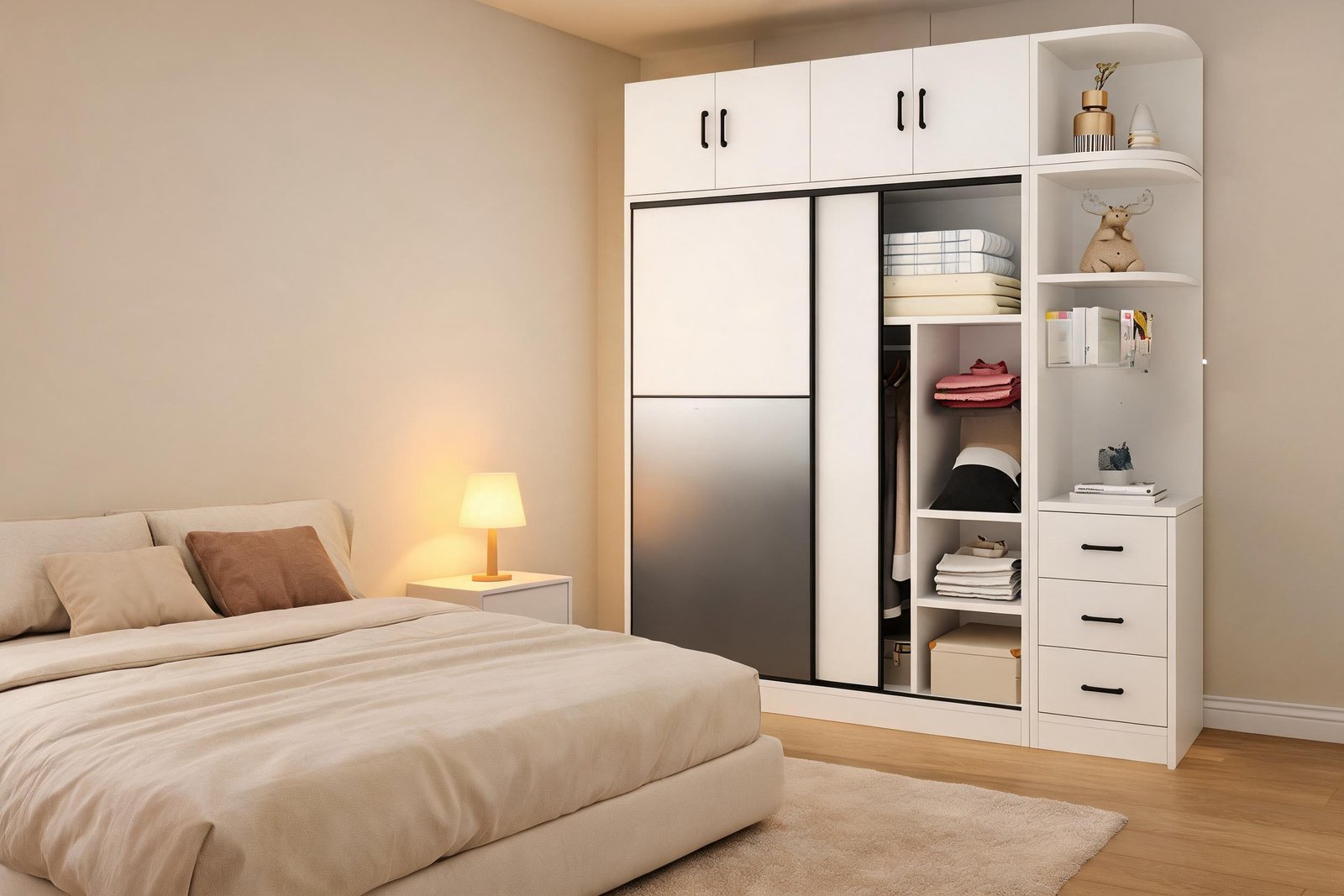
Match the case to the smallest wall reading first, then match the drawer position to how you actually dress in the morning. Shop the Pristine Eco-Glide Sanctuary 94.5 Inch White Sliding Wardrobe (JX-SD-024) here, the sliding wardrobe with drawers these measurements are written around. It is listed at $448, measures 240 cm tall by 50 cm deep, and comes with two sliding fronts, a top cabinet row and a side column with open shelves and three drawers. The product page carries the current price, the full specification and the care notes for the white panel finish. Order the width from your smallest wall reading rather than your widest, and the case goes in level on the first attempt. For a different finish or a taller panel set, see the wood grain sliding wardrobe with side drawers here at $672, and the full sliding door wardrobe range for the other widths and heights in the same construction.
