

Wine Cabinet vs Wine Fridge: Which Do You Need?
The question usually shows up the same way. Someone has six or eight bottles they actually care about, they have cleared a wall in the dining room, and now they are comparing two products that look identical in photos and cost wildly different amounts. I have measured both for the same 2-metre wall, and the answer almost never comes down to which one keeps wine better. It comes down to what you are doing with the bottles.
A wine fridge is a cooling appliance that slows aging. A wine cabinet is a piece of furniture that displays and organises. They overlap for maybe a third of buyers, and for everyone else the choice is obvious once the priorities are written down. Below I go through the differences that actually matter, what each one costs in 2026, and where the LED display cabinet fits for people who want the bottles visible without turning a living room into a cellar.
Wine Cabinet Vs Wine Fridge: What is the actual difference between a wine cabinet and a wine fridge?
More background: Wikipedia — Cabinetry. More background: Wikipedia — Wine cellar.
The most useful wine cabinet vs wine fridge advice is about order of decisions.
A wine fridge runs a compressor and holds a set temperature, usually 5–18°C, for long-term aging. A wine cabinet has no compressor: it holds bottles at room temperature in glass-front or open storage, protects them from light and dust, and puts the collection where you can see it. One preserves, the other presents.
That single sentence is the whole decision, and every other difference follows from it. Compressor units control temperature, humidity and, in better models, vibration. Display cabinets control light, dust and access. Wine Enthusiast draws the same line in its buying guide: coolers handle chilling, fridges and cellars handle preservation. Neither job is more important. They are just different jobs.
| Wine fridge / cooler | Wine display cabinet | |
|---|---|---|
| Cooling | Compressor, 5–18°C | None, room temperature |
| Protects against | Heat, temperature swings | Light, dust, handling |
| Bottle capacity | 6–165 typical | 15–90 typical |
| Typical 2026 price | $150–$900 | $130–$600 |
| Placement | Kitchen, utility room, bar | Dining room, living room, hallway |
| Power | Always plugged in | None, or a small LED driver |
| Noise | Compressor hum | Silent |
| Best for | Storing wine 6+ months | Serving wine this month, displaying a collection |
Do you need a wine fridge at all?
A quick note on wine cabinet vs wine fridge before the details.
No, if you drink most bottles within a few weeks. Red wine at 18–20°C is not being ruined by a dining room, and a fridge you never needed just adds noise and a power bill. You need cooling when you are holding bottles for six months or more, or when you buy in cases and want them to improve.
Here is the honest version. Wine ages faster and less predictably when it sits above 21°C for weeks, and it suffers when the temperature swings every day from a kitchen radiator to a cold windowsill. If your home does that, and you are sitting on bottles you plan to open in 2028, a compressor is not optional. If your home hovers around 19–22°C and your “collection” is twelve bottles that will be gone by Christmas, cooling solves a problem you do not have.
There is a middle case that gets ignored: people who want serving temperature, not storage. Chilling a red to 16°C before dinner takes twenty minutes in a bucket of ice water, which costs about $0 and no floor space. I would rather see that money go into glasses.
What does a wine display cabinet with LED lights do that a fridge cannot?
In practice, wine cabinet vs wine fridge works best when you decide the layout before the finish.
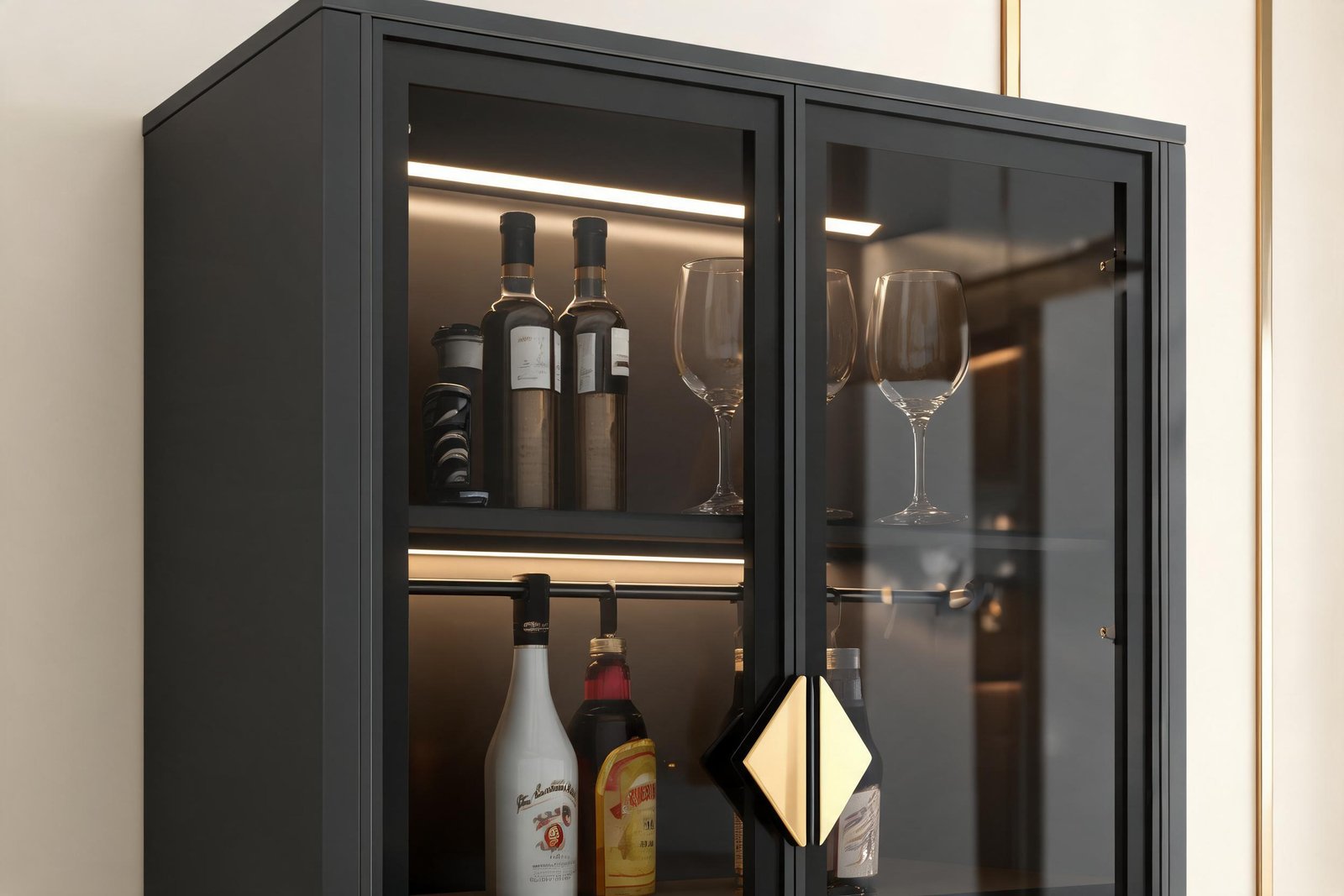
It puts the collection in the room you actually use. A glass-front cabinet with integrated LED lighting reads as furniture: shut, it is a tall dark unit against the wall; open, it is a lit bar with bottles, stemware and a decanter ready to pour. A stainless steel box under the counter never gets that reaction.
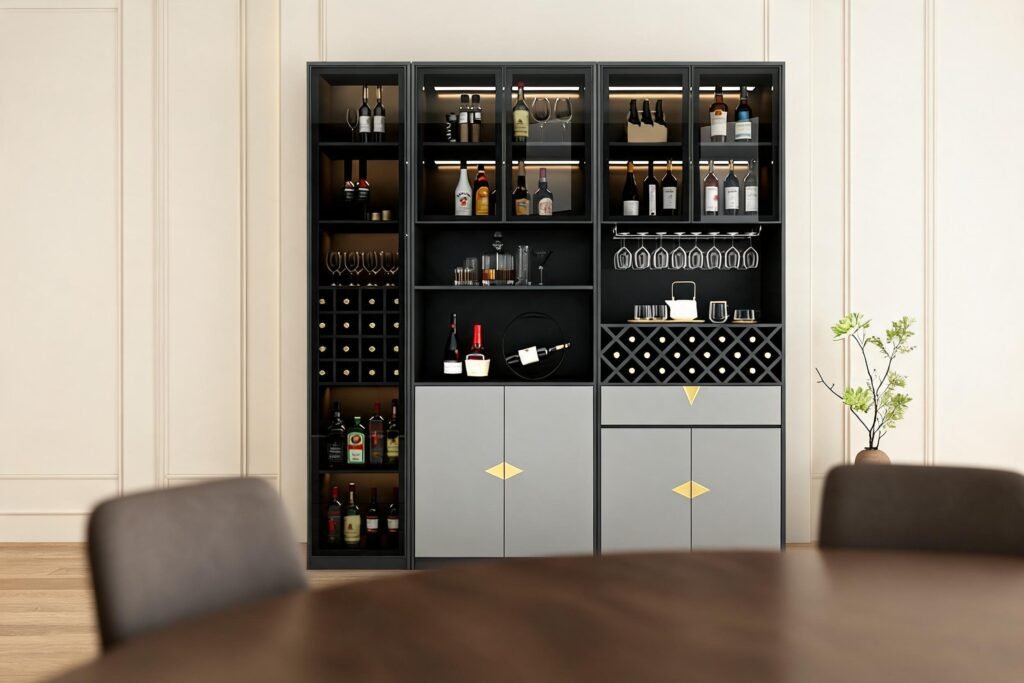
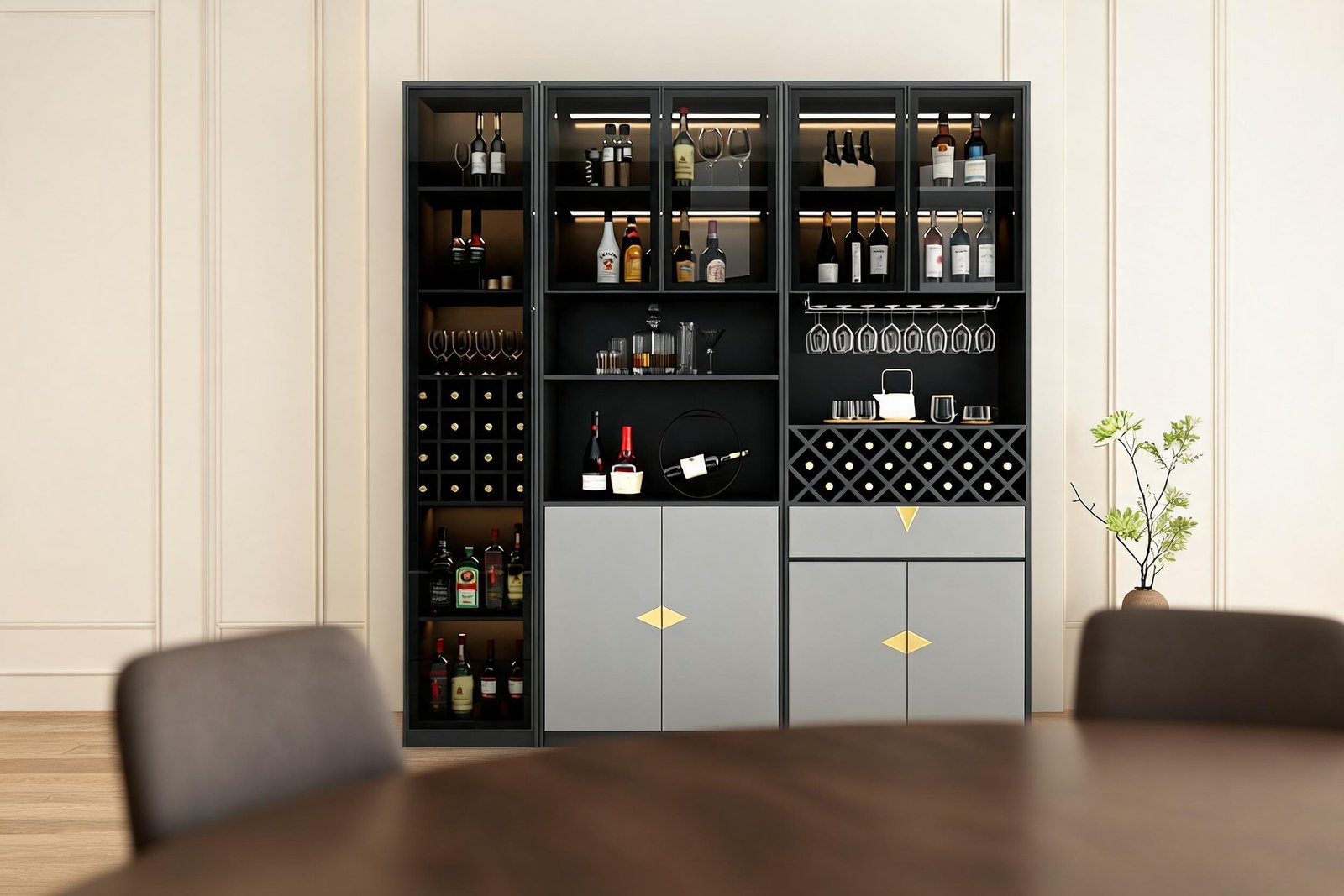
The JX-WC-009 is the piece I would point to here. It is 87 inches tall, built as three modules rather than one slab, with 3C tempered glass doors on the upper tier, warm LED lighting inside each section, an open middle niche for a cocktail tray or decanter, diamond bottle racks, a hanging rail for stemware, and deep grey lower doors with small gold handles for anything you do not want on show. The finish is charcoal rather than brown, which is why it works against pale walls without looking heavy. You can see the full configuration and the interior LED layout on the product page: Shop the 87-inch wine display cabinet with integrated LED lighting here.
What a cabinet cannot do is slow aging. Warm LED strips add very little heat, but the unit still sits at room temperature, and bottles left in it for two years will age at room-temperature speed. If the collection is meant to grow old, keep the long-term bottles in the fridge and treat the cabinet as the serving and display layer. Plenty of people I have worked with run both, and it is the combination that works.
Can a wine cabinet live in a living room or dining room?
Keep one principle in mind for wine cabinet vs wine fridge: proportion beats decoration.
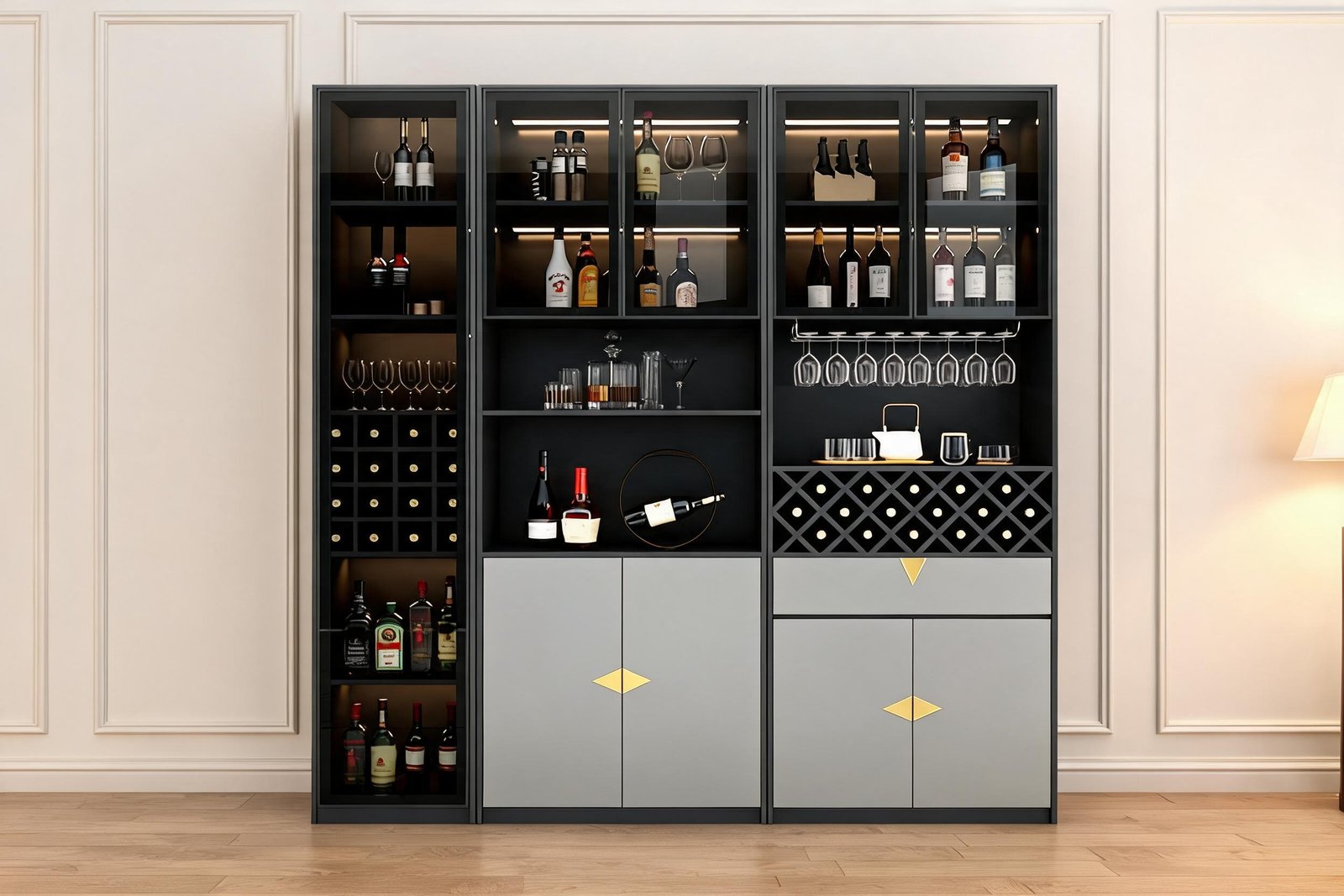
Yes, with two rules. Keep it off a wall that takes direct afternoon sun, and keep it away from radiators, floor vents and the top of a range. Rooms where people actually sit are usually 19–22°C, which is fine for serving stock and short-term storage.
Light is the more common mistake. UV degrades wine faster than mild warmth, which is exactly why the tinted tempered glass and closed doors on a cabinet matter beyond looks. If a cabinet has no doors at all and the room gets bright sun, the bottles at the front are the ones taking the hit. Rotate them, or buy the version with glass doors.
Two practical notes from setting these up. First, a 220 cm unit needs a wall with real length behind it: measure the run, then subtract 10 cm for the skirting and the door swing. Second, if you rent or plan to move, the modular build matters, because a three-section unit can come apart for a stairwell in a way a solid 87-inch carcass cannot.
Which should you buy for a small apartment or a small collection?
Our own rule for wine cabinet vs wine fridge comes down to three checks.
For six to twenty bottles in a small space, buy the smallest display cabinet you can live with and skip cooling unless you are aging. A 40 cm wide column with LED lighting and glass doors holds two dozen bottles, adds no noise, and uses a wall you were not using anyway.
That is exactly the gap the JX-WC-036 minimalist glass display cabinet at $132, which is the lowest entry point in this category on our site. It is a narrow glass display unit with LED lighting, meant to sit in a corner of a dining room or beside a desk. If you want to compare widths and finishes across the range before deciding, browse all display cabinets and wine cabinets here. The category page lists the tall modular units, the narrow LED columns and the mid-size glass-door cabinets side by side.
One caveat worth stating: narrow cabinets look great and hold less than people expect once you add stemware. Count your glasses before you count your bottles.
How much does each option cost in 2026?
What most wine cabinet vs wine fridge guides skip is the measurement step.
Prices have settled into clear bands. Entry wine coolers sit near $150–$250, mid-range dual-zone fridges run $400–$900, and glass-front display cabinets run $130–$600 depending on height and lighting. As of late September 2026, the best-selling wine fridge on Amazon was moving at $188, which tells you where the volume is.
What most wine cabinet vs wine fridge guides skip is the measurement step.
The maintenance maths is worth doing, because it is not in the product photos. A compressor runs continuously, draws power every hour of the year, and usually becomes the reason someone replaces the unit in six or eight years. A display cabinet with an LED driver draws a few watts, has no refrigerant, and typically outlives the fridge. Neither is cheaper in every case, but over ten years the gap is real.
The short answer on wine cabinet vs wine fridge: match the piece to the space first, then to the look.
There is also a design cost that rarely gets counted. A fridge needs a wall near power and it will not be the wall guests see. A cabinet can take the best wall in the room. If you are fitting out a dining space, that difference is worth more than the price gap between the two.
What I would do with forty bottles
If you are researching wine cabinet vs wine fridge, start with the points below.
The short answer on wine cabinet vs wine fridge: match the piece to the space first, then to the look.
The most useful wine cabinet vs wine fridge advice is about order of decisions.
Split them. Anything I plan to open after 2027 goes into a real cooler, six bottles at serving temperature sit in a small under-counter unit or in ice before dinner, and the rest live in a glass-front cabinet in the dining room where they get used and looked at. I have watched this pattern hold up in more homes than any single-unit setup, mostly because it matches how people actually drink.
A quick note on wine cabinet vs wine fridge before the details.
If I had to pick one unit and only one, and no bottles younger than three years were involved, I would take the cabinet and put the saved money into a case of something worth drinking. That is a preference, not a rule. But it is the choice most of the people who ask me this question end up happy with.
FAQ
In practice, wine cabinet vs wine fridge works best when you decide the layout before the finish.
If you are researching wine cabinet vs wine fridge, start with the points below.
Keep one principle in mind for wine cabinet vs wine fridge: proportion beats decoration.
Can a wine display cabinet keep wine cold?
No. It has no compressor, so bottles sit at room temperature. Chilling happens in a fridge, a cooler, or an ice bucket before serving.
Our own rule for wine cabinet vs wine fridge comes down to three checks.
Is a wine fridge worth it for a small collection?
Only if you are aging. For a dozen bottles you will drink within a few months, a cabinet with glass doors and LED lighting does the same job for less money and no noise.
What most wine cabinet vs wine fridge guides skip is the measurement step.
Does LED lighting inside a cabinet damage wine?
Warm white LED strips produce very little heat and almost no UV. Keep bottles a few centimetres from the strip and the effect is negligible.
The short answer on wine cabinet vs wine fridge: match the piece to the space first, then to the look.
Where should a wine cabinet go in a house?
Dining room, living room or hallway. Avoid direct afternoon sun, radiators, and anywhere the daily temperature moves more than a few degrees.
If you are researching wine cabinet vs wine fridge, start with the points below.
How many bottles does a 220 cm cabinet hold?
A tall modular unit like the JX-WC-009 holds roughly 40–70 bottles depending on whether the open niche is used for bottles or for glassware and a tray.
n
