

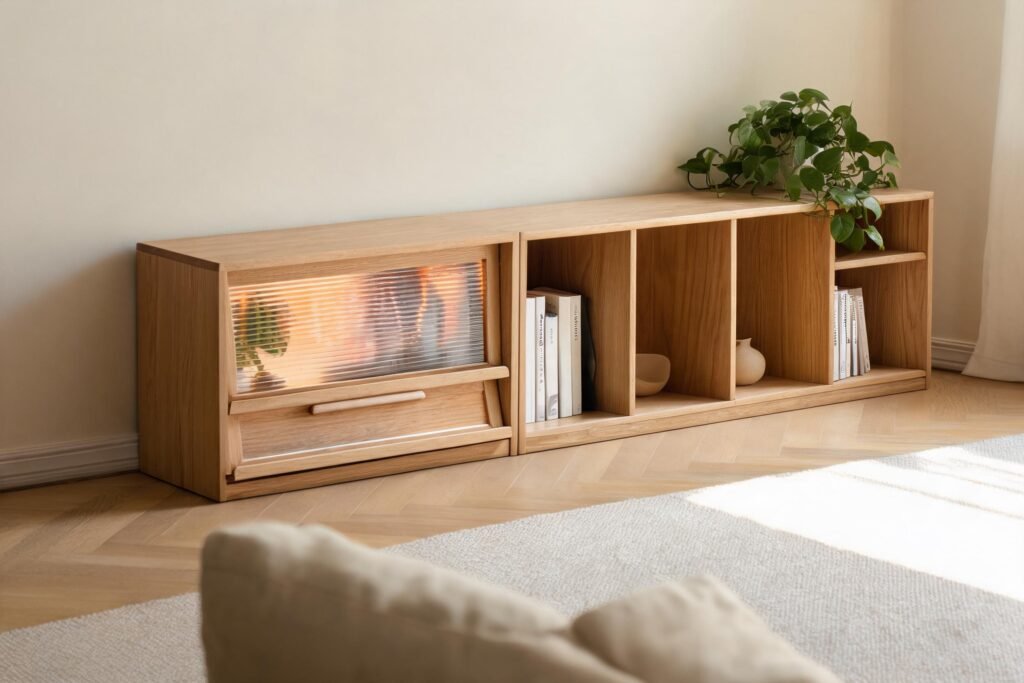
How to Arrange Bookshelves: 7 Rules That Work
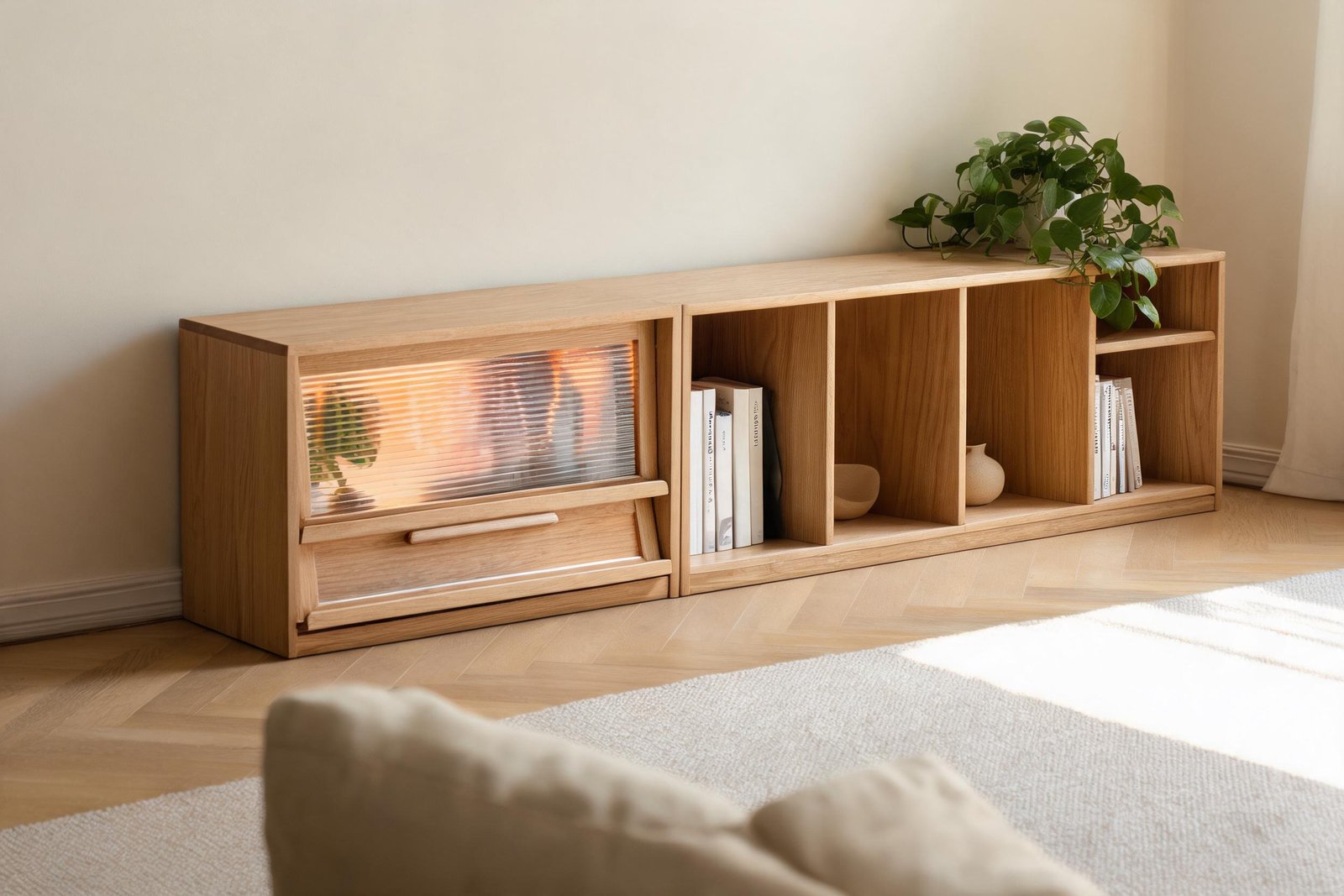
Bookshelf styling advice is everywhere, and most of it repeats the same three tips. Group in odd numbers. Leave space. Mix heights. All fine, none of it tells you what to do when you are standing in front of a low oak unit with two boxes of books, three vases and a dead plant on the floor.
I have rearranged the same shelf four times in a year, and the rules that survived are the ones that answer a question rather than decorate it. What goes back first, how full should each shelf be, what do you do with the ugly paperbacks, and how do you keep glass doors from becoming a dust trap you stop opening. Here is what actually held up.
How to Arrange Bookshelves: What Goes Back First
Learning how to arrange bookshelves is mostly about sequence.
The short answer to how to arrange bookshelves: empty it completely, put the books back first, then place objects. In any how to arrange bookshelves method, books decide the structure and the objects fill the gaps, so working in that order takes one pass instead of five.
Clearing the shelf first sounds dramatic, and it is the step most how to arrange bookshelves advice skips. If you rearrange around what is already there instead of learning how to arrange bookshelves properly, your brain just shuffles: that candle moves left, the photo goes behind the vase, and you finish with the same shelf you started with, about ten percent tidier. Take everything off, dust the shelves properly while you can reach them (the part of how to arrange bookshelves nobody enjoys), and put books back before anything decorative touches the shelf.
How full should a bookshelf be?
Once you know how to arrange bookshelves in the right order, the next question is volume.
Aim for about 70 percent books and 30 percent objects, with roughly a fifth of each shelf left empty. Packed shelves have nothing for the eye to rest on, and half-empty ones read as unfinished.
The maths is boring but useful. A 98 cm wide shelf section holds around 25 hardbacks at full capacity. Do not load it to 25. Keep it near 17 or 18, and leave the remaining length either open or occupied by one object. That open fifth is not wasted space, it is what makes the books look chosen.
Some shelf-by-shelf variation matters more than the average. If every shelf has the same density, the unit flattens into a grid. Let one shelf be almost all books, let the next carry a stack plus a ceramic, and let one be visibly sparse. My own rule is that at least one shelf in any unit stays close to empty. It reads as calm from across the room and gives the piece a place to breathe.
Should books stand upright or stack flat?
How to arrange bookshelves gets easier when you let the books decide their own posture.
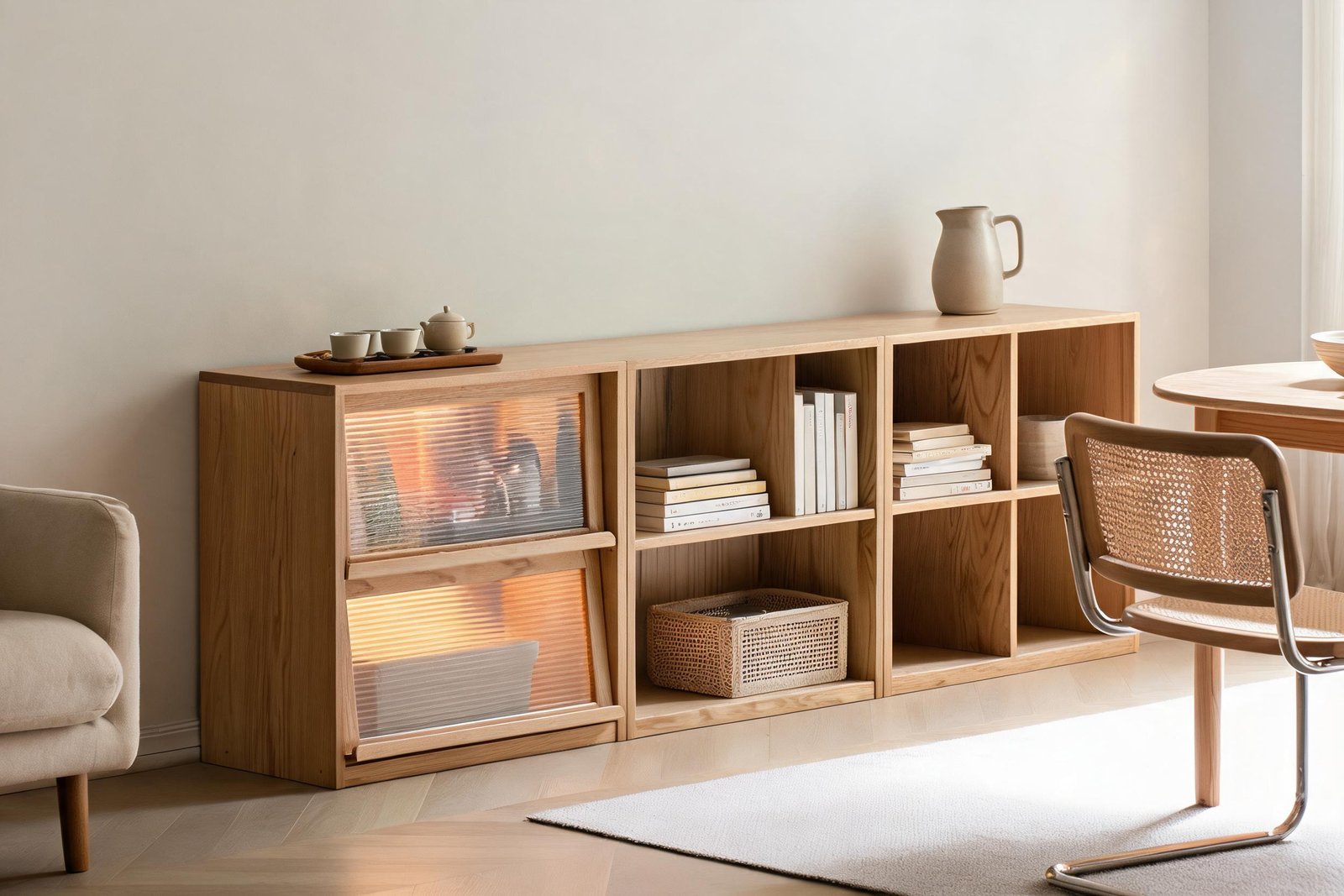
Mix the two, keeping upright books as the default and adding a horizontal stack every second shelf. Flat stacks work as low pedestals for a small object, and they break the relentless rhythm of spines standing at attention.
Two details make the difference between a styled stack and a pile. Keep stacks to three or four books, biggest at the bottom, and cap each one with something that earns the perch: a small bowl, a ceramic, a single framed print leaning back against the shelf behind it. Do not stack books on top of upright books. That is where shelves start looking like storage units again.
Spines should sit about a quarter inch back from the front edge, no further. Pushed to the back, the shelf develops a dust gutter and looks neglected. Flush with the front edge and you lose the soft shadow that gives the shelf depth.
Bookshelf Styling Ideas: Does Grouping by Colour Work?
Most bookshelf styling ideas start with colour, and it is worth knowing when that works.
It works visually and fails practically. A colour run of spines photographs beautifully and makes finding a specific title a chore. I tried it for a year and went back to grouping by subject, with the loudest jackets moved to shelves where a bright spine is doing something deliberate.
What I do instead is keep a quiet base: neutrals, cloth and linen spines, cream paperbacks in longer runs, and one or two places where colour is allowed to shout. Two or three dominant tones across the unit is enough. Anything past that starts reading as visual noise, and no amount of spacing fixes a shelf where ten unrelated cover colours are competing.
How to Style a Bookcase with Glass Doors
The same logic for how to arrange bookshelves applies behind glass, with one extra constraint.
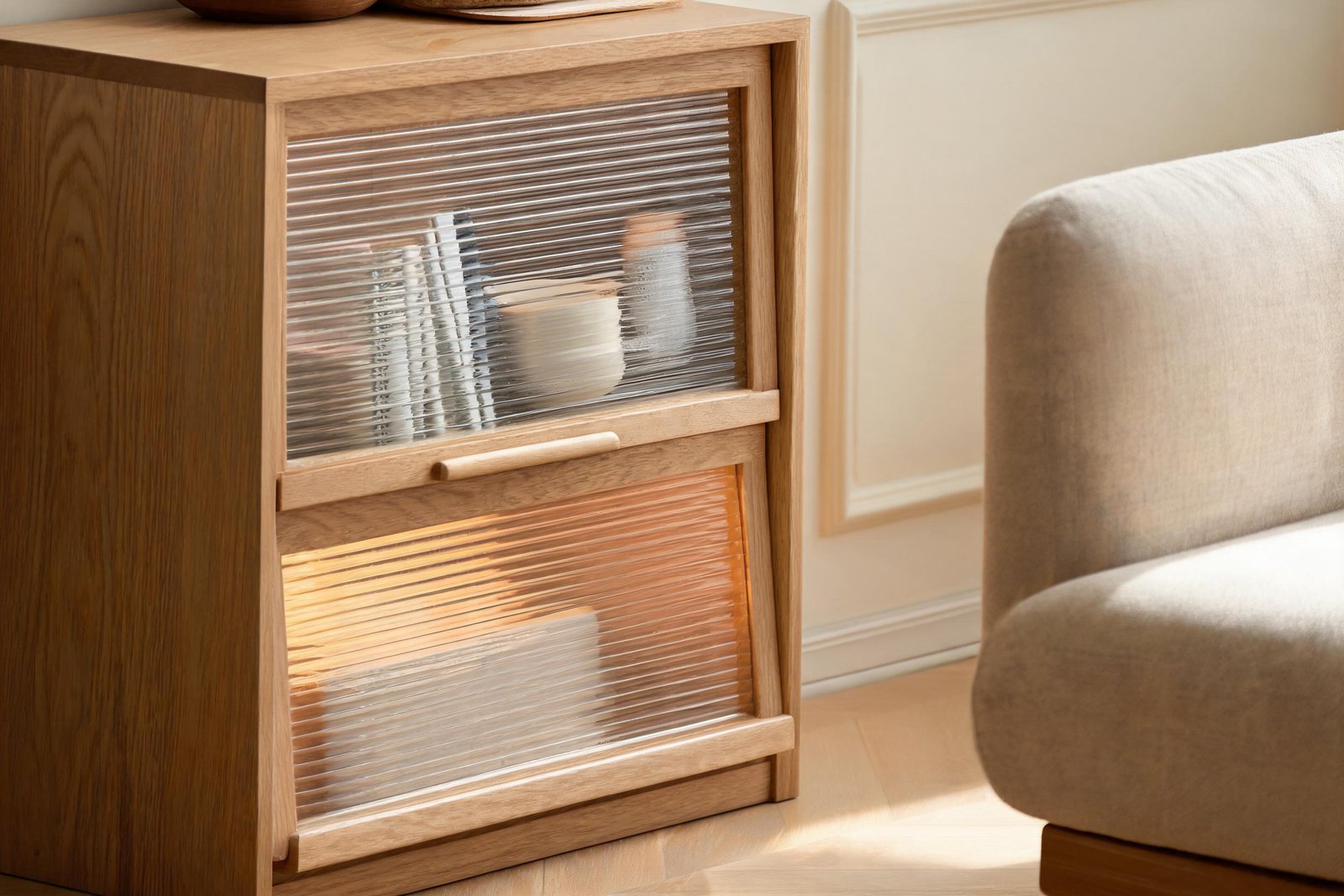
Treat the glass as a frame, not a lid. Style the visible shelves as normal, keep the busy or messy items behind the closed doors, and leave the shelf directly behind the glass a little sparser than you would on an open unit, because glass doubles the visual density.
Glass doors solve the two problems open shelving never escapes: dust and clutter. That is the honest argument for them, and it is also why fluted and rippled glass fronts are having such a run in 2026. Designers keep making the same point: reeded glass hides the untidy parts of a book collection while still showing texture and shape, and the vertical ribs scatter light so the contents read as a soft glow rather than a row of labels. It is a hundred-year-old material that came back because it does something clear glass cannot.
The JX-BC-053 is built on that idea. It is a low unit, 75 cm high and 35 cm deep, with a rippled glass door section on one end and open shelves on the other, in a natural oak finish that suits a Japandi or warm-minimal room. The width options run from 50 cm to 130 cm, so you can fit it under a window or stretch it across a wall as a low sideboard. Assembly is straightforward, and the shelves take real weight. You can see the door detail and the width options here: View the rippled glass door bookcase in our store.
One practical note about styling behind glass. Because the door cuts reflections and softens edges, objects placed at the back lose definition. Move the good pieces forward by a few centimetres and they still read through the ripple.
How much weight can a bookshelf take? (Wikipedia on bookcase construction)
How to arrange bookshelves safely also means respecting what the unit can carry.
Less than people assume, and the limit is usually the shelf board, not the frame. Engineered wood boards of 15–18 mm with a 9 mm back panel handle everyday books fine, but a metre of hardbacks is a heavy row, so keep the densest loads on the lower shelves and the short spans.
Three things keep a loaded shelf straight. Short spans: a 66 cm section sags far less than a 130 cm one under the same book count. Lower is safer: weight at the bottom keeps the unit stable, especially on a low cabinet that is not fixed to the wall. And even distribution: never let one end of a shelf carry a full row while the other end is bare. If a shelf is already bowed, flip it if the design allows, which buys time.
If you are shopping and the plan is a wall of hardbacks, look for units that state board thickness and use a centre divider per section. A single unsupported metre of shelf loaded with reference books will bow, whatever the marketing photos suggest. For a taller, closed-door setup with more capacity, see the 4-door glass bookcase at $383 here, and if you want to compare heights, widths and door styles across the range, browse all bookcases in our store.
Bookshelf Decorating Ideas Living Room: Mistakes to Avoid
The most common bookshelf decorating ideas living room guides get wrong is treating every shelf the same.
A short list, in the order I see them:
| Mistake | What it looks like | The fix |
|---|---|---|
| Same density on every shelf | Rows of similar mass, no rhythm | Let one shelf stay nearly empty |
| All books, no objects | Library wall, flat and heavy | One object every second shelf |
| All objects, no books | Styled display with nothing to read | Books first, objects respond |
| Everything vertical | Monotonous, no levels | Add a flat stack as a pedestal |
| Everything pushed to the back | Dust gutter, no shadow | Pull spines forward slightly |
| Matching pairs of objects | Stiff, showroom-like | Group in threes, vary the heights |
| Filling to 100 percent | Nothing stands out | Stop at about two-thirds full |
Bookshelf Decorating Ideas: The One Rule I Would Keep
If I had to reduce every bookshelf decorating ideas list to one rule, it would be this.
If you only apply one thing from this list, leave a shelf empty. It costs nothing, it takes a minute, and it is the change that makes the rest of the arrangement look intentional instead of crowded. Everything else here is adjustable to taste.
Styling takes two passes, not one. Arrange it, walk to the doorway, look at the whole unit from there, then come back and remove two things. That second look is where most shelves go from tidy to composed.
FAQ
How many books should be on each shelf?
Roughly two-thirds of capacity. A 98 cm section holds about 25 hardbacks at maximum, so keep it near 17 and leave the remaining space for an object or open air.
Should every shelf have decorative objects?
No. When you apply how to arrange bookshelves rules section by section, a good pattern is one object-led shelf, two book-led shelves, and one sparse shelf per four sections. Uniform object placement is what makes shelves look staged, and it is the first habit how to arrange bookshelves advice tells you to break.
Are glass door bookcases worth it?
For dust and clutter, yes — and the same how to arrange bookshelves logic applies behind the glass. You can keep the contents visible while the messy half stays behind a door, and reeded or rippled glass softens what shows (Wikipedia on reeded glass).
How do you stop a shelf from sagging?
Keep heavy books on the shortest spans and the lower shelves (Britannica on wood as a material), spread the weight evenly, and prefer units with a centre divider per section (Wikipedia on shelf construction) over one long unsupported shelf.
How long should styling a bookcase take?
Two hours for a full reset, plus a ten-minute edit the next day, is what how to arrange bookshelves realistically takes. If it takes longer, you are keeping more on the shelf than the shelf can hold.
