

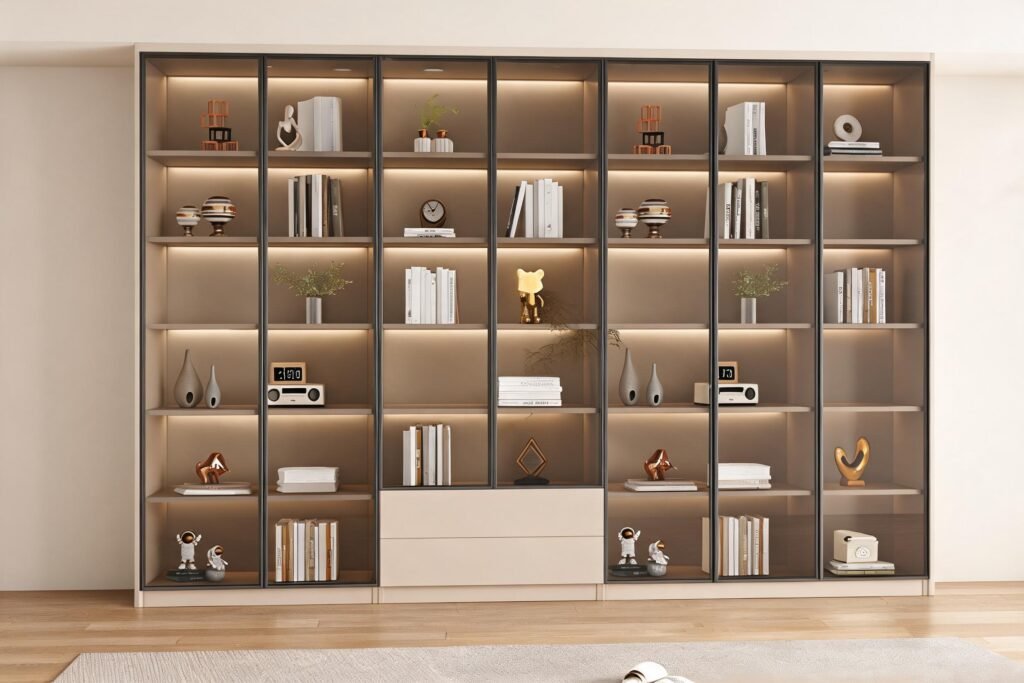
A bookcase with glass doors does two jobs that open shelving cannot do at the same time: it keeps a collection on show and it keeps most of the dust off it. The price of that is weight, money, and a surface that records every fingerprint.
What a bookcase with glass doors changes is less about storage than about maintenance. You stop lifting forty objects to dust under them, and you start polishing a flat pane twice a month. Whether that trade works in your room comes down to seven decisions, and six of them happen before you order anything.
The order matters. Measure the wall first, then the door swing, then the depth against your tallest book. Only after those three are settled does it make sense to argue about glass versus open shelves, or about how much light you want inside the case. Everything below follows that sequence.
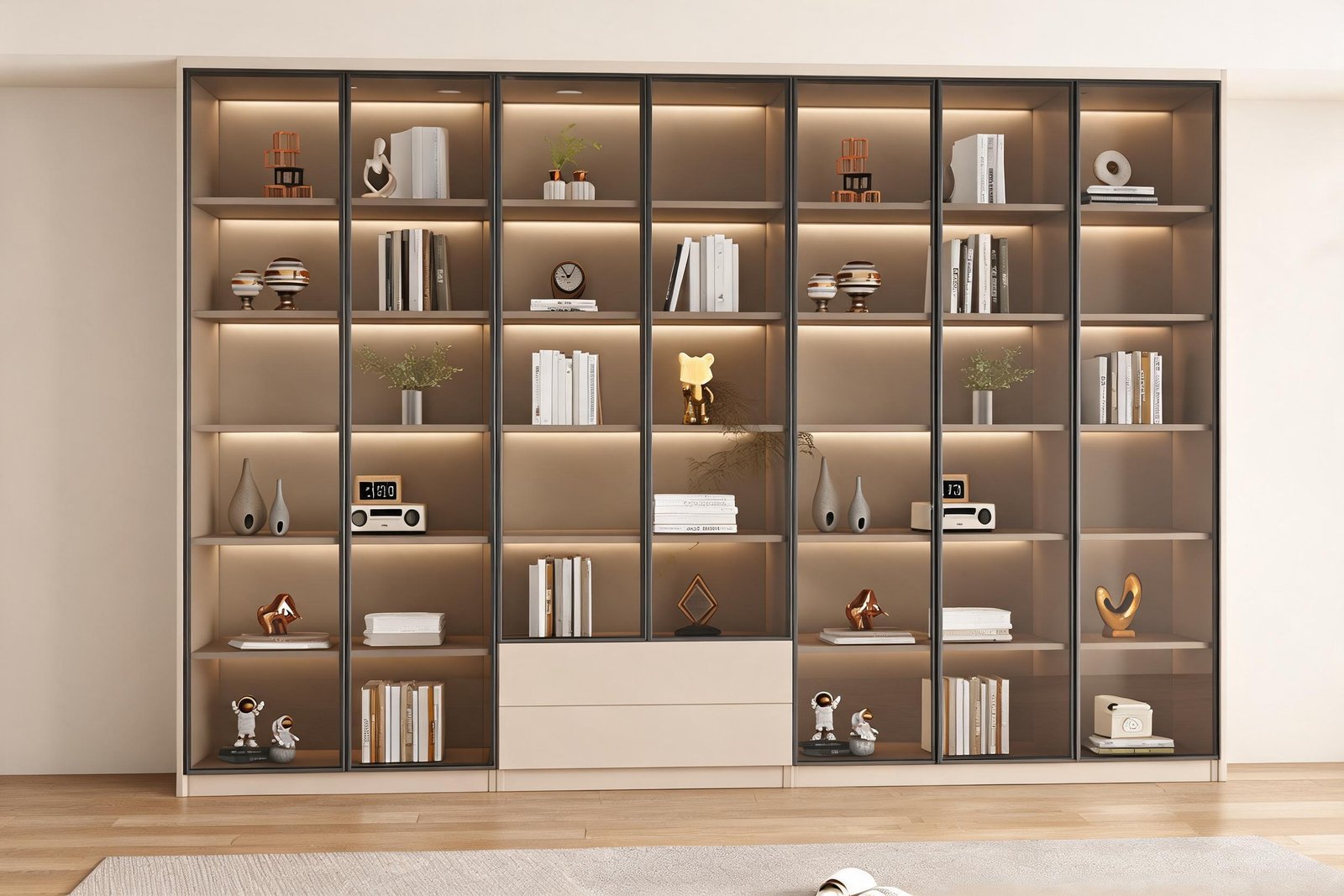
Rule 1: Size a bookcase with glass doors to the wall, not the other way round
Start with the clear run of wall, not with the width of the unit you like. A bookcase with glass doors that ends 2 in from a door frame looks like a mistake; one that ends 8 in short looks deliberate. Take the tape to three heights, floor, waist and just under the ceiling, and use the smallest number. Older houses bow, and a 78.7 in (200 cm) tall case has nowhere to hide a 0.5 in bulge.
Height is the measurement people skip. A 200 cm case is 78.7 in. Under a standard 96 in ceiling that leaves 17 in of wall above, which is enough for nothing and looks like nothing, so the case reads as furniture rather than as part of the room. Under an 8 ft ceiling the same case nearly touches, which is a different look and a harder one to get right. Decide which of the two you want before you buy, because no amount of styling fixes a height that is wrong.
Width comes in modules for a reason. The common widths for a bookcase with glass doors made for the export market convert to 23.6 in (60 cm), 35.4 in (90 cm) and 47.2 in (120 cm), and the modules are built to stand side by side as one continuous run. On a 144 in wall, two 47.2 in units plus one 23.6 in unit give 118 in of case and 26 in of air, which is a comfortable arrangement. Two 47.2 in units alone leave 49.6 in, and that gap will look like a missing piece unless something tall and narrow fills it.
| Wall run | One module | Two modules | Three modules |
|---|---|---|---|
| 96 in (8 ft) | 47.2 in, 48.8 in left | 2 x 35.4 in, 25.2 in left | not enough room |
| 120 in (10 ft) | 47.2 in, 72.8 in left | 2 x 47.2 in, 25.6 in left | 3 x 35.4 in, 13.8 in left |
| 144 in (12 ft) | 47.2 in, 96.8 in left | 2 x 47.2 in, 49.6 in left | 47.2 + 35.4 + 23.6 in, 37.8 in left |
Baseboards are the second thing that ruins a clean fit. A 0.75 in baseboard holds the back of the bookcase with glass doors away from the wall, and a 32 cm (12.6 in) deep unit standing 0.75 in proud of the plaster shows a shadow line along the whole run. Either notch the plinth around the baseboard or accept the gap and light it, but decide before delivery.
Rule 2: Give hinged glass doors room to open
Framed glass doors swing out, and they swing further than people expect because the frame adds width at the hinge side. Leave 24 in of clear floor in front of the case as a working minimum, and 36 in if two people need to pass while a door is open. In a hallway narrower than 36 in, a bookcase with glass doors will be opened one panel at a time forever, and the bottom shelves will stop being used.
That same 36 in applies to the walkway. A bookcase with glass doors is a wall of glass at eye height, and anything closer than 36 in to a sofa or a dining chair reads as a barrier rather than as storage. If the room cannot give you 36 in, the honest answer is a shallower, lower unit, not a deeper one.
One more thing about doors: glass panels are heavy. A framed tempered glass door on a 78.7 in case weighs noticeably more than a wood panel of the same size, and the hinges carry that weight for years. Open the door of any display case in a shop and let it hang at 90 degrees. If it sags at the outer corner, the hinge and the carcass are not stiff enough for the panel.
Rule 3: Match the depth to your tallest book, then add an inch
Depth is where most buyers lose usable space without noticing. A 32 cm carcass is 12.6 in, but the frame and the door leaf eat roughly 1 in of that, so the shelf you can actually use is about 11.6 in deep. A standard hardback is 6 to 9.5 in deep, which leaves room to spare. A large art or photography book can run to 12 in, and it will not sit flush behind glass on a 12.6 in carcass.
Measure the three deepest books you own before you order a bookcase with glass doors. If the answer is 12 in, either plan to store those books flat, or choose a case with more carcass depth and accept that it stands further into the room.
The rest of the depth question is about the room, not the books. Add the case depth to the 36 in walkway and you have the floor space the wall will consume: 12.6 in plus 36 in is 48.6 in, which in a 10 ft wide room is 40 percent of the width. That number is the one to argue with, because it decides whether the room still feels like a room.
Rule 4: Work out what a bookcase with glass doors is actually protecting
Glass on a bookcase with glass doors cuts dusting time, and the arithmetic is easy enough to do on the back of an envelope. Take one 23.6 in column with five open shelves and about eight objects per shelf. That is forty objects, each of which has to be lifted, wiped and put back, at roughly 12 seconds each. Eight minutes.
Add the shelf faces, six of them at 25 seconds, and one full pass on open shelving lands near 10.5 minutes. Behind glass the same column needs six panes cleaned inside and out, at about 30 seconds each. Three minutes. That is roughly 70 percent less work per pass, and if you dust once a month, about an hour and a half a year that goes back into your evening.
| Task | Open shelves | Bookcase with glass doors |
|---|---|---|
| Lift, wipe and replace 40 objects | 8 min | not needed |
| Wipe 6 shelf faces | 2.5 min | 1 min (shelf edges only) |
| Clean 6 glass panes, both sides | 0 | 3 min |
| Total per pass | about 10.5 min | about 4 min |
Two honest caveats. Framed glass doors are not sealed doors: fine dust still works its way past the stiles over a season, so a bookcase with glass doors still wants one full interior pass every six months, not never. And the outside of the glass is now a surface you look through, which means fingerprints at handle height become visible in a way that a dusty book spine never was. Glass trades scrubbing for polishing. Most people prefer polishing, but it is a trade.
Rule 5: Use the interior light for depth, not dazzle
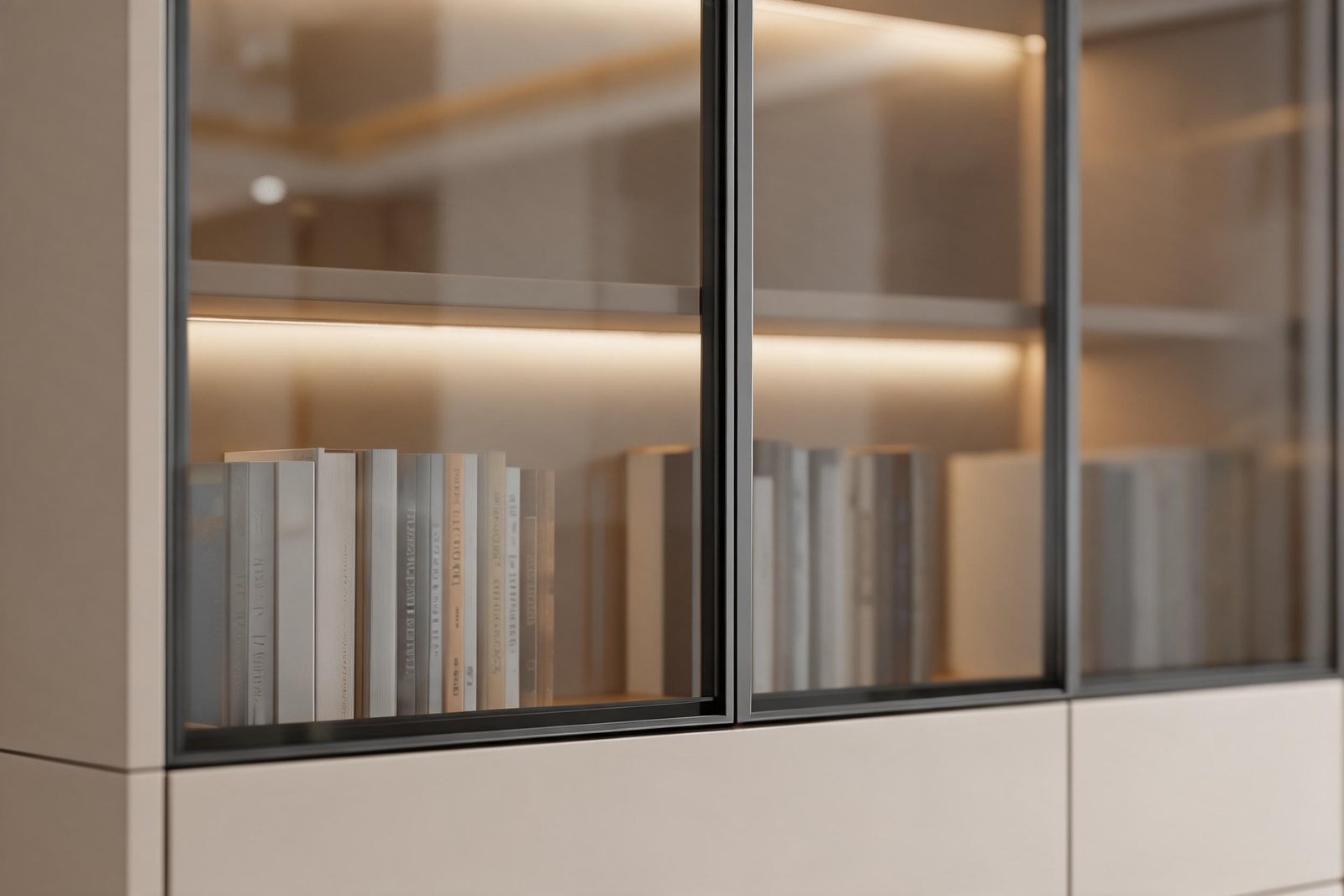
An LED strip under each shelf edge does more for a bookcase with glass doors than any styling decision, because it lights the shelf below rather than the room. The strip belongs at the front underside of each shelf, aimed back and down, so the light washes the objects and the back panel. Move it forward and it reflects straight off the inside of the glass, and you spend the evening looking at a row of bright dots instead of your books.
Bookcase with glass doors and lights: what the strip fixes and what it cannot
Warm white light suits paper and stoneware. Cool white on a shelf of books makes the page edges look grey, which is the opposite of what a display case is for. On a bookcase with glass doors the light also does structural work: it separates the shelves from the back panel, so a deep case reads as five shallow stages rather than one dark box.
The practical limit is the bottom shelf. It sits below eye level, so light from the shelf above never reaches it, and it will always be the darkest part of the case. Put the things you rarely look at down there: archive boxes, heavy reference volumes, the photo albums that come out twice a year.
If you want the full setup, the guide to glass door bookcases with LED lights covers strip placement and switching in more detail.
Rule 6: Style in blocks, not rows
How to style a bookcase with glass doors without a grid
The fastest way to make a bookcase with glass doors look cheap is to fill every shelf evenly. Even spacing flattens the whole run into a grid, and a grid behind glass looks like a shop display rather than a room.
Work in blocks instead. Give each column a job: one for book runs, one for objects, one mixed. Inside a column of a bookcase with glass doors, keep books in runs of eight to fourteen, standing or stacked, and stop the run before the shelf ends. A stack of three to five books lying flat makes a plinth for a single object, and that one object is what the eye lands on when the light comes on.
Leave roughly a third of each shelf empty. Behind glass on a bookcase with glass doors, empty space reads as air rather than as waste, because the back panel is a surface the light can play on. The full method, including how to break up a long run without making it busy, is in the guide to arranging bookshelves so they stay arranged.
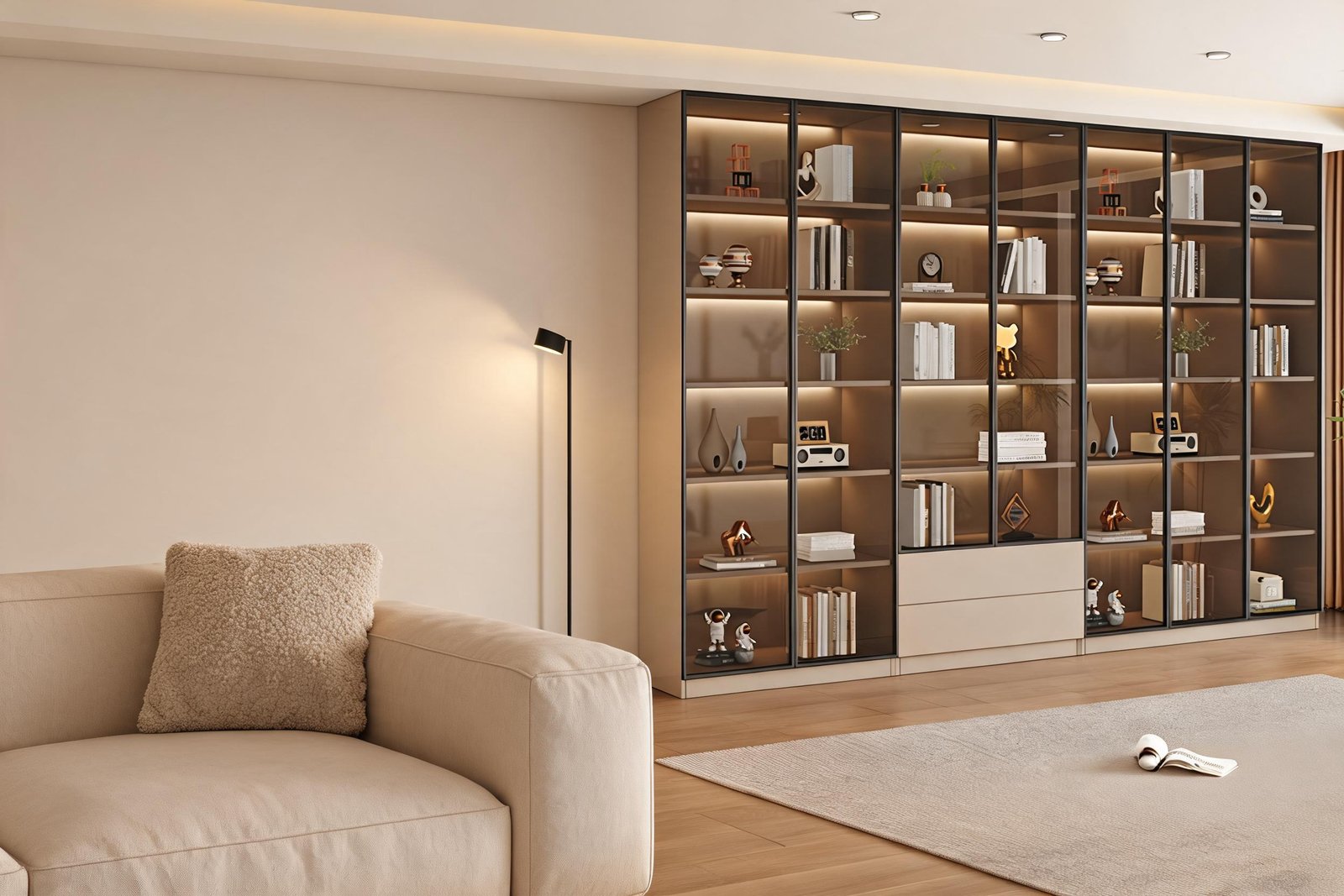
Rule 7: Compare glass, open and solid before you commit
Glass is not automatically the better door. It solves dust and display at the same time, and it fails in three specific situations: a room with small children who press on everything, a room with direct sun on the case, and a room where the contents are not worth looking at. A bookcase with glass doors in that third room is an expensive way to show the back of a filing box.
| Bookcase with glass doors | Open shelves | Solid doors | |
|---|---|---|---|
| Dusting | light, mostly glass | heavy, object by object | almost none |
| Display | full, behind glass | full, open | none when closed |
| Visual weight | medium, reflective | low | high |
| Cost for the same run | higher | lowest | middle |
| Best room | living, dining, study | hallway, kitchen, kids room | bedroom, utility |
Direct sun is the one people underestimate. A glass front turns a south-facing wall into a greenhouse for paper and photographs, and no blind solves it for an entire afternoon. If the case must face that wall, solid doors or a much lower unit are the calmer choice.
What the JX-BC-084 bookcase with glass doors offers, and where it stops
The 084 is a modular glass door wall unit built to those measurements. Widths are 23.6 in (60 cm), 35.4 in (90 cm) and 47.2 in (120 cm), all at 78.7 in (200 cm) tall and 32 cm (12.6 in) deep, so the modules can be joined into one continuous run. The carcass is a cream-beige flat matte finish, and the doors carry a slim matt black aluminium frame around clear tempered glass, which is the combination that keeps a run of this size from reading as a heavy wall of furniture.
Inside, each column has five open compartments with a warm LED strip hidden under the front edge of every shelf.
Bookcase with glass doors and drawers: what belongs below the glass
The drawer base is the option worth thinking about, because it decides what never has to look good. Two flat handleless drawers take the chargers, the spare batteries, the remote that controls the strip and the tangle of cables that no shelf display survives. Below the glass line, in other words, is where a bookcase with glass doors stops being display and starts being storage, which is the part most buyers forget to plan.
The boards are ENF-grade engineered wood board, the strictest formaldehyde emission class in China’s national standard (≤0.025 mg/m³), stricter than the E0 class usually quoted by furniture sellers. That class exists because composite panels are glued, and glue is where formaldehyde emissions come from in any panel-built furniture, whatever the country of manufacture.
Where this bookcase with glass doors stops: the 23.6 in module is one column, so it holds a single run of books per shelf and nothing more. The case arrives flat-packed, the carcass panels are long, and standing a 78.7 in unit upright is a two-person job. The glass doors are heavier than panel doors, so the hinges want to be checked after the first month and then once a year. And the LED strip lights the shelf, not the room: it is not a substitute for a floor lamp.
Pricing runs with size and with the base type. The 23.6 in (60 cm) unit starts at $758 with a closed base and $826 with the two drawer base, the 35.4 in (90 cm) is $1,213, and the 47.2 in (120 cm) is $1,648, with the drawer variant of each running slightly higher. Check the exact variant before ordering, because the base moves the number as much as the width does. If the wall is 8 ft and the budget is one module, shop the 23.6 in bookcase with glass doors here and measure it against your own run before ordering. The product page carries the current price, the full specification and the care notes.
Two other cases are worth a look before you commit. The JX-BC-079 with interior lighting at $813 suits a room that needs one tall focal piece rather than a run, and the JX-BC-083 eight door bookshelf at $481 is the cheaper way into a full-width glass front. The full bookcase collection lists all 83 pieces with their widths, so a wall can be planned in one sitting.
Method: how to measure a wall for a bookcase with glass doors
- Measure the clear wall at the floor, at waist height and 2 in below the ceiling. Write down the smallest of the three.
- Subtract 8 in for end clearance, then divide by the module widths you are considering, and check the leftover against the table in Rule 1.
- Note every obstacle along that wall: baseboard height, outlets, light switches, radiators, door frames. Mark them on the same sketch as the unit outline.
- Measure the deepest book you own, add 1 in for the door and frame, and compare that figure with the carcass depth of the bookcase with glass doors you are considering.
- Stand where the sofa or the table will be and hold a tape at 36 in from the wall. If it reaches the furniture, the walkway is too tight.
FAQ
How much does a bookcase with glass doors cost?
For a single column, budget from about $480 to $830 in this range, and from $1,200 to $1,650 for a 90 to 120 cm run. The 23.6 in module of the JX-BC-084 starts at $758 with a closed base, or $826 with the two drawer base, and the wider modules scale with width rather than with shelf count.
Do glass doors actually keep books dust free?
They remove most of the dust that settles on the books themselves, because the pane blocks the air movement that carries it. Fine dust still reaches the shelf edges over months, so one interior pass every six months is realistic. The bigger saving is that you stop lifting every object to dust under it.
How deep should a bookcase with glass doors be?
For normal hardbacks, a 12.6 in (32 cm) carcass is generous and leaves about 11.6 in of usable shelf. If you own art books at 12 in deep, plan to lay them flat or choose a deeper case, because a glass door will not close on a book that sits flush with the front edge.
Is tempered glass safe in a house with children?
Tempered glass is the right choice for furniture doors: when it breaks it goes into small blunt fragments instead of long shards. It is still glass. A bookcase with glass doors in a playroom needs the doors kept latched, and the bottom shelves should hold nothing heavy or breakable.
Will a glass door bookcase make a small room look smaller?
Usually the opposite, as long as the run stops short of the ceiling and the glass is clear rather than tinted or mirrored. A reflective front adds depth, while a solid door run of the same size closes the wall off. The failure case is a full-height run in a narrow room, where the reflection doubles the clutter.
Can the LED strip be switched off?
On modular cases the strip usually runs on a low-voltage driver with its own switch or remote, so it can be left off in daylight. Check that the driver is reachable after installation. A driver buried behind a fixed back panel is a maintenance problem waiting to happen.
A bookcase with glass doors is a small piece of architecture: it decides how much wall you give up, how much light the room keeps, and how often you handle the things you own. Get the three measurements right and the rest of the decisions get easier, because the case stops competing with the room and starts holding it together.
