

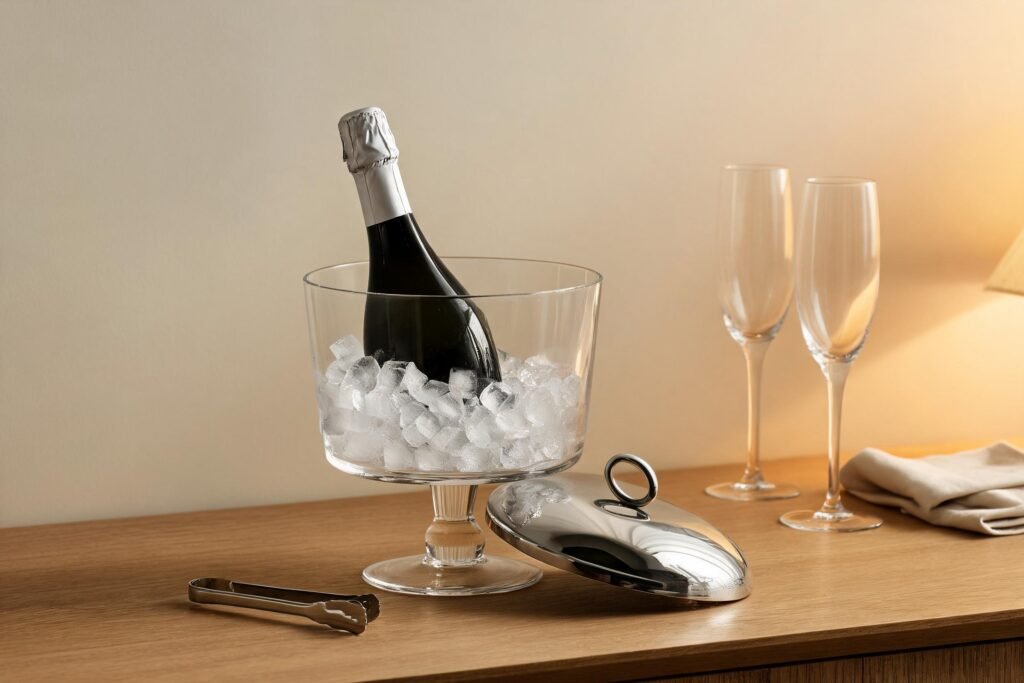
Champagne Bucket vs Ice Bucket: 7 Proven Picks
Most shoppers treat these as one object with two labels. They are not. A champagne bucket is built for a single narrow job: standing a 750ml sparkling bottle upright in ice water at an angle you can pour from. An ice bucket is built around volume and time, so a crowd can keep reaching in after the wine is gone.
I have chilled more bottles in a kitchen sink than in a proper champagne bucket. I stopped the night a bottle rolled over and took a bowl of ice across the table, and I have run acrylic, chrome-plated, glass and vacuum steel buckets side by side ever since.
The verdict: buy a lidded insulated bucket for general use, and an open pedestal bowl only if you serve bottle after bottle and want the label on show.
Champagne bucket vs ice bucket: the short answer
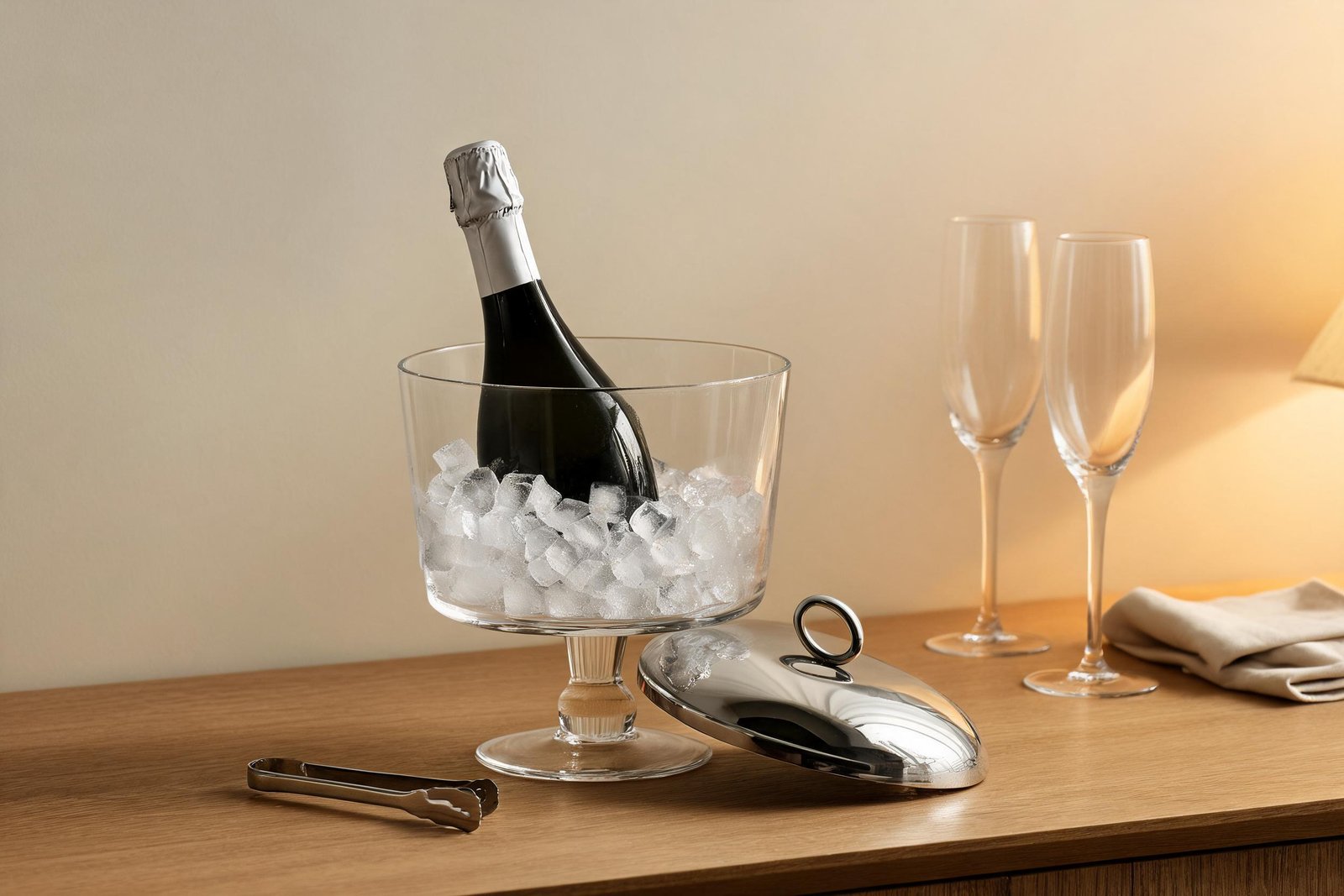
A champagne bucket is a tall narrow vessel that holds one 750ml bottle upright in ice water. An ice bucket for drinks is wider and squatter, holds ice for many drinks at once, and normally ships with a lid. Choose the champagne bucket for wine service, the ice bucket for mixed drinks. With room for only one, buy the lidded version.
The confusion starts in retail listings, where the same item gets filed under both names. A tall stainless champagne bucket with a domed lid and tongs is genuinely both things. It is narrow enough to cradle a bottle and wide enough to hold two litres of cubes.
The real difference is the trade-off between access and retention. A narrow bowl keeps a bottle standing but leaves little room for ice. A wide bowl holds more ice but swallows the bottle to the shoulder.
How to chill champagne fast
Ice water beats a fridge by a wide margin, because water conducts heat roughly 20 to 25 times better than air. A 750ml bottle in an ice water bath drops to serving temperature in about 20 to 30 minutes, while the same bottle in a 4C (39F) fridge needs 2 to 3 hours. A spoonful of salt takes the bath to about -5C (23F) and cuts the time to roughly 10 minutes.
Salt lowers the freezing point of the film of water around each cube, so melting ice keeps pulling heat out of the bottle instead of sitting at a flat 0C. Two teaspoons in a couple of litres is plenty.
The target is 6 to 10C (43 to 50F) for most sparkling wine. Colder and you mute the aromatics. My rule is 25 minutes in a plain bath or 12 minutes with salt, then two minutes out of the water.
One detail people miss: submerge the body, not just the neck. A bottle standing in three centimetres of ice chills almost nothing, which is why a 27cm champagne bucket beats a cooler that only takes the base. Champagne stays lively under its own pressure, so you do not need to shake or swirl it.
Ice bucket with lid vs open pedestal bowl
A lid keeps ice far longer and keeps dust and flies out. An open pedestal bowl is quicker to reach into at a party and lets the bottle stay visible. In a 22C (72F) room, cubes in an open bowl melt noticeably within 20 minutes and are slush by around 90 minutes. A lidded double-wall bucket still holds usable cubes after 6 to 12 hours.
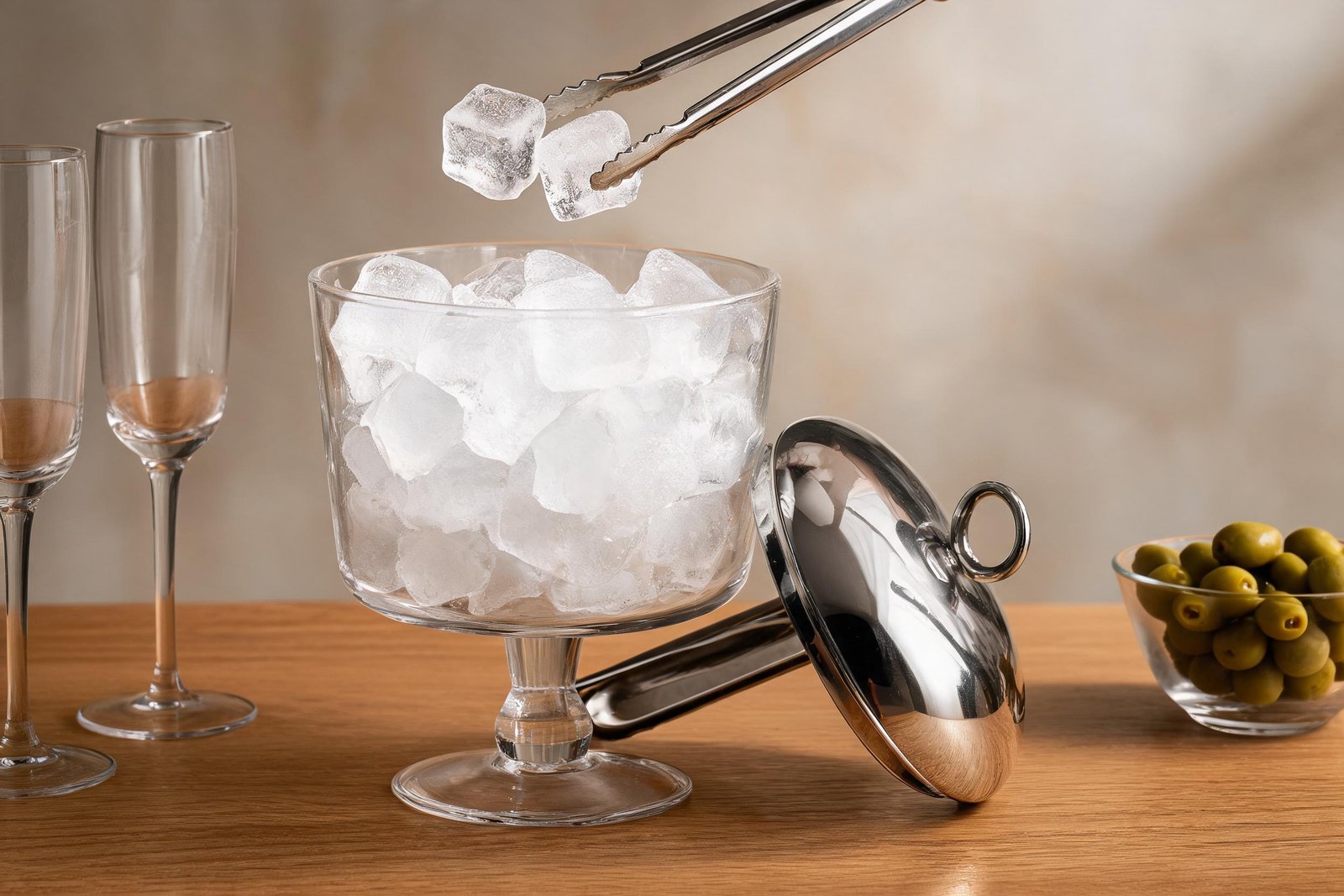
For dinner for four, the open bowl wins on feel: the bottle stands proud and nobody lifts a lid with a glass in hand. Past two hours, or at a buffet where guests wander, the lid wins on labour.
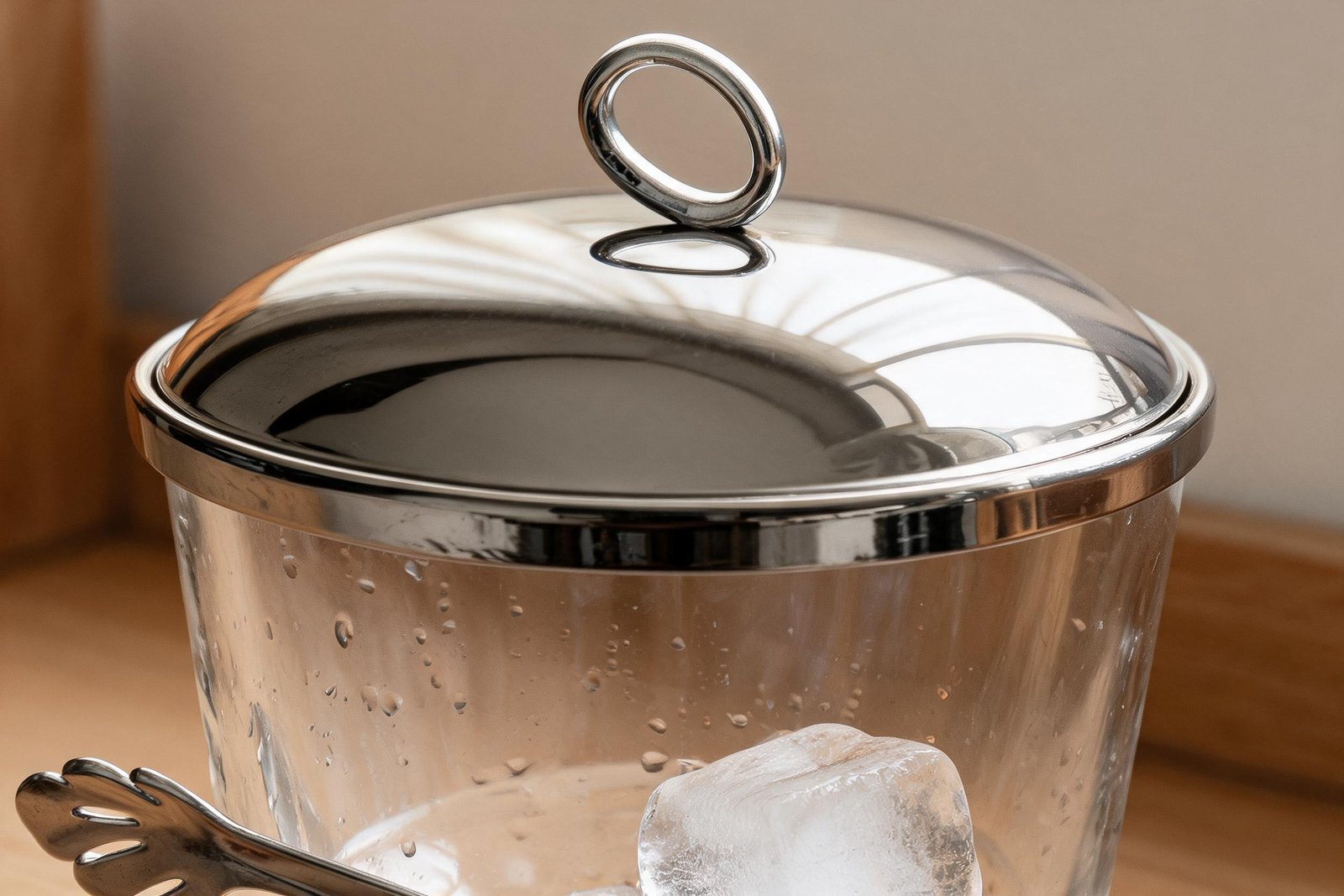
Tongs are the quiet factor. I resisted them for years and used my hands, which meant wet fingers on the bottle neck and a puddle under every glass. If you want the one that stays out on my counter, shop the glass ice bucket with lid and tongs here. It is the champagne bucket I keep out at home: a clear borosilicate bowl on a glass pedestal foot with a mirror-polished steel domed lid and a ring handle, 27 x 20cm, at $298.
The lid also stops the condensation nobody mentions until it happens: an open bowl of ice in a warm room sweats onto whatever it stands on. Double-wall steel and glass both reduce that.
Which one if you buy only one
Answer two questions honestly and the choice is obvious. How long must the ice survive, and how tight is your storage? If the answer is all evening, or the cupboard is narrow, the lidded insulated champagne bucket wins. If you serve bottle after bottle, the open pedestal bowl does.
| Your situation | Choose | Why |
|---|---|---|
| Ice must last past 2 hours | Lidded insulated bucket | Melting slows to a fraction of open air |
| Small kitchen, tight cupboard | Lidded bucket at 20cm wide | A pedestal foot wastes shelf space |
| One bottle with dinner | Open pedestal bowl | Fast access, bottle stays visible |
| Buffet or self-serve bar | Lidded bucket plus tongs | Fewer refills, no hands in the ice |
| Wine and mixed drinks, one vessel | Double-wall steel bucket | Handles both, hides the bottle fine |
For a general-purpose pick, see the double wall vacuum steel ice bucket price and details here – model JX-SSIB-132, vacuum insulated at $293, the version that keeps cubes overnight without condensation under it.
Materials that matter
Material decides how fast ice goes and how the bucket ages. The insulated layer matters more than the finish.
| Material | Chill speed | Ice retention | Care | Notes |
|---|---|---|---|---|
| Double wall vacuum steel | Fast | 6-12 hours | Hand wash, do not soak | Best all-rounder, no sweating |
| Single wall 304 stainless | Fast | 2-3 hours | Dishwasher safe | Light, dents if dropped |
| Chrome plated steel | Fast | 2-3 hours | Hand wash only | Plating pits if left wet |
| Borosilicate glass | Fast | 2-4 hours | Hand wash | Heavy base, shows the bottle |
| Acrylic | Medium | 1-2 hours | Dishwasher, top rack | Scratches and clouds with age |
Borosilicate glass takes a drop from a warm cupboard into a bowl of ice water without the stress cracking that hits ordinary soda-lime glass, which is why it turns up in good pedestal bowls. The trade-off is weight and a higher price for a champagne bucket of the same size.
If polish is the priority, shop the mirror polished steel ice bucket here – model JX-SSIB-130, single wall 304 stainless with a mirror finish at $273, and the one I would pick for a champagne bucket silver in finish. See the leather-wrapped steel ice bucket price and details here, at $231, and it suits a wood dining table.
Sizes: what fits and what does not
A standard 750ml sparkling bottle is about 30cm (12 inches) tall including the neck and roughly 9cm (3.5 inches) across the base, so 9cm is the number to hold onto when you read dimensions. An open champagne bucket listed at 27cm across the top usually tapers to a working well of 20 to 22cm.
Magnums are 1.5 litres and about 35cm tall. They do not fit most 27cm open bowls without leaning, and a leaning magnum spills. Insulated buckets are sold by capacity instead:
- 1.5 to 2 litres: one 750ml bottle, tight once you add ice
- 3 litres: one bottle comfortably, or a few beers
- 5 litres and up: two bottles, or ice for a full round of cocktails
Depth beats width. A tall narrow champagne bucket holds a bottle straighter and needs less ice than a wide party cooler.
Care, dishwasher and storage
Most buckets fail through water, not ice. Leftover ice water sitting overnight does the damage. Tip it out, wipe the inside dry, and leave the lid off until the interior is fully air-dry, or you get a metallic smell that transfers to the next bottle.
Single wall 304 stainless and most borosilicate glass survive a dishwasher. Chrome plating and double wall vacuum buckets do not, because water works into the seam where the walls join, so wash those by hand. Browse the full stainless steel homeware collection here: 140 pieces if you want the bucket to match tongs and a tray.
Do not store bottles in the bucket. A bottle left in a wet champagne bucket for a week picks up whatever the ice water left behind.
FAQ
Is a champagne bucket the same as an ice bucket? Mostly, in the modern insulated form. Both hold ice and water around a bottle. A champagne bucket is narrower and taller to stand a bottle upright, while an ice bucket is wider to hold loose ice for many drinks.
Can I use an ice bucket to chill champagne fast? Yes, and it is the quickest home method. Fill to two thirds with ice, add cold water and a spoonful of salt, then stand the bottle in it for 10 to 25 minutes.
How long does ice last in an ice bucket with lid? In a double wall vacuum bucket with the lid on, usable cubes survive 6 to 12 hours. In an open pedestal bowl they are slush within about 90 minutes.
Do I need tongs? Not essential, though you will use them every time. Tongs keep hands out of the ice and stop the wet-finger drip on the table.
What size champagne bucket fits a 750ml bottle? A 2 litre bucket handles one 750ml bottle with ice. For two bottles, go to 5 litres, and check the internal depth: you want to cover the bottle to the shoulder, so look for 25cm or more.
The one I would buy
For a home that entertains a few times a year, take the 27cm glass bowl with the steel domed lid, or the double wall steel bucket if you would rather not handle glass. Both cover a bottle and take ice for other drinks. Shop the glass ice bucket with lid and tongs here if you want the champagne bucket on my counter. I keep it there instead of an open cooler for one reason: I got tired of refilling it.
