

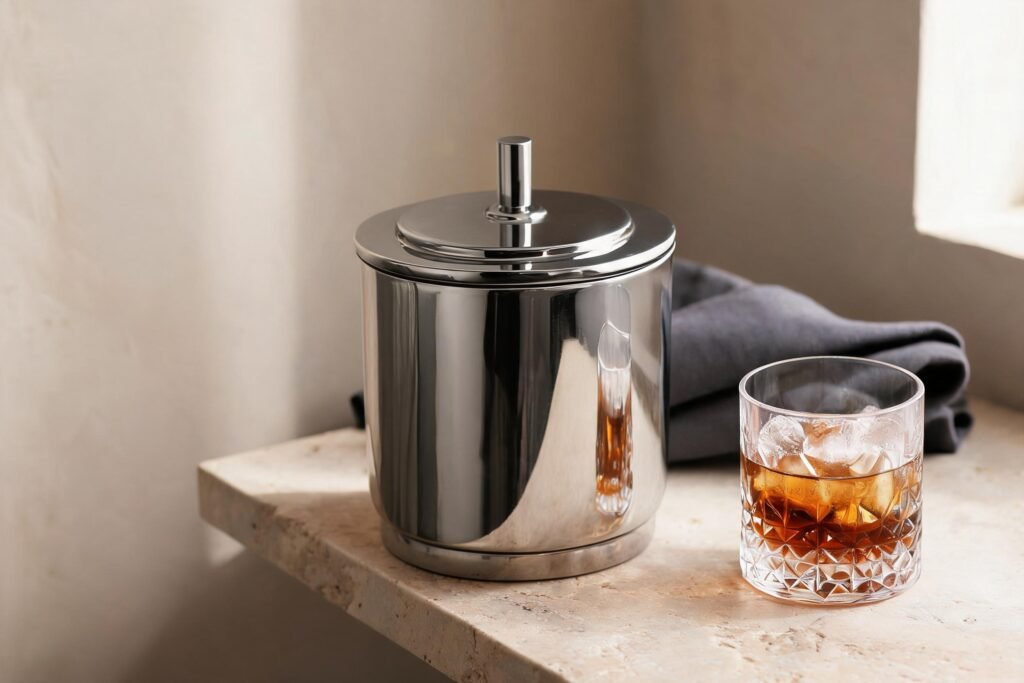
A wine bottle ice bucket has one job, and it is a narrower job than most buyers expect: hold a single 750 ml bottle upright in ice, at the table, without the bottle tipping or the ice ending up on the cloth. Buckets that fail at this usually fail on measurement rather than on looks. The mouth is too narrow for a Burgundy bottle, or the bucket is too tall for the table, or the capacity is right for ice but wrong once a bottle takes up half the volume.
This guide covers the four measurements that decide whether a wine bottle ice bucket works, the difference between a bucket and a cooler sleeve, what a lid can and cannot do, and how long chilling actually takes. It ends with the sizes worth considering for one bottle and the point at which two bottles need a different piece of equipment entirely.
Wine Bottle Ice Bucket: The Four Measurements That Decide It
A wine bottle ice bucket needs a mouth at least 2 cm wider than the bottle it holds, an interior height of 12 cm or more, a base that clears the plate and glass beside it, and a capacity that leaves room for ice after the bottle is in. Get those four right and the rest is finish.
Start with the bottle, because a wine bottle ice bucket is only as good as the bottle it accepts. A standard 750 ml Bordeaux-style bottle stands 29 to 30 cm tall and measures 7.4 to 7.6 cm across. A Burgundy bottle is squatter and wider at 8.4 to 8.9 cm. A Champagne bottle adds glass thickness and reaches 8.6 to 9 cm, sometimes more. A magnum doubles the volume and pushes the diameter past 10 cm. The standard bottle formats change shoulder and neck shape with size, which is why a bucket that swallows a Bordeaux bottle can look crowded with a Burgundy one.
That spread matters at the mouth of any wine bottle ice bucket. A bucket with an 18 cm opening accepts a Champagne bottle with about 4.5 cm of clearance on each side, which is enough to slide ice down the gap. A decorative bucket with a 9 cm opening will drop a Bordeaux bottle in and refuse a Burgundy one, and no amount of ice fixes that.
| Bottle | Diameter | Fits an 18 cm mouth? | Submerged depth in a 14 cm bucket |
|---|---|---|---|
| 750 ml Bordeaux | 7.4 to 7.6 cm | yes, comfortable | about half the bottle |
| 750 ml Burgundy | 8.4 to 8.9 cm | yes, tight but workable | about half the bottle |
| 750 ml Champagne | 8.6 to 9 cm | yes, with room for ice | about half the bottle |
| Half bottle, 375 ml | 6 to 7 cm | yes, very loose | most of the bottle |
| Magnum, 1.5 L | 10 to 11 cm | yes, but no ice room left | less than a third |
The submersion figure is the one people underestimate. A low wine bottle ice bucket sits close to the table, so it chills the bottom half of a bottle and leaves the shoulder and neck at room temperature. That still works, because liquid moves heat through the glass and the wine inside mixes by convection, but it is slower than a tall floor bucket that swallows the whole bottle.
Ice Bucket for Wine Bottles: Why 18 cm Is the Useful Number
A wine bottle ice bucket becomes genuinely useful at about 18 cm of opening and 14 cm of height: wide enough for any 750 ml bottle plus ice, low enough to sit on a dinner table without blocking the view across it.
Below that, a wine bottle ice bucket turns into a candle holder with ice in it. Above it, the piece turns into a floor bucket that belongs beside a bar cart rather than on a table. An 18 cm wine bottle ice bucket is about the largest size most dining tables can carry. The gap between 18 and 22 cm is where most of the practical table buckets sit, and it is where the piece has to make a choice between footprint and ice volume.
Height in a wine bottle ice bucket has a second constraint that has nothing to do with bottles. A bucket on a dining table competes with the sightline. At 14 cm tall, an 18 cm bucket lets everyone at the table see over it, which is why the low wide proportion works for a table and the tall narrow proportion works on a bar. The same logic that governs centrepiece height applies to anything standing in the middle of a table.
Footprint is the third number to check on a wine bottle ice bucket. An 18 cm circle needs 18 cm of clear table, plus a couple of centimetres for the puddle that condensation leaves behind. On a 60 cm deep table with plates set at either end, that is comfortable. On a narrow bistro table it is not.
Table Ice Bucket With Lid: What the Lid Actually Does
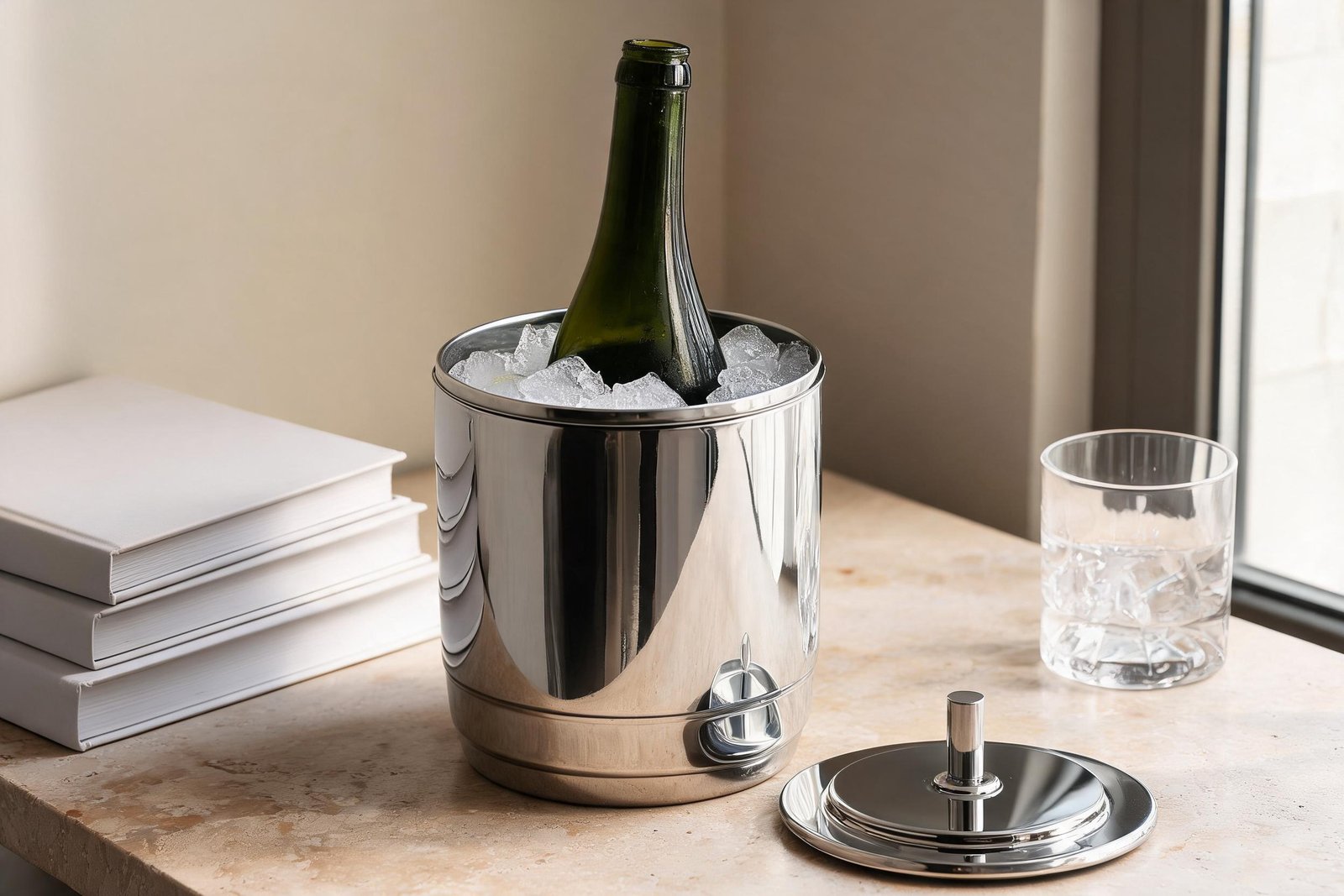
A table ice bucket with a lid keeps ice longer between pours, and that is the whole benefit. The lid does not chill faster and it cannot be used with a bottle standing in the bucket, because the bottle sticks out through where the lid would sit.
That last point is worth being blunt about with any wine bottle ice bucket. A lid is for the hour before service, when the bucket is loaded with ice and waiting. Once the bottle goes in, the lid comes off and stays off. Buyers who expect to close the lid over a bottle are buying the wrong shape.
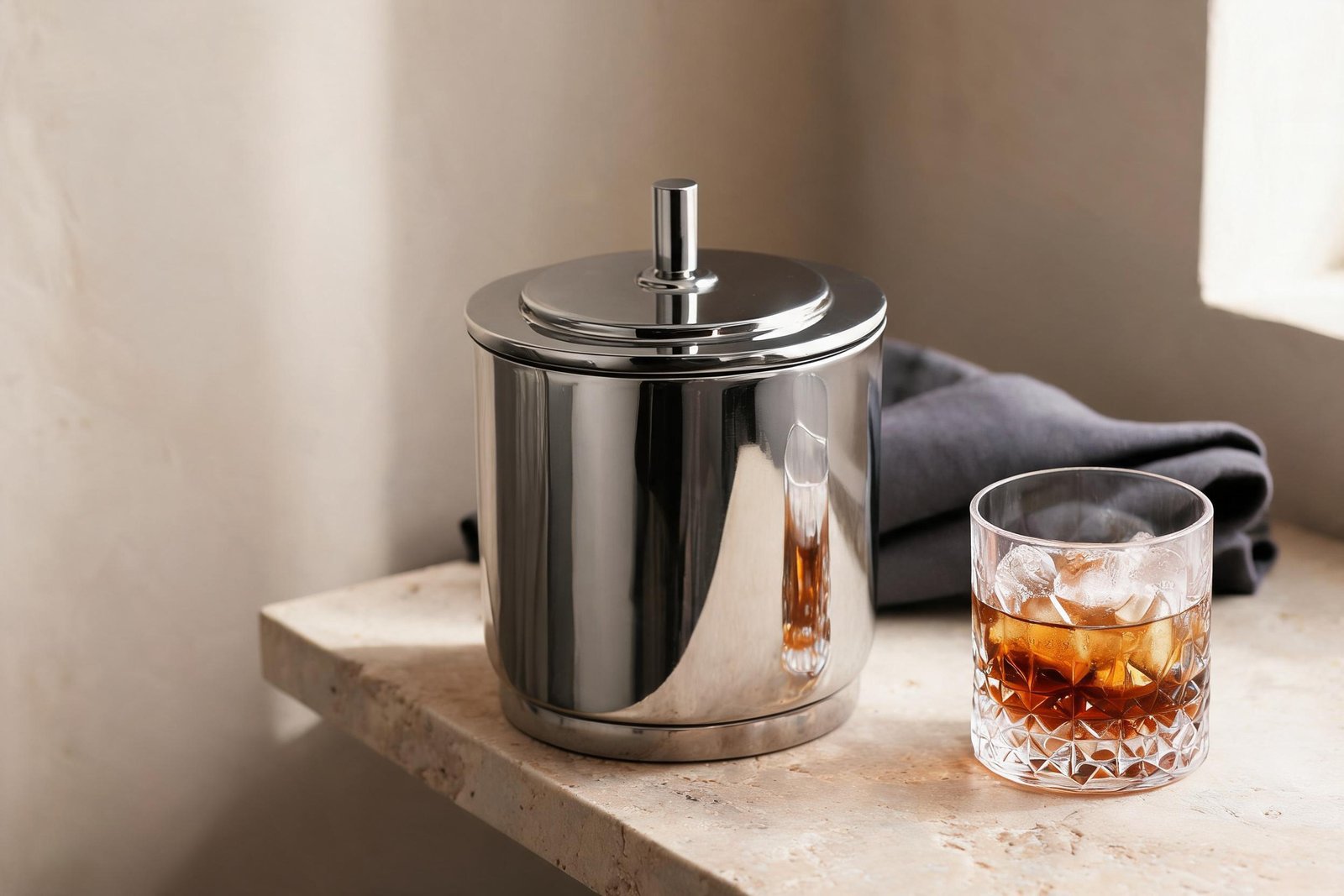
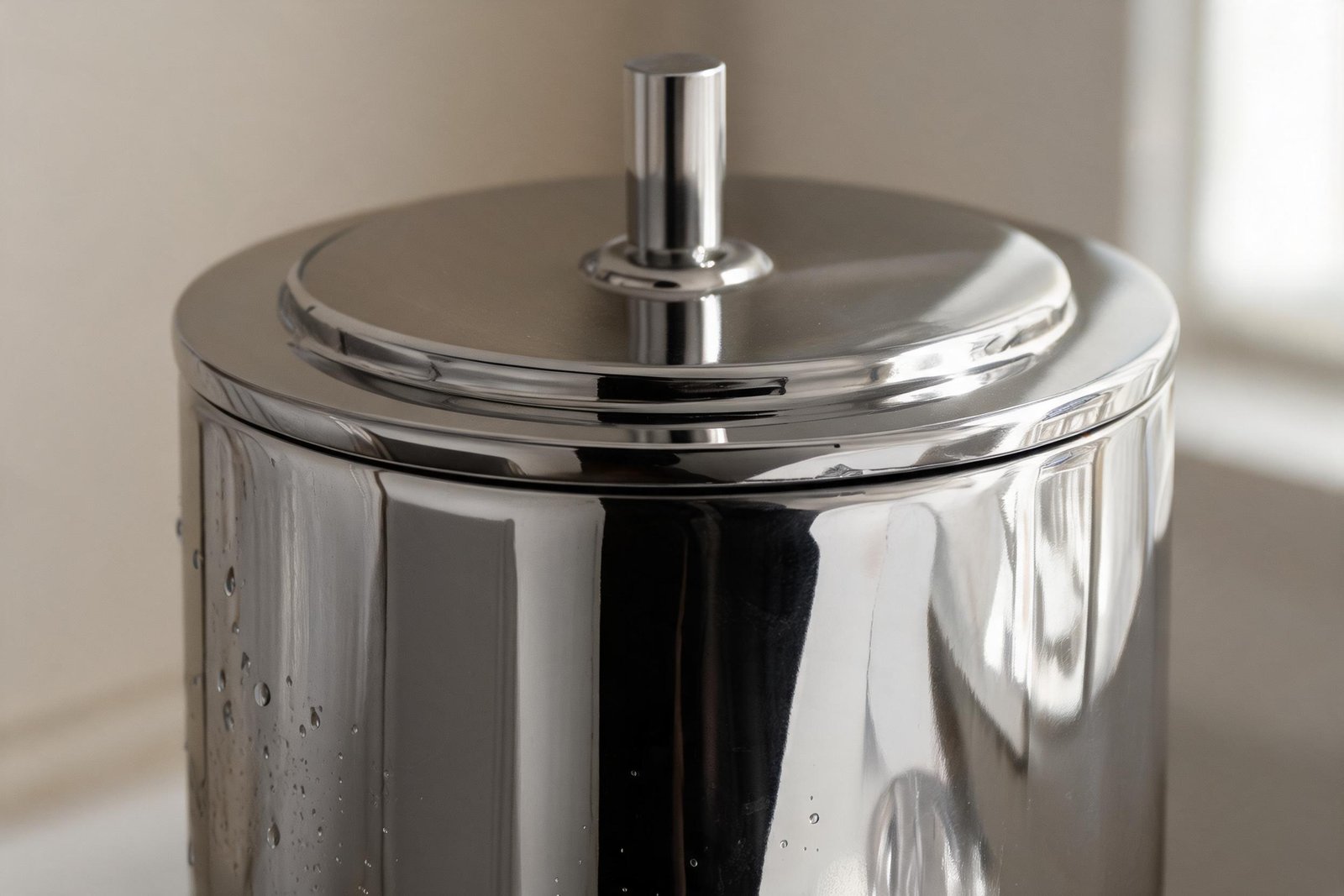
What the lid does well is slow the melt while the bucket waits, and keep dust and fridge odours off the ice if the bucket is stored cold. A flat lid with a small machined knob lifts with two fingers, which matters when the other hand is holding a bottle.
Small Ice Bucket With Lid and Tongs: Is 1.5 L Enough?
A 1.5 L small ice bucket with lid and tongs holds one 750 ml bottle plus roughly half its volume in ice, which is enough to bury the bottom of the bottle and chill it in about twenty minutes. It is not enough for a second bottle, and it is not enough for a party.
The arithmetic for a wine bottle ice bucket is simple and worth doing before you buy. A 750 ml bottle displaces 750 ml of the bucket’s 1.5 L, leaving 750 ml for ice and melt water. Ice cubes pack at roughly 60 percent, so that space holds about 450 g of ice at the start — a generous handful either side of the bottle, refreshed once during a long dinner.
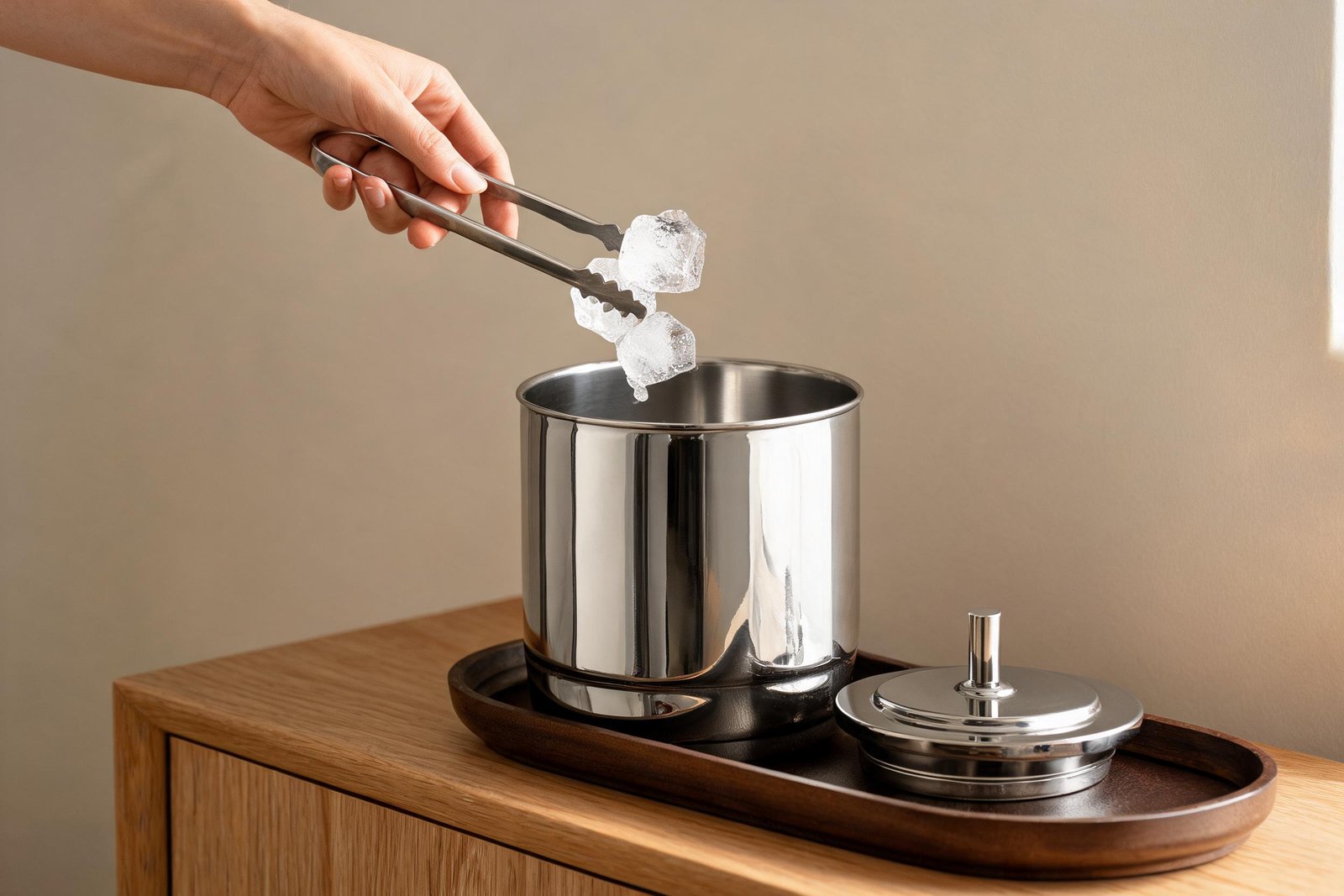
Tongs are the accessory that gets used more than expected. Dropping ice in by hand means the cubes that missed end up on the table, and wet hands on polished steel leave marks. A pair of tongs also lets you lift the bottle out of a full bucket without fishing for the neck.
How Long Does a Bottle Take to Chill in an Ice Bucket?
In an ice and water bath, a room-temperature bottle reaches serving temperature in about 15 to 20 minutes. The same bottle in a refrigerator needs roughly 45 minutes, because air moves heat far more slowly than water.
The reason is conduction. Water carries heat away about twenty times faster than air, so a mixture of ice and a little water — a slurry, not dry cubes — is the fastest domestic option short of a freezer, which is a bad idea for wine: it can push a bottle below freezing at the neck and pop a cork.
Three practical notes follow for any wine bottle ice bucket. First, add a splash of water to the ice; dry cubes chill unevenly because they only touch the bottle at points, while a slurry holds close to 0 °C until the last cube melts, as the physics of melting ice explains. Second, rotate the bottle once or twice so the cold reaches the whole circumference. Third, keep the bucket out of direct sun, which undoes the work faster than the ice can replace it.
Sparkling wine is different. A Champagne bottle at cellar temperature needs only 10 to 15 minutes in ice, and over-chilling mutes the aroma. Red wine should not be iced at all unless the room is above 26°C, and then five minutes is plenty.
Multi Wine Bottle Ice Bucket: When Two Bottles Do Not Fit
A multi wine bottle ice bucket is a different product class: wider, usually oval, and designed for three to six bottles with ice between them. Two bottles will not fit in a round 18 cm bucket, and forcing the second one in leaves no ice space at all.
In a round wine bottle ice bucket, two 8 cm bottles side by side need 16 cm before you add a single cube, so an 18 cm opening leaves 2 cm total for ice on both sides. That is a bottle stand, not a chiller. The honest position is that a round table bucket is a one-bottle piece, and a two-bottle evening needs either a second bucket or a wider oval one.
Capacity is the number to check, not just diameter. Two 750 ml bottles plus enough ice to matter means about 3 L of usable volume, which is twice the interior of a 1.5 L table bucket. That is why the pieces that genuinely hold multiple bottles are noticeably larger and heavier, and why they belong on the floor or a cart rather than in the middle of a table.
Where a Table Bucket Stops Working
A low, single-wall table bucket is the wrong tool in four situations, and buyers do better knowing them in advance.
- Long dinners. A single-wall wine bottle ice bucket sheds ice in about an hour and a half in a warm room. A double-wall or vacuum piece holds four hours and up.
- Warm rooms. Above about 24°C, melt water fills the bucket and the chill fades; you need to pour it off halfway through.
- Large bottles. A magnum fits the mouth but not the ice, and it stands so high that only a third is submerged.
- Condensation on finished wood. Cold steel in a warm room leaves a ring. A tray or a coaster is not optional on oak or walnut under a wine bottle ice bucket.
The flip side is worth stating too: a table bucket is not a wine fridge, and it is not meant to be. It chills one bottle fast, presents it at the table, and puts it within reach. Judged on that, a small single-wall bucket with a lid is more useful than a large cooler that never leaves the kitchen.
How to Use a Table Bucket Properly
Five steps get the most out of a wine bottle ice bucket.
- Chill the bucket first if the room is warm — a minute of cold water takes the heat out of the steel.
- Fill one third with ice, then add the bottle, then pack ice around it to two thirds. Ice added last sits against the bottle instead of under it.
- Add a splash of cold water so the ice makes contact across the whole surface.
- Set the bucket on a tray and keep it out of the sun, with the lid beside it.
- Pour off melt water after 30 minutes and top up the ice if the bottle is staying at the table.
For a fuller treatment of how much ice a group actually needs, the ice bucket sizes guide works from guest count down to litres. If the bucket is going on a cart rather than a table, the bar cart fit checks cover clearance heights and handle clearance instead.
FAQ
Can you put wine in an ice bucket?
Yes. A wine bottle ice bucket with ice and a splash of water is the fastest way to chill a bottle at home. Keep the neck above the waterline, add ice as it melts, and take red wine out after a few minutes because cold mutes it.
How many bottles fit in a 1.5 L ice bucket?
One 750 ml bottle, with room for roughly 450 g of ice around it. A second bottle would take up the remaining space and leave nowhere for ice, so a 1.5 L wine bottle ice bucket is a single-bottle piece.
What is a wine bottle ice bucket holder?
A holder is the stand or cradle that keeps a bottle upright inside the bucket, sometimes a separate insert and sometimes a moulded well in the base. It matters for bottles with narrow bases, which tip when the ice shifts.
How much ice do I need for one bottle?
About 500 g of ice plus a splash of water chills one 750 ml bottle in 15 to 20 minutes. Double it if the bucket sits on a warm table for more than an hour.
Do I need a lid on a table ice bucket?
A lid slows melting while the bucket waits, which is worth having on any wine bottle ice bucket. It cannot stay on once a bottle is standing in the bucket, so treat it as storage rather than serving equipment.
The Table Bucket for One Bottle
The Steel Ice Bucket with Tongs (JX-SSIB-130) is a wine bottle ice bucket built to the measurements above rather than around them. The body is a straight-sided cylinder 18 cm across and 14 cm high, holding 1.5 L, with a flat lid and a short machined knob. The mouth clears a Champagne bottle with room for ice on both sides, and the low profile keeps the sightline open across a table for four. A shallow inset foot keeps it stable on a cloth, and the mirror-polished wall reflects candlelight back into the glass.
It is a single-wall piece. That is the honest limitation: ice lasts about an hour and a half, so it suits a dinner rather than an all-evening party, and it is not the bucket to buy if you want ice to survive four hours. For that, a double-wall piece is the right answer. What it does well is chill one bottle quickly, look like it belongs on a set table, and stay light enough to carry in one hand when full.
The tongs are included, and cold hands are the reason. Lift the bottle out with them rather than fishing.
Shop the Steel Ice Bucket with Tongs here — $273, with the specification and care notes on the product page.
For a wider wine bottle ice bucket that takes a Champagne bottle at an angle, the 24 cm ice bucket (JX-SSIB-126, $188) suits a smaller table, and the 28.5 cm ice bucket (JX-SSIB-135, $218) is the one to choose if the bucket will sit on a bar rather than a dining table. For the rest of the range, the stainless steel home collection gathers buckets, shakers and serving pieces in one place.
