

A vase can be the right height for your table and still the wrong vase for your flowers, because the opening decides almost everything that happens afterwards. Vase mouth size sets how many stems go in, how upright they stand, how fast the water clouds, and whether the arrangement looks deliberate or stuffed. Buyers usually compare height first and opening second. Reverse that order: measure the opening, then the height, then the finish, and the shortlist gets much shorter.
This guide works through the vase mouth size measurement properly. It starts with what the opening can physically hold, moves to the material and the daily routine, then covers the trade-offs between a narrow throat and a wide petal rim, and ends with four concrete sizes and the stems each one takes.
Vase Mouth Size Comes Before Height
Vase mouth size is the width of the opening measured across its widest point. It controls stem count and stem angle; height only controls where the flowers sit in the room. A 27 cm vase with a 10 cm mouth holds three stems well and fifteen badly, whatever its height suggests.
The two measurements are not interchangeable, and mixing them up is the most common buying error in this category. A tall narrow vase and a short wide vase can hold the same volume of water and behave nothing alike on a table. Water volume tells you how long the flowers survive. Vase mouth size tells you what the arrangement will look like while they do.
A vase has always been a container first and an ornament second; the history of the form runs from storage jars to sculptural objects, and the opening is the part that never changed function.
Stems do not stack like pencils in a cup. Each stem arrives with leaves, a cut end that splays, and a natural tendency to lean. In practice a stem claims about 1.5 times its own thickness once you allow for those angles, which is the number worth carrying into a shop. That factor is why a vase mouth size of 14 cm feels generous with five stems and cramped with nine, and why the same bunch looks sparse in a wider neck.
How Many Stems Per Vase: The 1.5 Rule
The working rule: divide the narrowest part of the vase mouth size by 15 mm. That gives the maximum number of average stems before they jam. Take off a third for a comfortable arrangement.
A rose stem runs 6 to 9 mm across. A tulip is thicker, 8 to 12 mm. Peonies and hydrangeas sit at the top of that range and drink heavily. Eucalyptus and agonis run thin at 4 to 6 mm. The rule holds for all of them because it measures space, not species.
| Opening across | Maximum stems (thin, 5 mm) | Maximum stems (rose, 8 mm) | Comfortable arrangement |
|---|---|---|---|
| 10 cm | 13 | 8 | 3 to 5 stems, upright |
| 14 cm | 18 | 11 | 5 to 7 stems |
| 17 by 13 cm | 17 | 10 | 5 to 6 stems, fanned |
| 21 by 22 cm | 22 | 13 | 7 to 9 stems |
| 32 cm | 42 | 26 | 12 to 15 thin stems, or 3 to 5 branches |
Those ceilings are mechanical limits, not targets. A vase filled to its arithmetic maximum has no room for air, and no room for the flowers to open. The third you remove is what makes an arrangement read as arranged.
There is a second use for the table above. If you already own the vase and cannot remember its size, the number of stems that go in without a fight tells you the vase mouth size to within a centimetre or two. A vase mouth size of 14 cm jams at nine roses; 21 cm does not.
Single Stem Vase: The Mouth Does All the Work
A single stem vase needs a mouth of 2 to 4 cm for one flower, because a lone stem has nothing to lean against. Below 2 cm the stem will not enter; above 4 cm the bloom tips sideways the moment the water level drops. That is the smallest useful vase mouth size in the range.
This is where most one-flower displays fail. A 6 cm opening with a single rose inside looks like a mistake rather than minimalism. The stem needs either a narrow throat or a tall narrow mouth that grips it along its length. That grip is a physical constraint, and marbles or a tape grid do not fix it neatly.
For a single large bloom — peony, dahlia, one long-stemmed lily — a vase mouth size of about 3 cm holds the stem within a few degrees of vertical. For a single branch or a single seed head, 5 to 7 cm works better, because the stem is heavier and the extra room lets you angle it deliberately.
Sculptural Vase With Branches: When the Mouth Stops Being a Vase
A sculptural vase with branches is working as a frame, not a container. Dry branches need a vase mouth size of 12 cm or more, no water, and a base heavy enough that a leaning branch cannot tip the whole piece.
Branches are the case where a wide mouth is not a compromise but the point. Three to five stems of willow, olive or eucalyptus at 60 to 90 cm need a mouth wide enough to splay from a single point, and a body wide enough at the base to resist the lever arm. A narrow-mouth vase with tall branches is a tipping hazard on any surface a person walks past.
A tall vase for branches also needs height discipline. Once the branch tops pass roughly 150 cm above the floor, the arrangement reads as a floor piece and belongs against a wall, not beside a walkway. The vase anchors, the branches draw.
Four Mouth Sizes, Four Different Jobs
The same vase design often ships in four openings, and each one solves a different problem. Matching the vase mouth size to the job takes about a minute and saves the return shipping later. Read the opening column first; the height column is the second decision, not the first.
| Size | Opening | Height | Stems it holds | Water | Where it belongs |
|---|---|---|---|---|---|
| Small | 14 cm | 22 cm | 5 to 7 | two thirds full | bedside, bathroom shelf, kitchen counter |
| Medium | 17 by 13 cm | 23 cm | 5 to 6, fanned | two thirds full | sideboard, console, low dining centrepiece |
| Large | 21 by 22 cm | 26 cm | 7 to 9 | two thirds full | dining table, entry table, open shelf |
| Extra large | 32 cm | 28.5 cm | 12 to 15 thin stems, or 3 to 5 branches | one third for branches, none for dry stems | floor-adjacent plinth, fireplace side, corner |
The medium size causes the most hesitation, because 17 by 13 cm is an oval rather than a circle. That oval is useful: it lets a bunch spread along one axis instead of forming a ball, which is exactly what a low centrepiece needs.
That sideways spread is also what a holiday table wants. The Thanksgiving centrepiece ideas piece takes the same stem-count maths into a seasonal setting, with a sphere vase instead of a petal one.
Water, Weight and the Daily Routine
Once the vase mouth size is settled, the routine decides whether the flowers last the week. Three habits do most of the work.
Fill to roughly two thirds for cut flowers, or one third for branches; the level is judged against the vase mouth size, not against the base.
A wide opening exposes more water surface than a narrow one, so a larger vase mouth size means checking the level more often; a 32 cm opening can lose a third of its water in three days in a warm room. Change the water every second day and recut the stem ends at an angle at the same time. The angled cut keeps the stem from sitting flat on the base of the vase, where it seals itself shut. The conditioning notes on cut flowers explain why clean water and a fresh cut matter more than any sachet.
Weight is the other daily factor. Stainless steel holds a low centre of gravity for its size, and a vase with a slight waist and a flat base resists a nudge better than a straight cylinder of the same height. That matters in a house with children, or on a table that gets used for homework.
Cleaning is where a wide vase mouth size earns its keep. You can reach the interior with a soft brush, and the polished wall shows every fingerprint, so it needs a wipe rather than a scrub. Mild soap and warm water, no abrasive pad. Harsh cleaners dull mirror-polished steel permanently.
Stoneware, Glass and Steel: What the Material Does to the Mouth
The material changes how the same vase mouth size behaves on a table. It is worth a paragraph because the differences are practical rather than decorative.
Stoneware is opaque, so the stems disappear and only the flowers count. A stoneware vase can therefore carry a wider mouth without looking empty, and small chips at the rim are the usual failure mode after a few years.
Glass shows the water, the stems and every clouding. It reads lighter in a small room, and a glass vase with a wide mouth looks empty when it holds only five stems, which pushes people to overfill.
Mirror-polished stainless steel reflects the room back and hides the water line almost completely, so a wide opening looks intentional even with a small bunch. It also throws window light into a dark corner. The trade-off is maintenance: fingerprints show, and the piece needs a soft cloth rather than a shelf life of neglect.
Where a Wide Mouth Goes Wrong
A wide vase mouth size fails in four predictable ways, and it is worth knowing them before you buy rather than after the flowers droop.
- Flowers flop outward. Without a constriction, stems lean until they touch the rim. The fix is a narrower mouth or a taller vase, not more stems.
- Water evaporates faster. A wide opening exposes more surface, so a large vase mouth size needs a daily glance rather than a weekly one.
- The footprint spreads. A large vase mouth size forces the arrangement sideways, and a low spread plus a wide base can crowd place settings. Height rules cover the vertical problem; footprint is the horizontal one.
- Heavy blooms win. Wide-mouth vases are poor at holding a top-heavy bouquet upright without mechanics. Sunflowers and large hydrangeas need a narrow throat, or a grid.
There is one more limitation worth stating plainly. A 32 cm opening is sold as a floor vase, and it is a poor choice for a dining table even at 28.5 cm tall, because the spread of the flowers — not the height of the vase — is what ends up in front of a guest.
How to Measure Before You Buy
Four measurements, taken with a tape and a single stem in hand, turn a vase mouth size into a decision.
- Measure the widest point of the opening, not the base. A tapered vase can be 8 cm at the foot and 16 cm at the rim.
- Measure the narrowest point if the mouth curves inward anywhere. The throat is what grips the stems, and it is usually 1 to 2 cm tighter than the rim.
- Count the stems you actually buy in a normal week, then multiply by 1.5 cm. If that number is larger than the vase mouth size you measured, the vase is too small for your habit.
- Check the height against the surface. On a dining table, vase plus flower heads should stay under about 30 cm so the view across the table survives.
The Vase Height for Dining Table guide works through the vertical maths in detail, including why 27 cm of steel plus 15 cm of bloom is already too tall. Mouth size and height are two halves of one decision, and both are cheaper to check at home than to fix after delivery.
For a wider look at the range, the stainless steel home collection gathers the vases, buckets and serving pieces in one place.
FAQ
How many stems per bud vase?
A bud vase with a 1.5 to 2.5 cm opening holds one stem. At 3 to 4 cm it holds two or three thin stems, such as spray roses or thyme. Above 5 cm it stops behaving like a bud vase.
How many flower stems per vase of 20 cm?
A 20 cm vase mouth size holds about 13 average stems before they jam, and 8 to 10 comfortably. That count assumes stems of 8 mm. Thin stems of 5 mm allow nearly double; heavy hydrangea stems cut it by half.
Can you put dry branches in a steel vase?
Yes, and stainless steel suits them because it does not stain and the weight sits low. Leave the vase empty of water, cut the branch ends cleanly, and keep the base wide enough that a leaning branch cannot tip it.
Does a wide mouth make flowers fall over?
It does when the stems are top-heavy or few. A vase mouth size above roughly 15 cm gives each stem room to lean, and nothing holds it upright. The usual fix is a bunch that fills the opening, or a vase with a narrower throat.
What is the difference between mouth size and neck size?
The vase mouth size is measured at the top opening; the neck is the narrowest point just below it, where a vase pinches inward. Neck size sets how firmly stems are held, while the mouth sets how many can be introduced at once.
The Petal Vase in Four Mouth Sizes
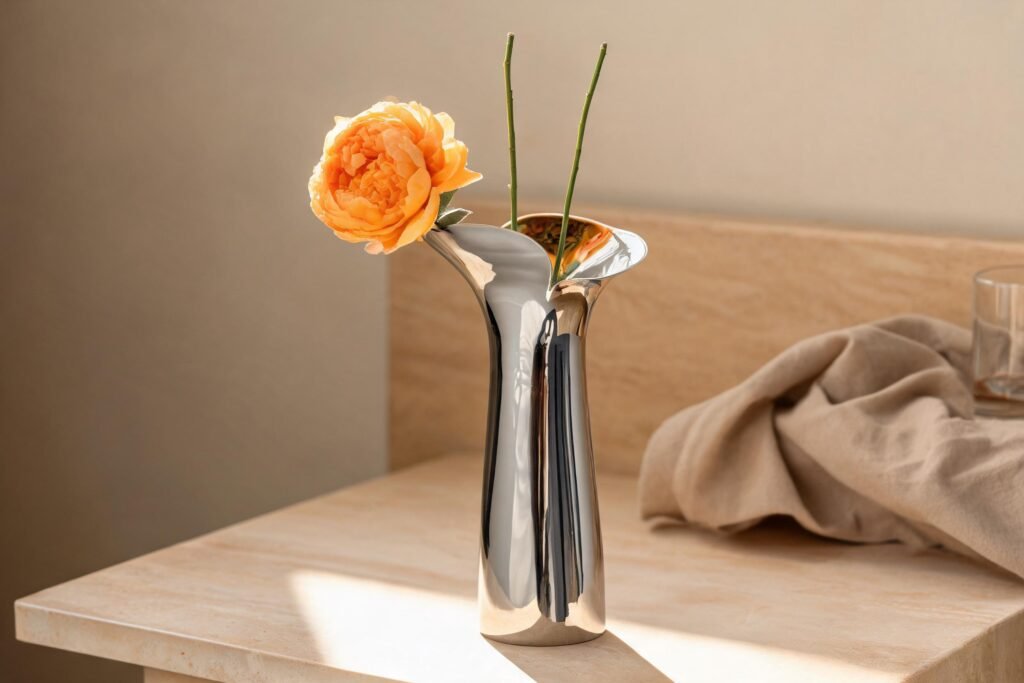
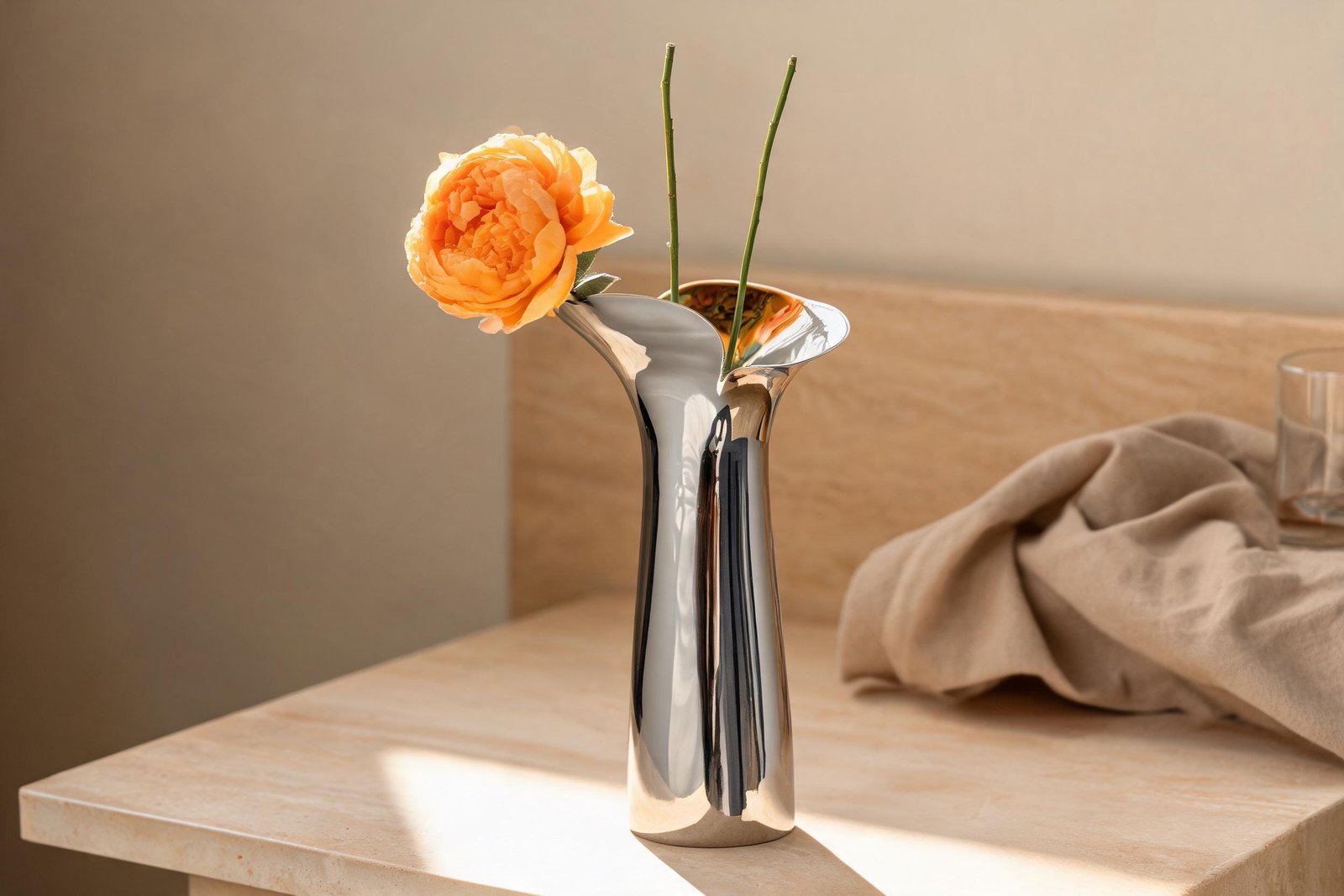
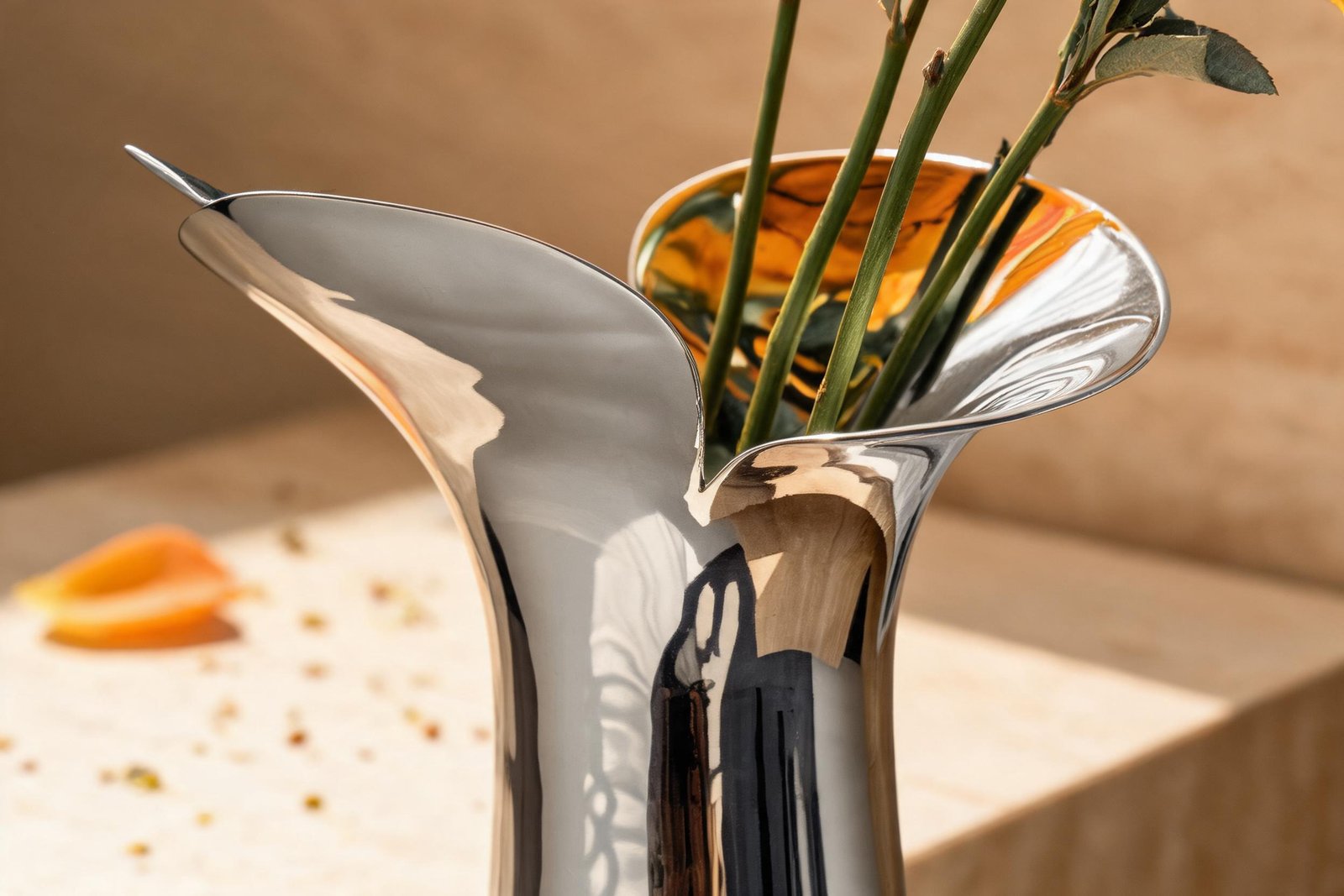
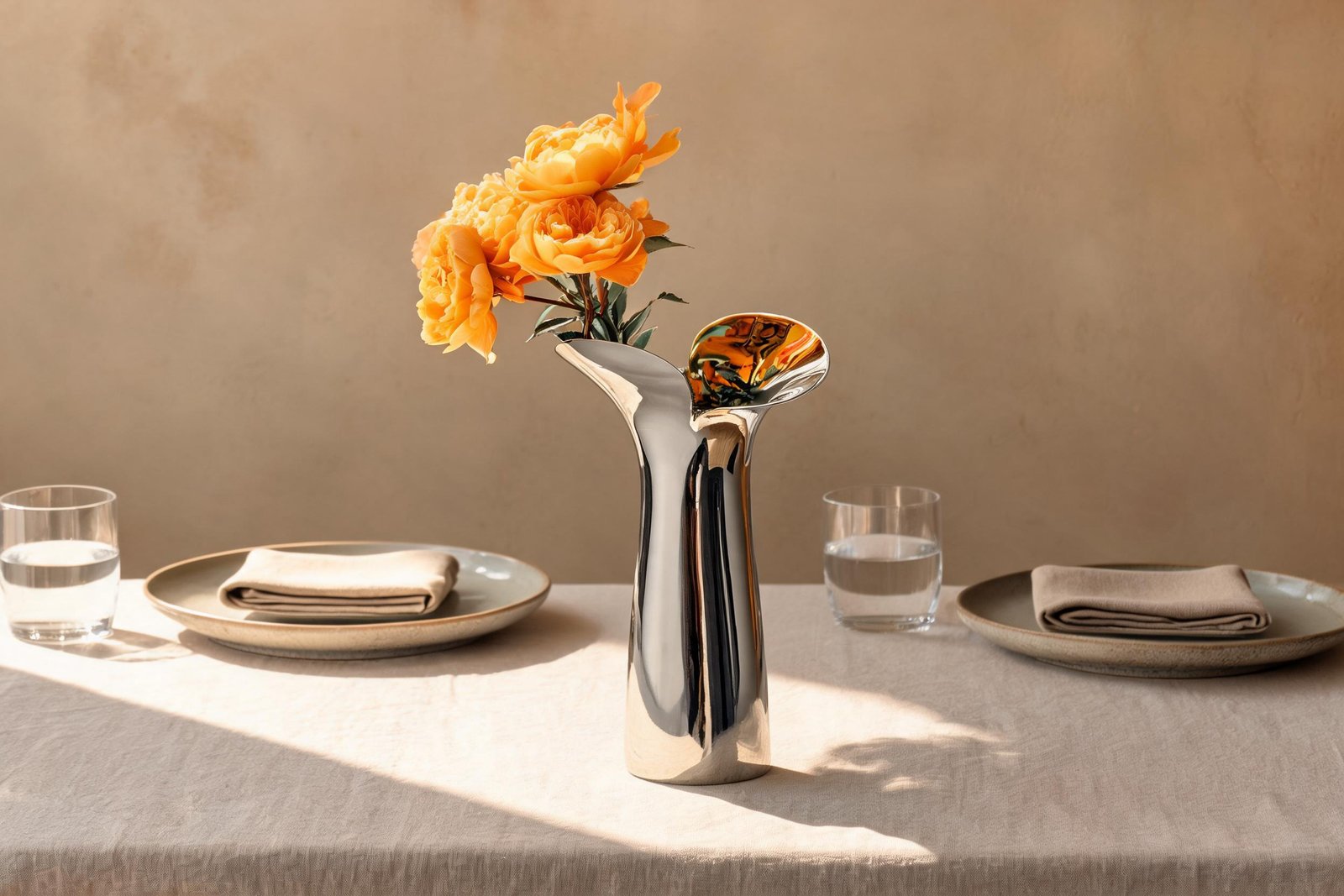
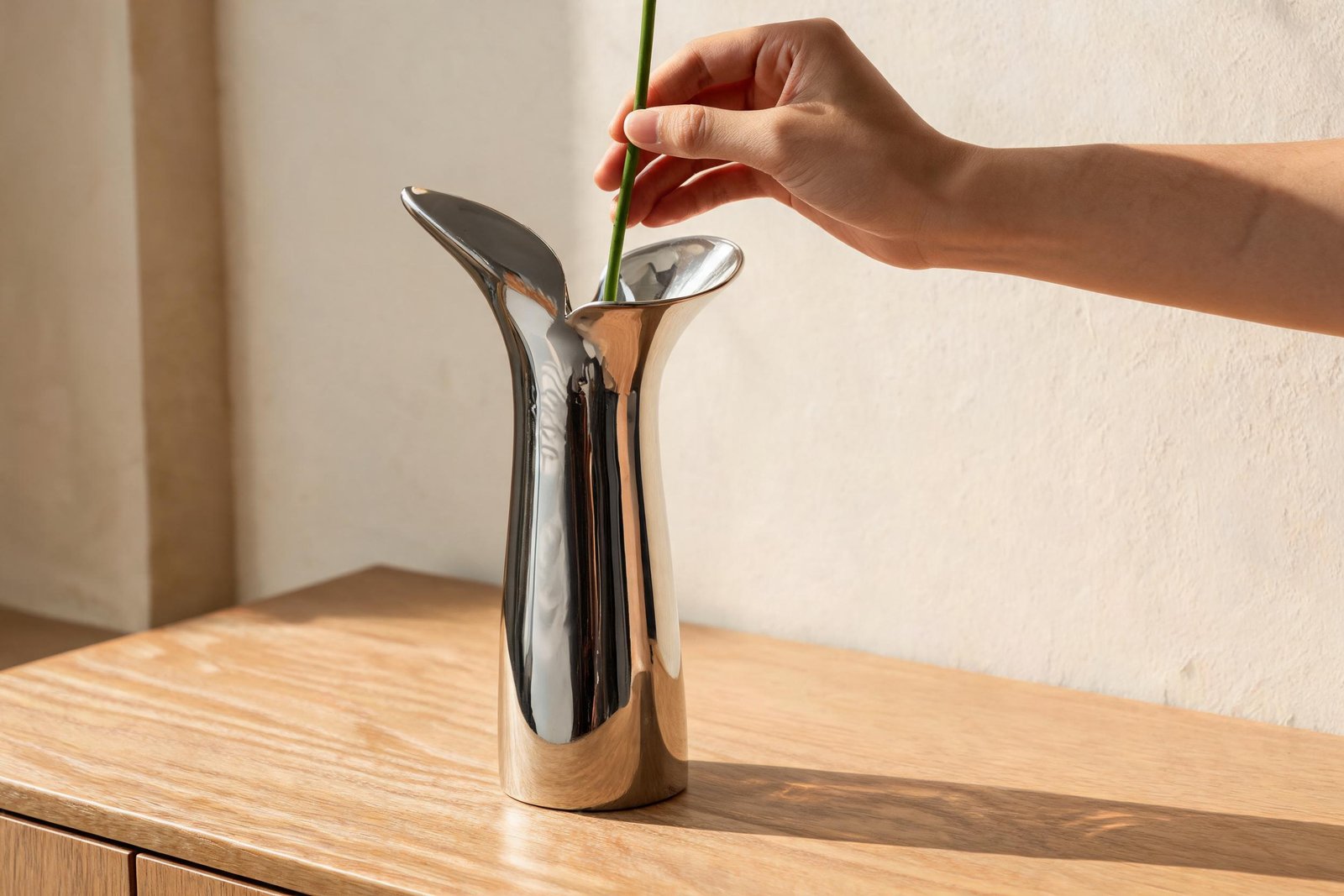
The Steel Petal Vase (JX-SSV-44) is built around exactly this question. Its rim is cut on a diagonal: one side rises into a single folded point, the other stays low and sweeps across, so the opening is a tilted oval rather than a circle. That shape holds a small bunch without a frog or a grid of tape, because the low side supports the stems while the high side keeps the heads from falling outward.
It comes in four vase mouth sizes — 14, 17 by 13, 21 by 22 and 32 cm — at heights of 22, 23, 26 and 28.5 cm. All four stay under the 30 cm sightline for a dining table, so the vase mouth size is the only variable that changes the arrangement. The body pinches into a waist and then opens again toward a plain flat base, which keeps the centre of gravity low; the mirror-polished finish reflects window light back into a dark corner, a practical benefit a matte ceramic vase does not offer.
It is not the right vase for a top-heavy bouquet, and it is not the right vase if you want twenty stems in one opening. It is the right vase for five to nine stems, one sculptural branch, or a single large bloom, and for anyone who would rather see the stems than hide them.
Shop the Steel Petal Vase here — $135, with the size selector on the product page.
For a narrower vase mouth size and a taller silhouette, the Ribbed Vase (JX-SSV-42, $121) takes three to five long stems through a 10 cm opening, and the smaller dining vase (JX-SSV-39, $115) suits a three-stem arrangement on a side table. Each product page carries the current price, the full specification and the care notes.
