

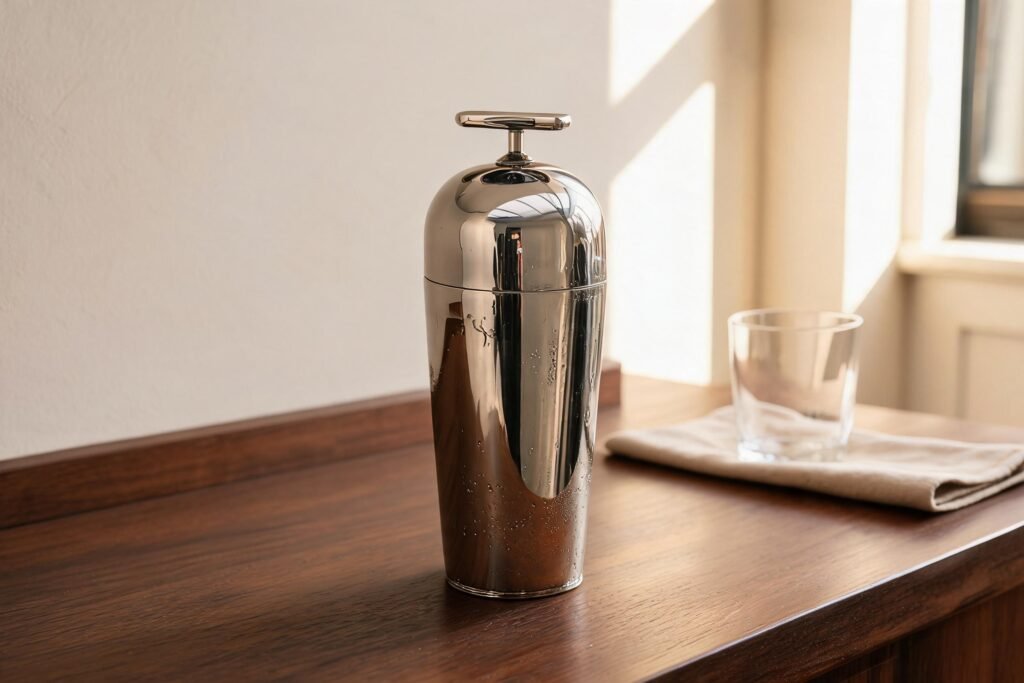
A cocktail shaker stuck shut is the least dramatic failure in a home bar and the most annoying. Nothing has broken. The lid has not been cross-threaded, because there are no threads. The drink cooled the air inside a closed steel can, and the outside air is now pressing the cap down harder than your hand can pull it up. The fix takes about twenty seconds once you know which part to move, and it starts by accepting that a cocktail shaker stuck shut is a pressure problem, not a strength problem.
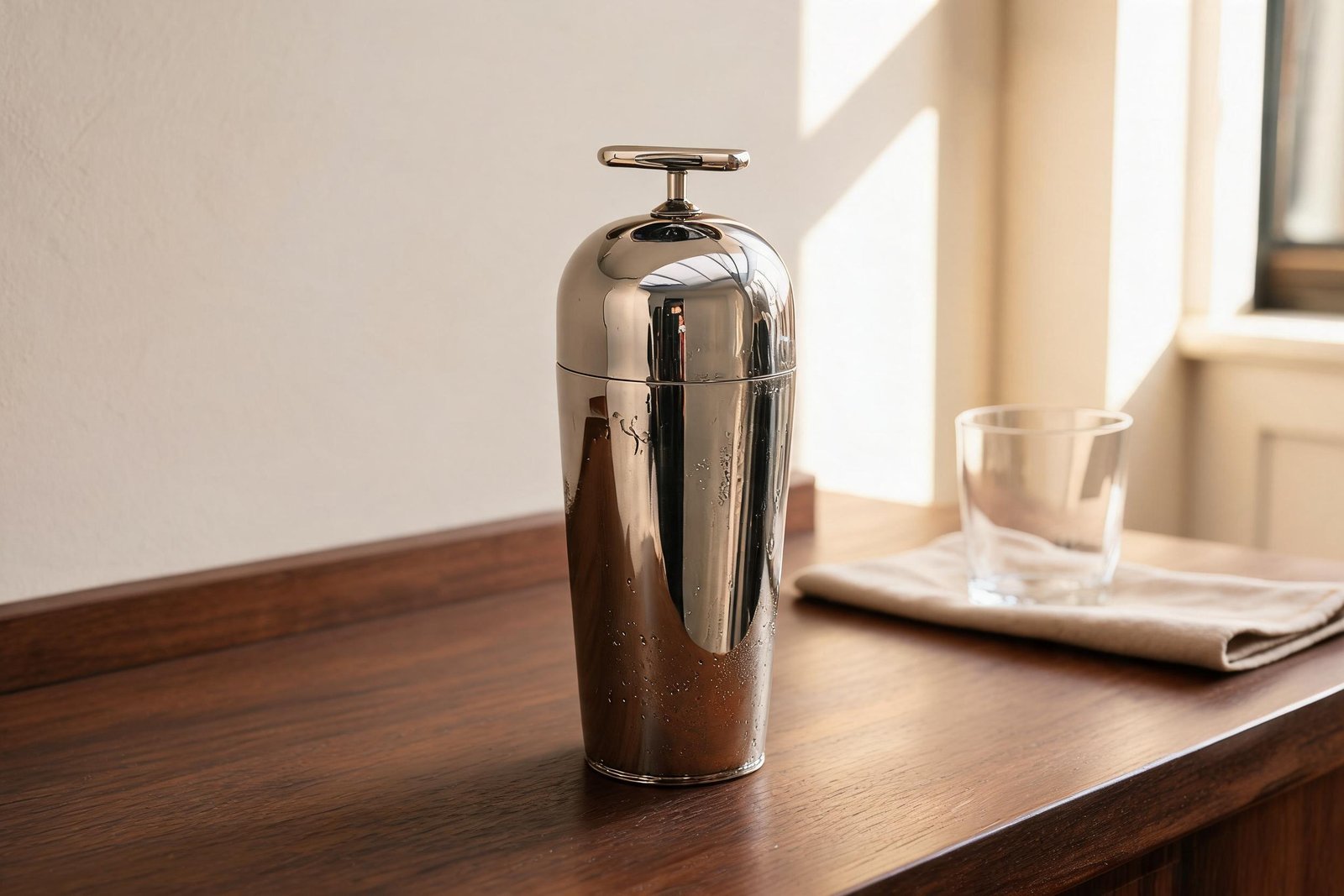
The Short Answer: A Cocktail Shaker Stuck Shut Is a Pressure Problem
A cocktail shaker stuck after a shake is held by pressure, not by muscle. Air trapped in the headspace cools from room temperature to below zero, the internal pressure drops by roughly 1.4 psi, and that difference arrives on top of a tapered friction fit that was already tight before you started.
Why Does My Cocktail Shaker Get Stuck?
It sticks because cooling shrinks the contents of a sealed metal can, which is why a cocktail shaker stuck shut is a pressure event rather than a torque event. The trapped air loses pressure, melting ice gives up volume, and the drink contracts as it chills. The cap is then held by a partial vacuum plus the taper of the joint, and the vacuum is what makes a lid feel welded on.
That answer surprises people who assume they twisted too hard. Tightness is a small part of it. Even one tightened with only two fingers will still lock if it is shaken for fifteen seconds with ice, and one hammered shut with the heel of a hand will usually open if the drink inside stayed warm. The pressure difference does the work, and it needs cold.
The same mechanism explains the second most common surprise: the cap comes off easily while the strainer section stays married to the body. Two joints, one vacuum, and the thinner joint wins. A cocktail shaker stuck on that lower joint rather than the cap is a geometry problem, not bad luck.
The Size Question Comes First: 26 cm, 9 cm and the Two-Thirds Line
Fit comes before physics here. Stuck behind a shelf you cannot clear is a different problem from stuck by pressure, and the first is easier to avoid. This shaker stands 26 cm tall including the cap and the T-bar handle, and it measures 9 cm across its widest point, so it needs a shelf gap of at least 26 cm and a counter spot about a hand wide. At 492 g it stays put on a wet counter while you shake.
Those outside numbers set how much goes inside, and they also decide how often a cocktail shaker stuck shut happens: overfill the tin and the ice has nowhere to go. Working from a 9 cm outside diameter and a wall of roughly a millimetre, the working space is about 8.4 cm across, an internal area near 55 cm². Fill to two-thirds of the height, the standard working fill, and you are using close to 890 ml of space counting the ice: two large cocktails or three small ones.
That fill line is not just about spills. A shaker packed to the rim has no room for ice to tumble, so it dilutes unevenly and loads the taper. A cocktail shaker stuck at the end of the night is usually one that was filled to the top, then shaken hard.
Three Things Shrink at Once Inside a Sealed Tin
Three volume changes run at the same time during a shake, and all three pull the pressure down, which is why no single trick reliably frees a cocktail shaker stuck on a joint. They are worth separating because each one suggests a different prevention, and because most advice online collapses them into one vague sentence about cold metal shrinking.
Cold Air Loses Pressure
Air in the headspace starts at room temperature and is chilled by contact with the ice and the cold walls. Cool a fixed mass of gas in a fixed volume and the pressure falls in proportion to absolute temperature. A drop from 25 °C to −5.7 °C takes the air from 298 K to 267 K, a loss of about a tenth of its pressure.
Melting Ice Gives Up Volume
Ice is less dense than water, which is why it floats and why a full glass of ice does not overflow as it melts. Ice at 0 °C runs about 0.917 g per ml, so 63 g of ice occupies roughly 69 ml; melted, the same 63 g takes 63 ml. Every shake ends with a slightly smaller pile of solid and liquid than it started with, and the space left behind must be filled by air at lower pressure, which is the second reason a cocktail shaker stuck feels heavier than it did a minute earlier.
Cold Liquid Takes Less Space
Spirit contracts as it chills, much like any liquid. The effect is smaller than the other two but points the same way. In the worked example below, drink plus ice shrank by about 8 ml over a 13.5 second shake, and that 8 ml is the entire margin the trapped air gains. Small margins are enough to leave a cocktail shaker stuck on the counter.
What Cocktail Shaker Pressure Adds Up To
Cocktail shaker pressure is not the pressure of a shaken soda can. It is the opposite: a partial vacuum of about 1.4 psi below the room, roughly a tenth of an atmosphere. You feel suction, not a lid about to blow. That direction matters, because it tells you to press down and twist rather than pull harder.
The Numbers: 1.37 psi and About 6 kg of Extra Grip
The measurement most often quoted comes from Dave Arnold at Cooking Issues, who modelled a sealed 842 ml shaker can holding 100 ml of 80 proof vodka at 25 °C and 172 g of ice at 0 °C. The ice takes up 188 ml, leaving 554 ml of air. After a 13.5 second shake the drink and the air inside sit at −5.7 °C and 63 g of ice has melted. Run the gas law and the pressure should fall by about 1.7 psi; his gauge read 1.37 psi, which is the figure quoted in nearly every thread about a cocktail shaker stuck on a Boston tin.
Scale that to a 9 cm lid and the arithmetic is short. A 9 cm circle covers 63.6 cm², or 0.0064 m². Multiply by 1.37 psi, which is 9,446 pascals, and the pressure difference pulls with about 60 newtons: a bit over 6 kg of steady load, before the friction of the taper is counted. That is why a cocktail shaker stuck for ten minutes usually means a tired hand rather than a broken shaker. His 8.1 cm can needed roughly 13.6 lb to separate, which lands in the same place.
| Quantity | Value in the worked example | Why it matters at home |
|---|---|---|
| Headspace air | 554 ml from 842 ml total | More air means a bigger pressure drop |
| Shake time | 13.5 seconds | Shaking 30 seconds adds little more cooling |
| Final drink and air temperature | −5.7 °C | Below freezing, normal for a wet shake |
| Ice melted | 63 g | Dilution, and the volume loss that follows |
| Pressure change | 14.7 psi down to 13.33 psi | −1.37 psi, about a tenth of an atmosphere |
| Force on a 9 cm lid | ≈ 60 N, about 6 kg | The number your wrist is arguing with |
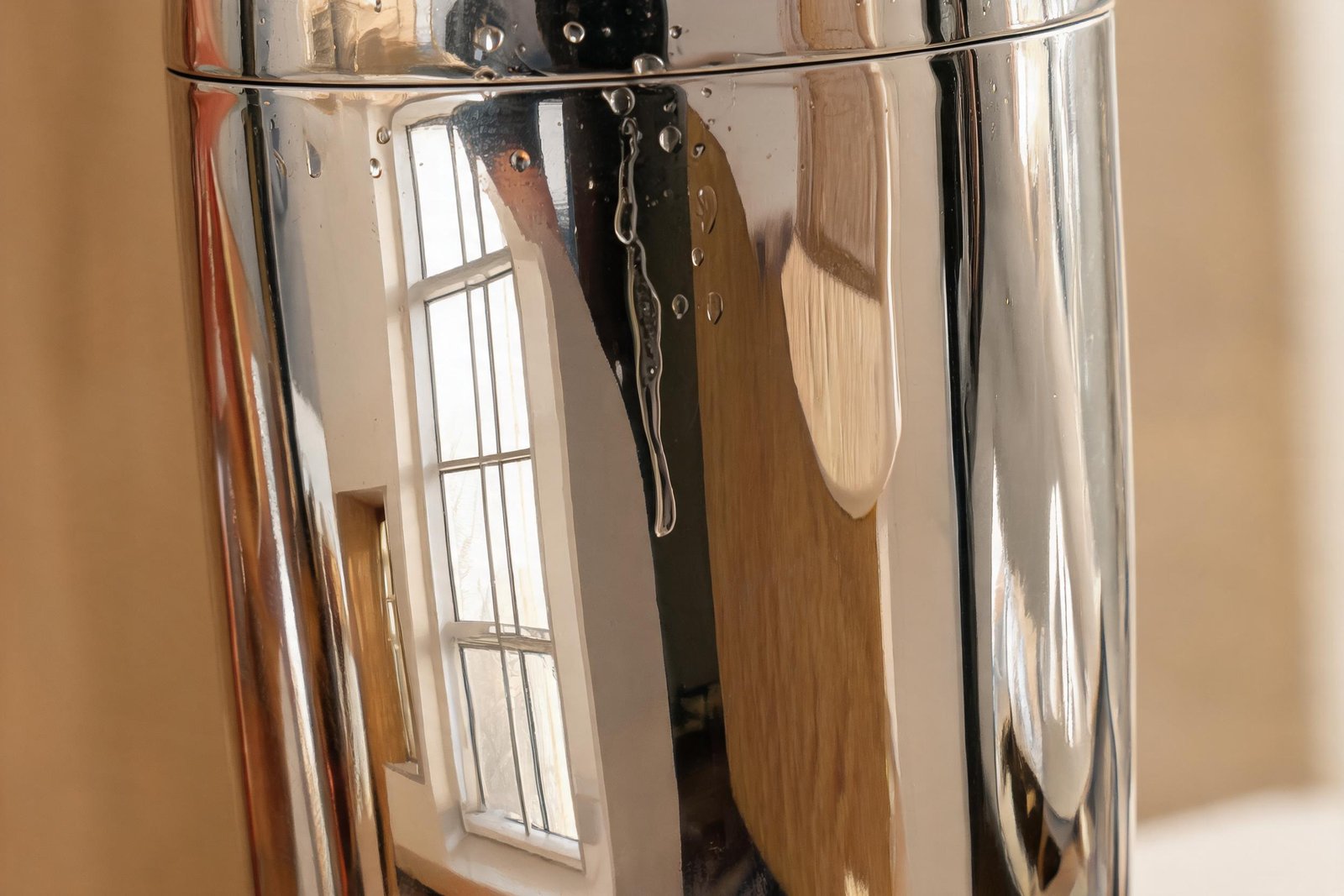
Anyone who has fought a cocktail shaker stuck for ten minutes will recognise those six kilos. It is why a wet hand slips and why patience beats force.
Cocktail Shaker Stuck After One Drink? The Taper Is Doing the Locking
A cocktail shaker lid stuck after a single drink is usually a taper problem wearing a vacuum as a disguise. Every cobbler shaker, this one included, is a set of cones: the strainer section sits into the body on a shallow taper, and the cap sits onto the strainer on a second taper. Steel on steel with a film of chilled liquid is a friction joint, and friction joints tighten in one direction only.
The joint is also thin, which is why a three-piece shaker punishes impatience. The strainer skirt is a thin ring, so a little misalignment wedges it and a little syrup glues it. That is how a cocktail shaker stuck shut happens even when the cap was barely tightened.
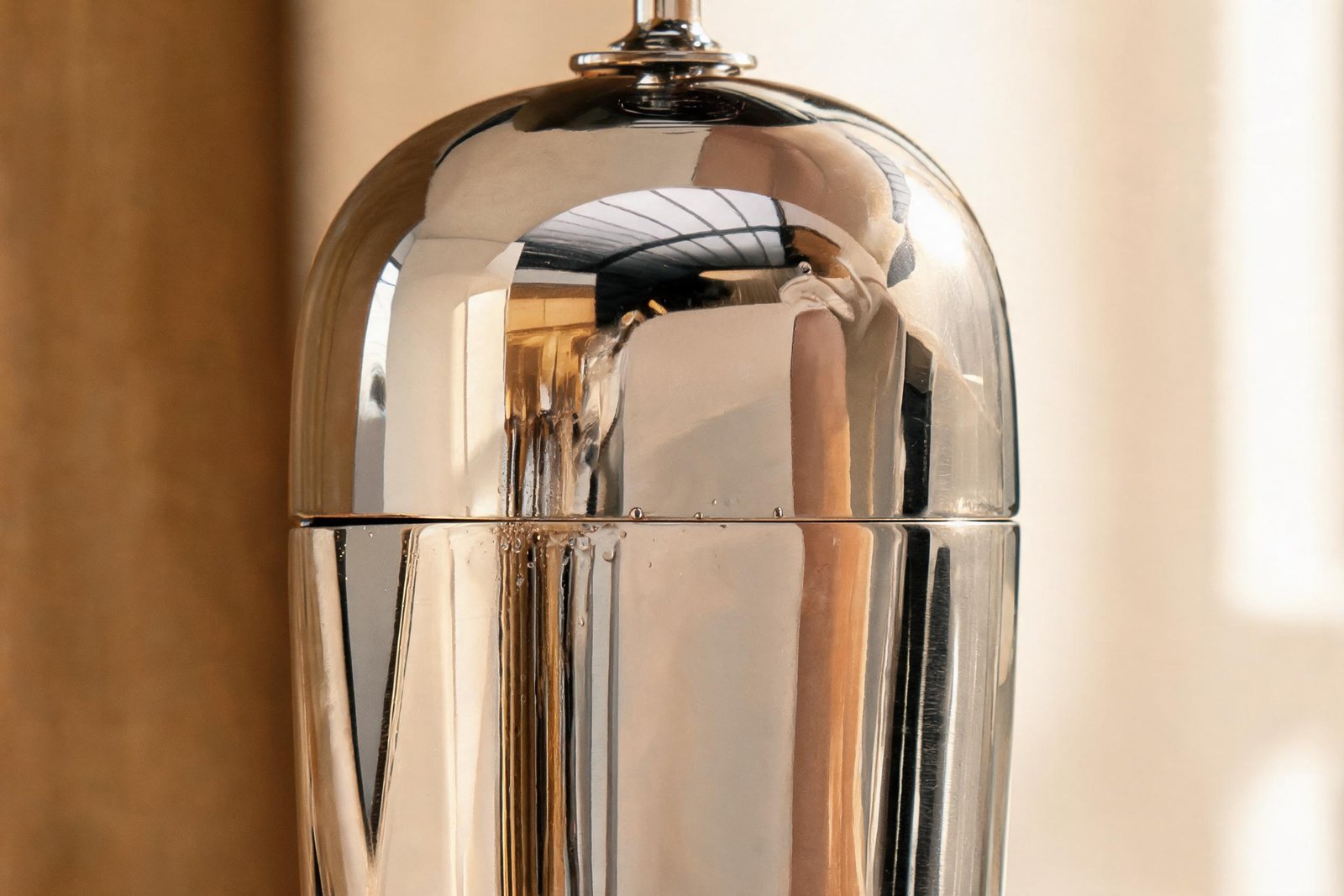
One popular explanation does not survive the arithmetic. Cold metal contracting around the lid sounds right and contributes almost nothing. Stainless steel expands about 17 parts per million per kelvin, so cooling a 9 cm joint through 30 K changes its diameter by less than five hundredths of a millimetre. That is a fraction of a human hair, against a wedge that bites by millimetres. The metal is not gripping you; the air is, and that is why a cocktail shaker stuck shut does not care how strong your forearm is.
How to Open a Stuck Cocktail Shaker in Under a Minute
Work in this order and stop as soon as it gives. Pulling first is the instinct and the worst move, because a cocktail shaker stuck by vacuum will come apart in under a minute if you stop pulling and unload the taper instead.
- Put it down and stop pulling. Set the shaker upright on a stable counter and take your hands off it for a second. A straight pull raises the normal force on the taper, and friction rises with it.
- Tap the shoulder seam, not the top. With the heel of your hand, give two or three short sharp taps at the seam where the dome meets the body, turning a quarter turn between taps. The aim is to flex the outer ring for a fraction of a second, not to beat the lid off.
- Press down, then turn. Rest one palm flat on the T-bar, press down a few millimetres to unload the taper, then twist anticlockwise while lifting. Down before up is the whole trick.
- Warm only the outside. If it still holds, run warm tap water over the outer part for ten to fifteen seconds and keep the cap out of the stream. The outer ring grows, the inner part stays cold, and the joint loosens. Hot water on both halves does nothing, because both sides grow together.
- Soak a sugar lock. If syrup, liqueur or citrus pulp went into the joint, tapping will not help. Stand the joint in warm water for ten minutes, then repeat step 3.
- Never lever it. A knife blade, a screwdriver or the edge of the counter opens the shaker and ruins the seal at the same time. Once the taper is dented, the joint leaks for good and the piece becomes a vase, which is how a cocktail shaker stuck in the first week becomes a permanent leak in the third.
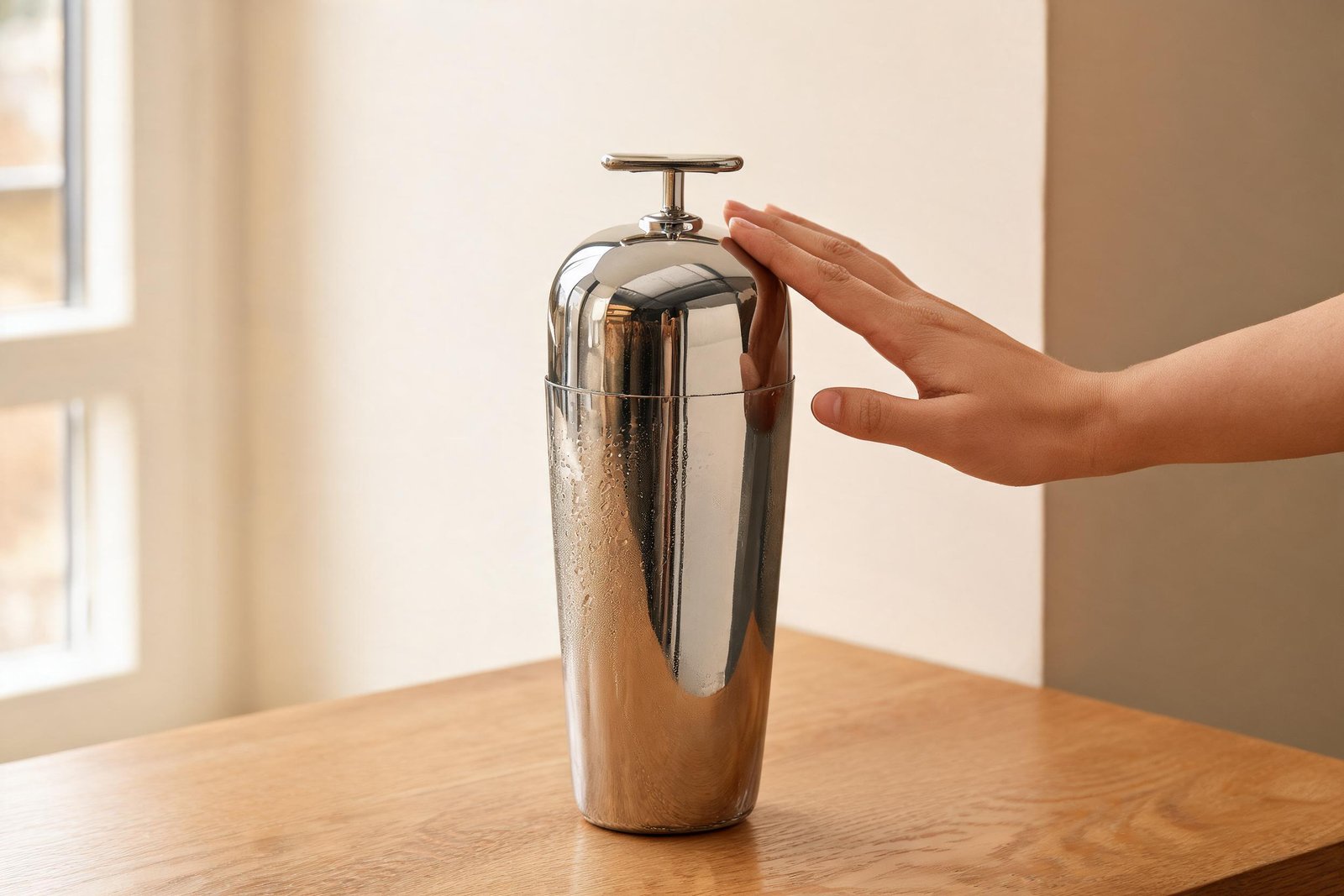
A warm cloth on the seam is the gentlest version of step 4 and the one to try first on a mirror finish, because a hot stream on polished steel leaves mineral marks that then need polishing out. Most cocktail shaker stuck cases give way at step two or three, before water is needed.
How to Prevent a Cocktail Shaker From Sticking
Prevention is three habits and one piece of discipline, and none of them cost anything: far cheaper than learning to free a cocktail shaker stuck at midnight with guests waiting.
Seat it dry, and seat it once. Wipe the taper before the cap goes on. A film of water or syrup turns a friction fit into a glued fit. Set the cap with a light press and a quarter turn, never with the heel of your hand.
Fill to two-thirds and no further. Ice needs room to move. A tin filled to the rim dilutes unevenly and jams the taper from the inside.
Break the seal between rounds. If you are making four drinks, open the shaker fully between each one, even when reusing the same ice. A joint opened while still cold and wet comes apart easily.
Open it while it is still cold. The lock is strongest in the first minute. Ten minutes on the counter warms the air, which relaxes the vacuum, and this is why a cocktail shaker stuck at seven sometimes opens by itself at nine, the vacuum letting go rather than the jam being permanent.
| What a stuck cocktail shaker feels like | What is actually happening | What to do |
|---|---|---|
| Cap turns freely but will not lift | Vacuum plus a shallow taper, no glue | Press down, then twist anticlockwise |
| Cap and strainer come off as one piece | The lower joint is the tighter of the two | Tap the body seam, then warm the outer ring |
| Nothing moves at all, even warm | Sugar, syrup or dried citrus in the joint | Soak the joint in warm water for ten minutes |
| Lid released a hiss when it opened | Air was drawn in past a worn taper | Check the joint for a dent or a burr |
A cocktail shaker stuck for any other reason is rare enough to justify a message to the seller: a bent rim, a burr on the skirt, or a joint machined out of round.
Three-Piece or Two-Piece: Which One Actually Locks Up
A three-piece cobbler shaker like this one gives a built-in strainer and a clean pour, at the cost of two friction joints instead of one. A two-piece Boston tin has a single, much larger joint that is easier to break and needs a separate strainer. Neither is better in the abstract; they fail differently, and a cocktail shaker stuck on a cobbler is almost always stuck at the lower joint.
| Three-piece cobbler (this shaker) | Two-piece Boston or French | |
|---|---|---|
| Joints that can jam | Two tapers | One large taper |
| Where it jams | Usually the lower strainer joint | Where the tin meets the glass or cap |
| Opening method | Tap the shoulder, press and twist | One sharp heel-of-hand tap at the seam |
| Strainer | Built in, fine holes | Separate Hawthorne or Julep strainer |
| Best for | Two to four drinks, one clean pour | Batches, crushed ice, speed |
| Weak point | Clogs on crushed ice and pulp | Needs a second tool and a steady hand |
Does a Heavier Shaker Open Easier?
No. Weight changes how a shaker feels and how steadily it sits, but not the pressure difference across the lid or the angle of the taper. A 492 g shaker opens no harder than a 300 g one of the same design, so buying weight to cure a cocktail shaker stuck problem is money spent on the wrong thing.
What mass does buy is control: it absorbs the wobble in a fast shake, keeps the base planted on a wet counter, and the thicker wall resists the small dents that eventually turn a taper into a leak. A short T-bar adds grip where the cap is smallest, which matters with cold, wet hands and turns a cocktail shaker stuck on the cap into a two-finger job.
Where This Shaker Fits and Who Should Skip It
The honest limits first. A three-piece cobbler is the wrong tool for crushed ice in volume, because the fine strainer holes clog; the wrong tool for eight drinks at once, because the cap is small and your hands will be slippery by the fourth; and the wrong tool for anything carbonated, since CO2 leaves solution and turns the vacuum into pressure, which is why prosecco and tonic are built in the glass instead.
Within those limits, this is the shaker for a two-drink Friday and a four-drink dinner, and a cocktail shaker stuck on this dome is easy to reach because the T-bar sits above your palm. The mirror finish can stay on the counter, the 26 cm height clears a standard shelf gap, and 492 g keeps it steady one-handed. The dome seats with a light press, so the joint that locks is the one you can reach with your palm, and a cocktail shaker stuck here rarely needs more than one tap.
If you want the same physics with a different hand feel, our slanted 22 cm steel shaker is shorter and squatter for smaller hands, and the tiered three-stage shaker puts the strainer in a taller stack for longer pours. Both are cobbler designs with the same two-joint geometry, so the rules here apply unchanged and a cocktail shaker stuck on either one frees the same way.
For the working capacity behind those recommendations, the cocktail shaker size guide covers fill lines and drink counts, and the strainer and batching guide covers what a built-in strainer will and will not pass. If you are building a bar around the shaker, the stainless steel collection holds the ice buckets and trays that go with it, and the ice bucket size guide settles how much ice a table of six needs.
Shop the Mirror Stainless Steel Shaker (JX-SSSR-159) here. It is $161, it stands 26 cm on a 9 cm base, and it weighs 492 g. The product page carries the current price, the full specification and the care notes, including the finish care that keeps a mirror surface from clouding.
FAQ
Is a stuck martini shaker lid the same problem?
Yes, with one variation. A martini shaker lid stuck after a wet shake is the same vacuum on a taper, but the smaller cap gives your fingers less leverage. Press down with the flat of your palm before twisting, and tap the joint rather than the cap; a cocktail shaker stuck on a small cap usually gives within a few seconds.
How do you open a frozen cocktail shaker?
Treat frozen as stuck and skip the freezer instincts: a cocktail shaker stuck in the freezer is colder, tighter and harder to open. Warm the outer joint under running tap water for ten to fifteen seconds, then press down and twist anticlockwise. Never put a sealed shaker in the freezer to loosen it, and never pour boiling water over it, because the shock is hard on a mirror finish.
Why does a cobbler shaker stick more than a Boston shaker?
A cobbler has two tapered joints; a Boston has one large one. The second joint sits just above the liquid line, so it collects chilled syrup and pulp, and its thin skirt flexes unevenly when seated at an angle. More joints, more chances to jam, which is why a cocktail shaker stuck on the lower taper is the common case rather than the exception.
Can a cocktail shaker stuck shut be avoided completely?
Not completely, because the vacuum is a consequence of cooling a sealed can. You can make it rare by seating the joint dry, filling to two-thirds, and opening the shaker between rounds. That is usually enough to go months without a jam.
Does warm water damage a mirror-polished shaker?
Warm tap water is fine. Boiling water, harsh descalers and abrasive pads are not, because they dull the polish and leave mineral rings. Dry the joint with a soft cloth after washing, and leave the shaker open until it is completely dry before the cap goes back on.
A cocktail shaker stuck shut is a cooling problem with a mechanical symptom, and once the two joints and the pressure difference make sense, a jam stops being a crisis. Dry the taper, fill to two-thirds, tap the shoulder before you twist, and a cocktail shaker stuck shut becomes a twenty-second delay instead of a ruined evening.
