

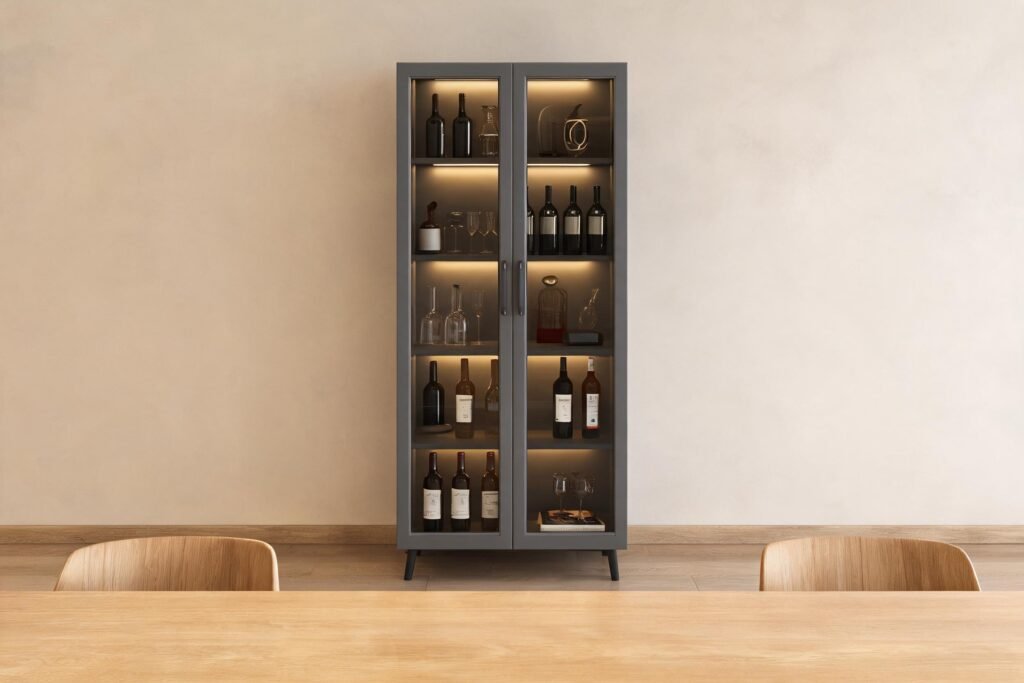
Display cabinet depth is the measurement that decides whether a cabinet ends up holding wine or only china, and it is the one number most listings put last. A cabinet sold as 40 cm deep measures 40 cm from the back panel to the outside face of the door. The shelf inside it measures about 36 cm. A 750 ml Bordeaux bottle is 30 cm from base to cork, so it lies neck out with 6 cm to spare, and it stands upright if the shelf above leaves 33 cm of clear height. Those three sentences settle most of the display cabinet depth question; what follows is the arithmetic behind them and the places where it gets tight.
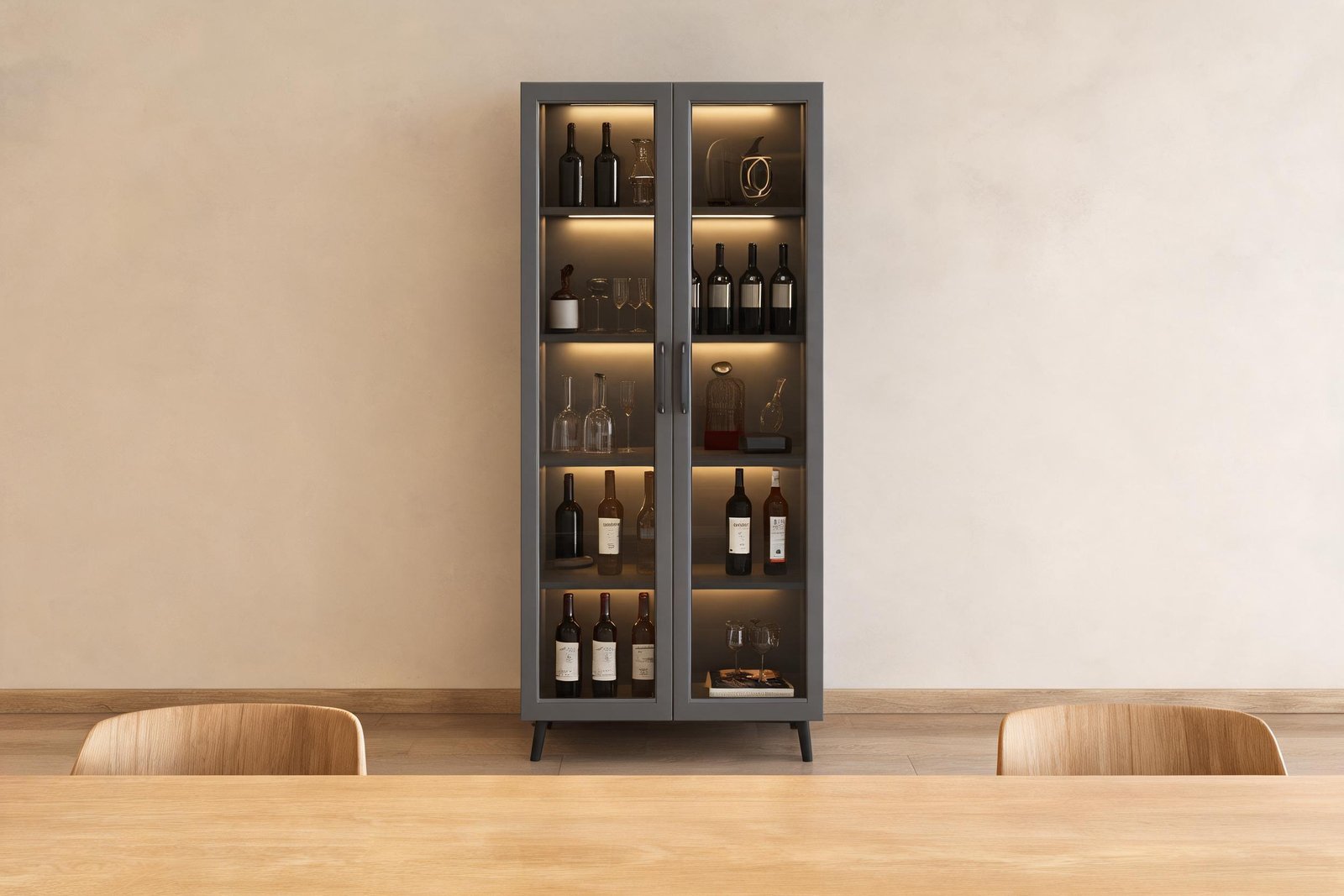
Four numbers decide the purchase, in this order: usable display cabinet depth, the clear height between shelves, the room the glass doors need when they open, and how many bottles the width can hold. Get them in that order and the cabinet does the job it was bought for.
What Display Cabinet Depth Do You Actually Get?
A display cabinet depth of 40 cm gives 36 to 37 cm of usable shelf. Take off a 9 mm back panel, a 15 to 18 mm carcass and the 2 cm a framed glass door takes at the front, and 40 cm becomes 36 cm of flat shelf where objects actually stand.
That 4 cm loss is not a defect, it is how cabinets are built, but it changes what fits at any display cabinet depth. The table below runs the same subtraction across the display cabinet depth options sold today, with a standard Bordeaux bottle as the test object.
| Advertised depth | Usable shelf depth | Bottle laid neck out (30 cm) | Bottle standing (30–33 cm) | What the depth is good for |
|---|---|---|---|---|
| 30 cm | 26 cm | No, cork stands proud of the shelf edge | Yes, if the bay is 33 cm | Glasses, small objects, spirits only |
| 35 cm | 31 cm | Short bottles only, 30–31 cm | Yes | Display first, wine second |
| 40 cm | 36 cm | All 750 ml bottles, 6 cm spare | Yes, tight for sparkling | Mixed display and wine |
| 45 cm | 41 cm | Magnums at 36–38 cm | Yes | Generous, costs floor space |
| 50 cm | 46 cm | Wooden cases and boxes | Yes | Deep storage, the back row disappears |
Depth is not the same thing as usefulness. A 50 cm cabinet stores more and shows less: the back 15 cm becomes the place objects go to be forgotten, and the light strip under each shelf reaches the front row far better than the back. Forty centimetres is the display cabinet depth where a bottle lies down safely and a row of glasses still reads as a row rather than a queue.
Do Wine Bottles Fit in a 40cm Deep Display Cabinet?
Yes, on two conditions: the bottle lies neck out, and the shelf has something to stop it rolling into the door. Bordeaux at 30 cm and 7.6 cm across, Burgundy at 31 cm and 8.1 cm, Champagne at 32 cm on an 8.8 cm body (the standard wine bottle dimensions are worth checking against your own shelf) all fit inside a display cabinet depth of 36 cm of usable shelf, with the neck facing the glass.
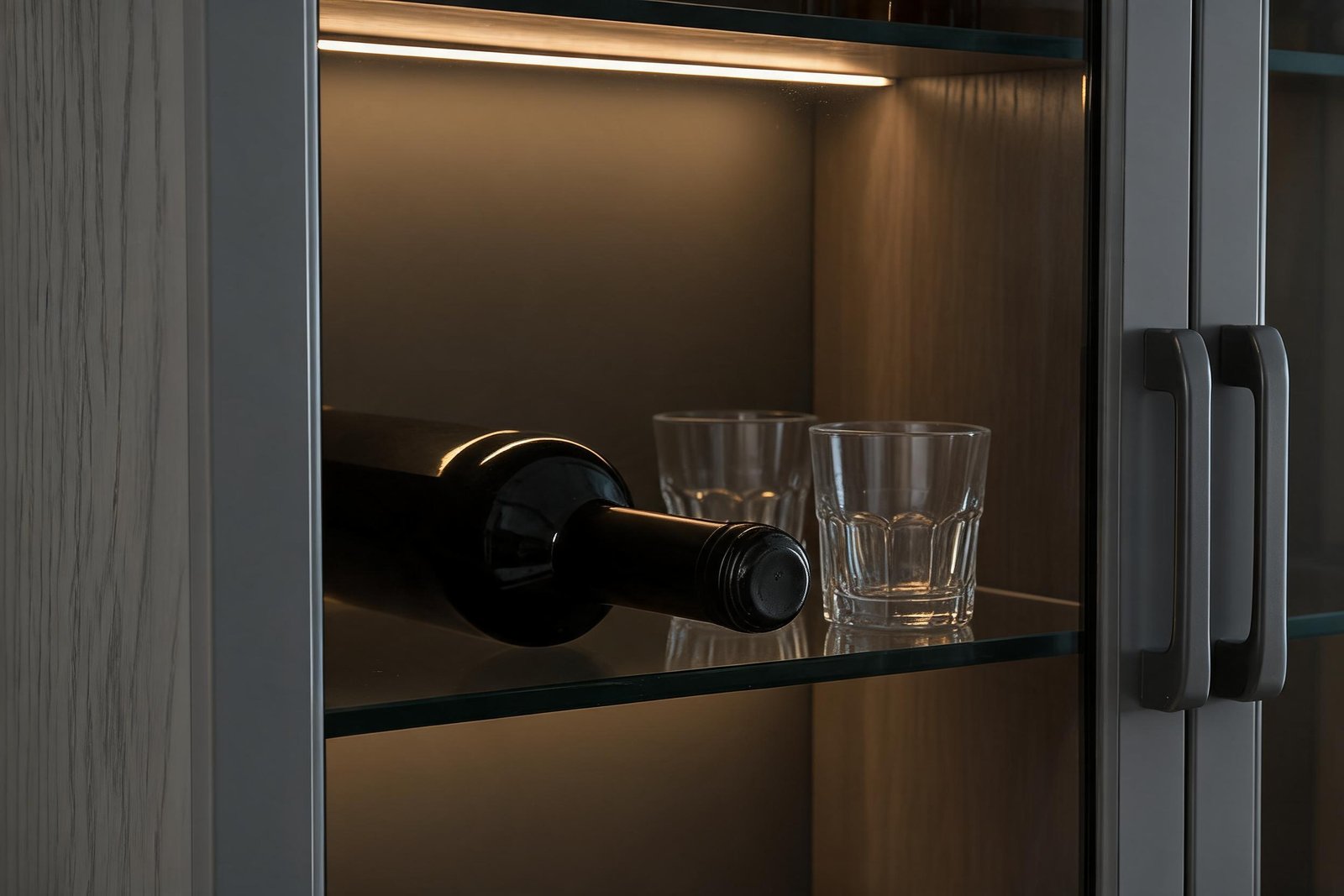
Standing up is the harder test and the one buyers miss. A standard bottle needs 33 cm of clear height. Every height in this cabinet range gives roughly 36 cm between shelves, so a Champagne bottle clears the shelf above by 2 cm and a magnum, 36 to 38 cm tall and 11 cm across, stands in none of them. No amount of display cabinet depth fixes that: the limit is the gap between shelves, not the floor of the shelf. Magnums lie down, or they live on the bottom level with the shelf above raised.
The shelves are flat tempered glass, not moulded cradles, and a bottle laid on flat glass needs a stop whatever the display cabinet depth is. A folded linen runner pushed against the front edge does the job. Cradles hold more bottles per shelf and look like a wine store; flat shelves let bottles stand up and let glasses share the level. Very few cabinets do both, which is the trade-off worth accepting before ordering rather than after.
Display Cabinet Dimensions: Width, Height and How Many Bottles
Width sets how many bottles fit across one shelf, height sets how many shelves exist. Those two display cabinet dimensions work as a pair, and neither one alone tells you the capacity. The clear height between shelves stays close to 36 cm whatever the overall height, so a taller cabinet adds levels instead of more room per level.
| Size (W x H x D) | Shelves | Usable width | Bottles per shelf (8 cm pitch) | Bottles if two levels go to wine |
|---|---|---|---|---|
| 60 x 90 x 40 cm | 2 | 56 cm | 7 | 14 |
| 70 x 125 x 40 cm | 3 | 66 cm | 8 | 16 |
| 70 x 160 x 40 cm | 4 | 66 cm | 8 | 16 |
| 80 x 195 x 40 cm | 5 | 76 cm | 9 | 18 |
An 80 cm wide cabinet five levels tall would hold 45 bottles if every level went to wine, and nothing else. That is the failure mode of a wine-only plan in a dining room: 45 bottles is more than most households open in two years, and the piece stops being a display cabinet and becomes a rack with glass in front of it. With the same display cabinet depth, two wine levels plus three levels of glassware and objects is the split that keeps it useful.
Display cabinet dimensions also decide whether the piece reads as furniture or as a wall unit, and the display cabinet depth has to be judged in the room it will stand in. At 195 cm tall the cabinet reaches most of the way up a 240 cm wall and needs 210 cm of ceiling to be lifted into place. At 125 cm it sits under a picture or a mirror, and the top surface becomes usable for a tray of glasses during a party.
How Deep Should a Display Cabinet Be for Glassware and Objects?
For glassware, deeper is better up to a point. A wine glass base is 7 to 8 cm across, so 36 cm takes four rows front to back, and a stemmed glass 20 to 24 cm tall uses most of the bay height. For small objects the same display cabinet depth works against you: anything under 12 cm tall sits in shadow at the back of a 36 cm shelf.
Two ways to use that. Step the back row up on a low riser so it reads above the front row, or keep the front 20 cm for small pieces and put tall objects at the back, where their height carries them over the row in front. Lighting does the rest of the work: an LED strip under each shelf at 3000 K throws light across the front third of the shelf and falls away toward the back panel, which is why the back row needs either height or its own light source regardless of display cabinet depth.
Glass Cabinet Depth: Door Swing and the Floor It Costs
The doors are the part of the measurement that people forget. Two hinged doors on an 80 cm model are about 39 cm wide each, and a door opened to 90 degrees projects 39 cm into the room on top of the 40 cm the carcass already occupies. Add the 50 cm a person needs to stand and reach inside and the working zone in front of the cabinet is 89 cm. Glass cabinet depth on its own says nothing about that; the swing does.
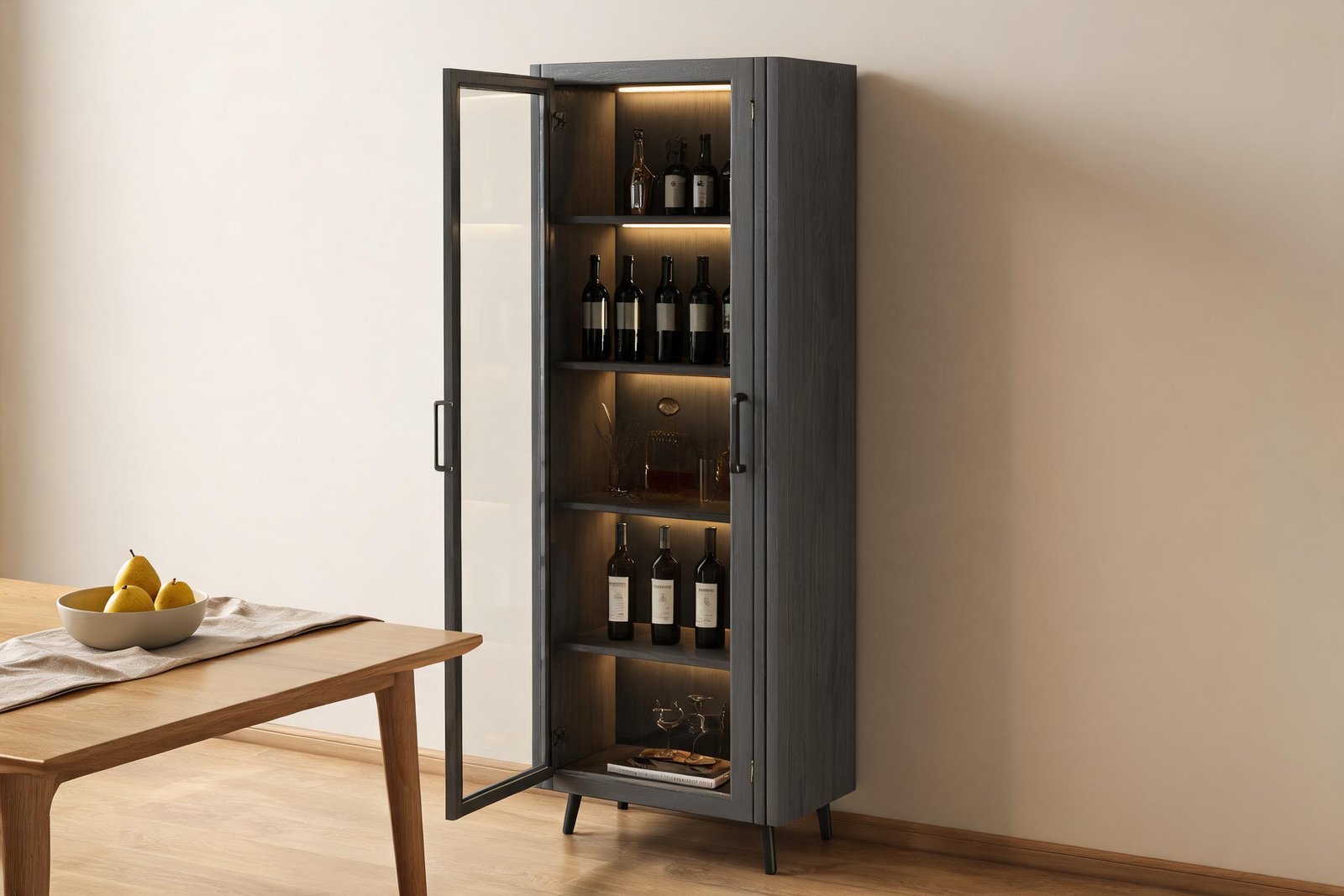
In a 100 cm walkway that leaves 11 cm to squeeze past an open door, which nobody does twice. Either keep 90 cm clear in front or place the cabinet at the end of a run, where the door opens along the wall instead of across a path.
Grey or white is the last decision, and taste is not the only input. White lifts the light level inside and makes the rim of a glass read clearly; grey hides dust between cleanings and gives dark bottles a background that keeps their labels legible. Against cream walls and oak floors grey sits calmer; against a white wall the white version disappears into it, which is sometimes exactly what a small room needs.
Wine Cabinet Dimensions: 90, 125, 160 or 195 cm
The four heights answer four different rooms. Ninety centimetres is sideboard height: the top becomes a serving surface, and the cabinet holds two levels. A hundred and twenty-five is half a wall, three levels, and it fits under artwork. A hundred and sixty is four levels and comes close to the ceiling in a modern flat. A hundred and ninety-five is a full wall of five levels and needs 210 cm of ceiling to stand up. Wine cabinet dimensions of this kind are really a question about the room.
Because the bay height stays at about 36 cm in all four, the height changes capacity and presence rather than the fit of a single bottle. A display cabinet depth of 40 cm behaves the same at 90 cm tall as at 195 cm; what changes is how much of the wall is covered and how many levels are available for wine. A 90 cm cabinet beside a dining table reads as furniture, and the same money spent on a 195 cm cabinet in a low room reads as a cupboard that does not fit.
The 40cm Deep Glass Display Cabinet in This Range
JX-WC-029 is the piece these display cabinet depth numbers were taken from: 40 cm deep, in twelve combinations from 60 x 90 cm to 80 x 195 cm, in grey or white. Each module carries two tempered glass doors in a slim frame, five adjustable levels, an LED strip under each shelf at warm 3000 K, and thin dark metal legs that lift the carcass clear of the floor.
The carcass is ENF-grade engineered wood board — the strictest formaldehyde emission class in China’s national standard (≤0.025 mg/m³), stricter than the E0 class usually quoted by furniture sellers — finished in a wood grain that resists daily wear. The glass doors are noticeably heavier than panel doors and account for much of the price gap between this and a plain cupboard; tempered glass is what makes that weight worth carrying. They also show fingerprints, so a microfibre cloth belongs on the list with the cabinet.
Two practical notes before ordering. The cabinet arrives flat packed and needs full assembly, including door alignment, which is a two person job. The shelves are adjustable rather than fixed, so the 36 cm bay can be re-cut: drop one shelf and a 45 cm bay opens up for a decanter or a magnum, at the cost of a 27 cm bay above it. That kind of adjustment is the reason a fixed display cabinet depth is workable in more than one room.
Prices run from $295.68 for the 60 x 90 cm to $855.68 for the 80 x 195 cm, in both colours. For a full wall run, see the modular wine wall system (JX-WC-024) here at $577.92: a wine wall with full-length rebound glass doors that takes the same bottle arithmetic along the whole wall instead of one bay.
If bottles are half the point, see the 40 cm deep glass display cabinet (JX-WC-029) here. The product page carries the current price of $295.68 for the smallest size, the full twelve-size list, the colour options and the assembly note, so the display cabinet depth can be matched to your own wall before delivery. The rest of the range sits in the display cabinets and wine cabinets category, where depth and height are listed per model.
Frequently Asked Questions About Display Cabinet Depth
Is a 40 cm display cabinet depth enough for wine bottles?
Yes for standard 750 ml bottles laid neck out: 36 cm of usable shelf against a 30 to 32 cm bottle. Magnums at 36 to 38 cm do not lie flat in every model, and none stand upright in a 36 cm bay.
What display cabinet depth holds the most bottles?
The width decides that more than the depth. At 40 cm, seven bottles per shelf in a 60 cm cabinet, eight in a 70 cm and nine in an 80 cm, allowing 8 cm per bottle with a small gap.
Can a glass display cabinet hold glasses and bottles together?
Yes, and that is what the depth is for. Bottles lie on the lower two levels, where the weight is low, and glasses go above them, where the light strip reaches them and the shelves carry less.
Does a glass door need clearance in front?
About 39 cm of swing on an 80 cm model, plus 50 cm to stand in. Keep 90 cm clear in front, or place the cabinet where the door opens along a wall instead of across a walkway.
How deep should a display cabinet be in a narrow room?
Thirty-five centimetres is enough for objects standing up and for glasses, but not for a bottle laid down. In a room under three metres wide that saving usually matters more than the wine capacity.
Before You Order
Four numbers decide a display cabinet depth question: 36 cm of usable shelf, 33 cm of clear height for a standing bottle, 39 cm of door swing, and 8 cm of width per bottle. Measure the wall, then the walkway, then check the bottle you actually drink. The ice bucket for a bar cart guide runs the same arithmetic for the serving end of the room, and the ice bucket sizes guide covers how much ice a cabinet this size is likely to be serving beside.
