

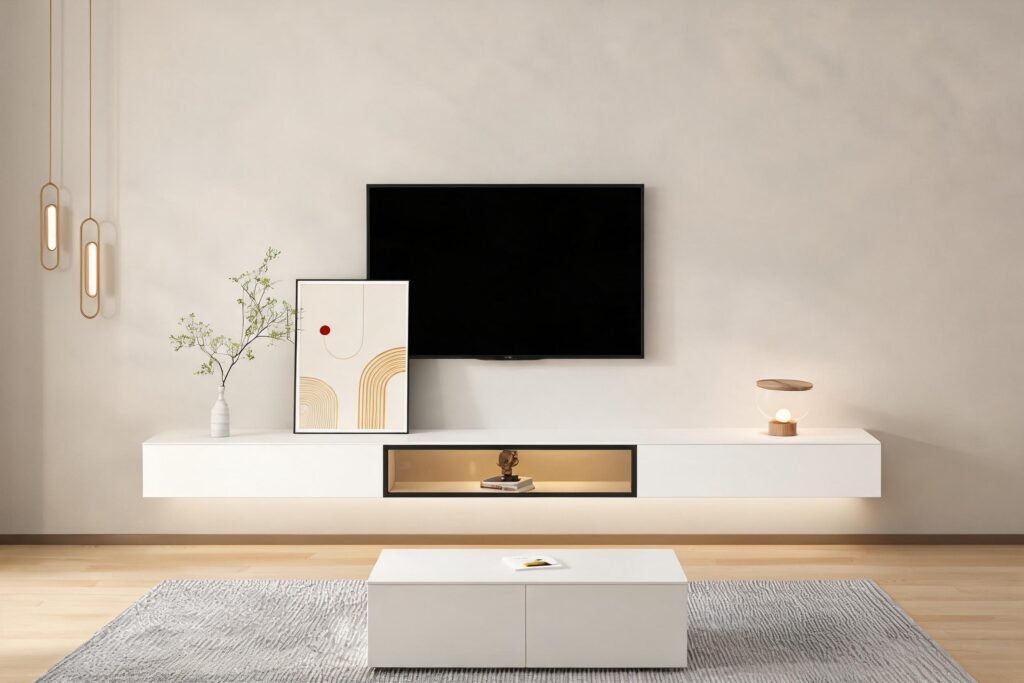
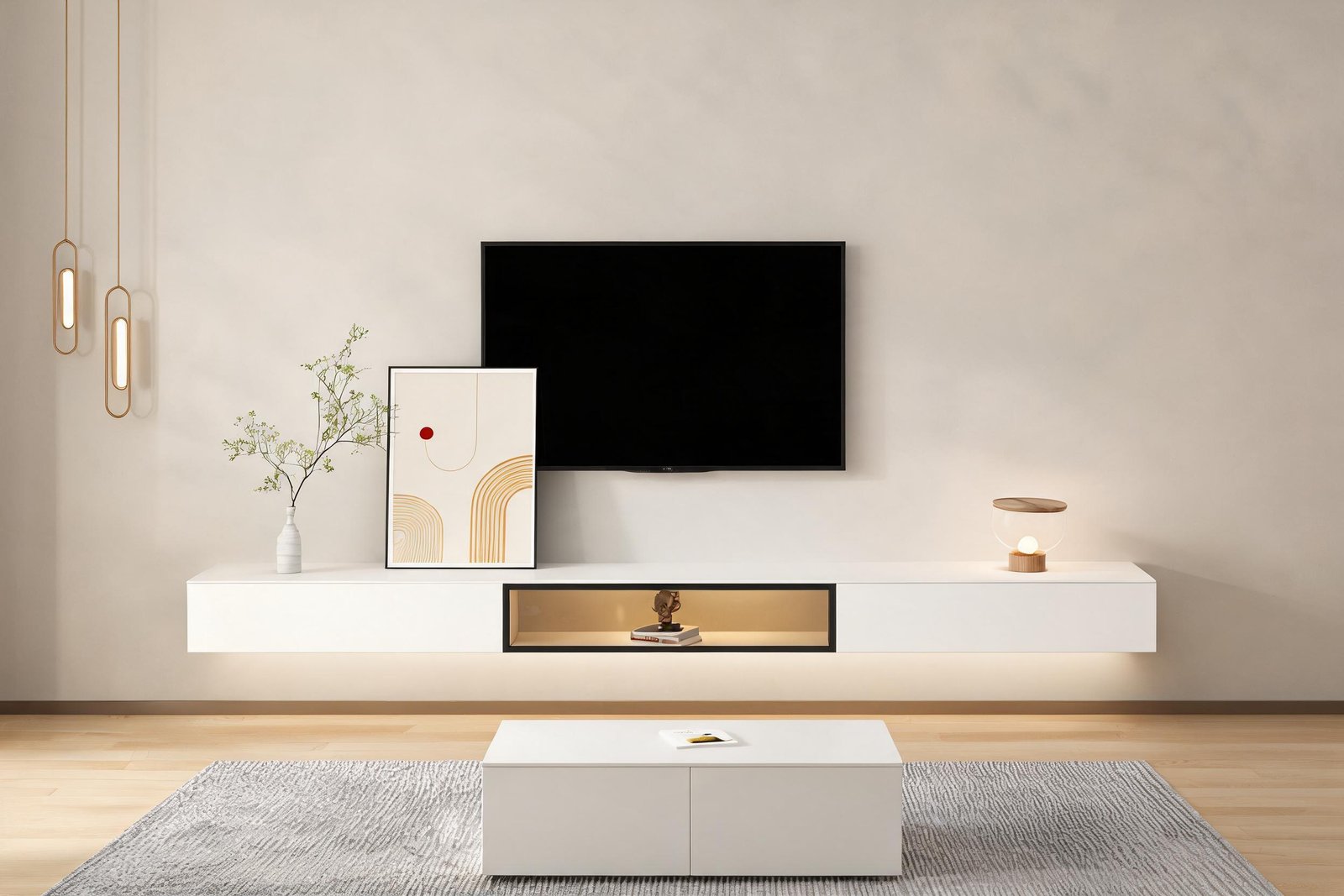
I have lived with a floating media console for three years, and the gap between a tv stand with led lights that looks deliberate and one that looks cheap is much smaller than most people assume. It comes down to color temperature and where the strip sits. My own unit is 180 cm wide in matte warm white, wall mounted with an open shadow gap underneath, with one central compartment closed by a clear tempered glass door and a warm white strip inside. I got nearly every setting wrong in the first week.
What follows is the setup I landed on and the honest limits of the accent light inside a tv stand with led lights.
Why a TV Stand With LED Lights Can Look Cheap
The light inside a console is an accent, never a room light. When I first ran my strip at full power with the diodes pointing straight at the glass, the compartment read like a display case in a phone shop. Fixing it took two changes and neither cost money. I lowered the output and moved the strip out of sight. If you are starting from scratch, see the Floating Glass Door TV Stand price and details here.
TV Stand Lighting Ideas That Begin With One Warm Color
Most workable tv stand lighting ideas start with a single color temperature and refuse a second one. I chose 2700K and stopped there. Mixing a warm strip inside a tv stand with led lights with cool 5000K ceiling spots made the compartment look grubby by comparison rather than cozy. The Kelvin scale runs from warm amber at the low end to cool blue white at the high end, and a lower number always means warmer light.
For a living room the comfortable band is 2200K to 3000K, which makes a warm white strip at 2700K to 3000K the safe choice for a media wall. Reach 4000K and above and the wall starts to read as an office.
Pick One Color Temperature Across the Whole Room
A warm strip on the console and cold spots overhead fight each other all evening. My ceiling had four 5000K downlights when I moved in. Swapping those bulbs for 3000K units did more for the look than anything I changed on the console itself. To compare shapes first, you can browse the full TV stands collection here before you commit to a width for your own tv stand with led lights.
LED TV Stand Lights at 2700K, 3000K and 4000K
This is the short version I give friends who ask how to set led tv stand lights without overthinking it.
| Setting | Where it suits | When to avoid it |
|---|---|---|
| 2700K warm white | Evening scenes in a living room, and any time the room lamps are already warm | A bright daytime room, where it can look dim and orange |
| 3000K soft white | Daytime use and mixed rooms with a cool window | Late at night, when most people want a lower number |
| 4000K cool white | Utility areas and garages | A media wall you sit in front of every night |
| RGB color changing | A party trick or a child’s room | A calm living room, where saturated color pulls attention from the screen |
My own pick stayed at 2700K for the interior strip and 3000K for the ceiling, which is how I keep a tv stand with led lights feeling like one room rather than two.
Where the Strip Sits Matters More Than Its Power
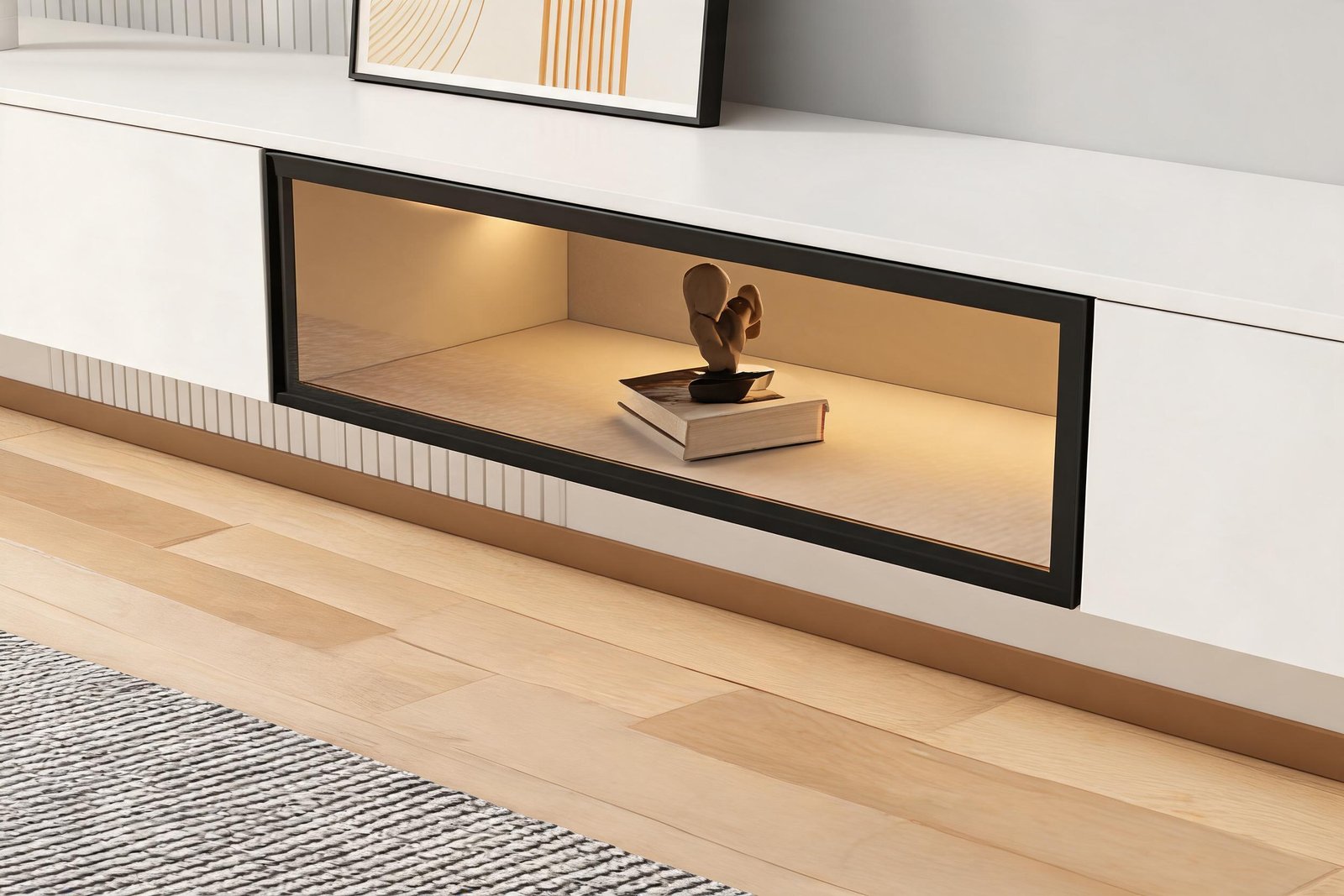
Placement does more work than wattage on any tv stand with led lights. The strip should sit at the back of the compartment so the glow washes the panel instead of hitting your eyes through the glass.
Exposed LED diodes read as dotted hot spots through a glass door, so choose a diffused strip and hide it behind a lip or under the top panel. If you are weighing up a glass front at all, the tempered glass explainer notes it is roughly four times the strength of annealed glass of the same thickness, and it breaks into small blunt granules instead of shards, which is why I was willing to put one in front of a lit compartment.
How to Style a TV Stand Around a Glass Door
To learn how to style a tv stand around a glass front, remember that the door mirrors the screen whenever the interior is brighter than the room. That single fact drives most of the settings I use on a tv stand with led lights. For movie nights I dim the interior light low, and I raise it only when the screen is off.
The Best TV Stand With LED Lights Setup Uses Separate Scenes
One setting is never enough, so I built three. A bright 3000K daylight scene for the afternoon. A low 2700K evening scene for reading. A movie night scene with the interior strip off or at its lowest. Every tv stand with led lights works better with a low setting kept in reserve for films.
If you want a wider console with lighting already built in, view the extendable glass TV stand with LED ambiance here, which comes in 79 inch and wider sizes.
A Second Strip Under the Floating Console
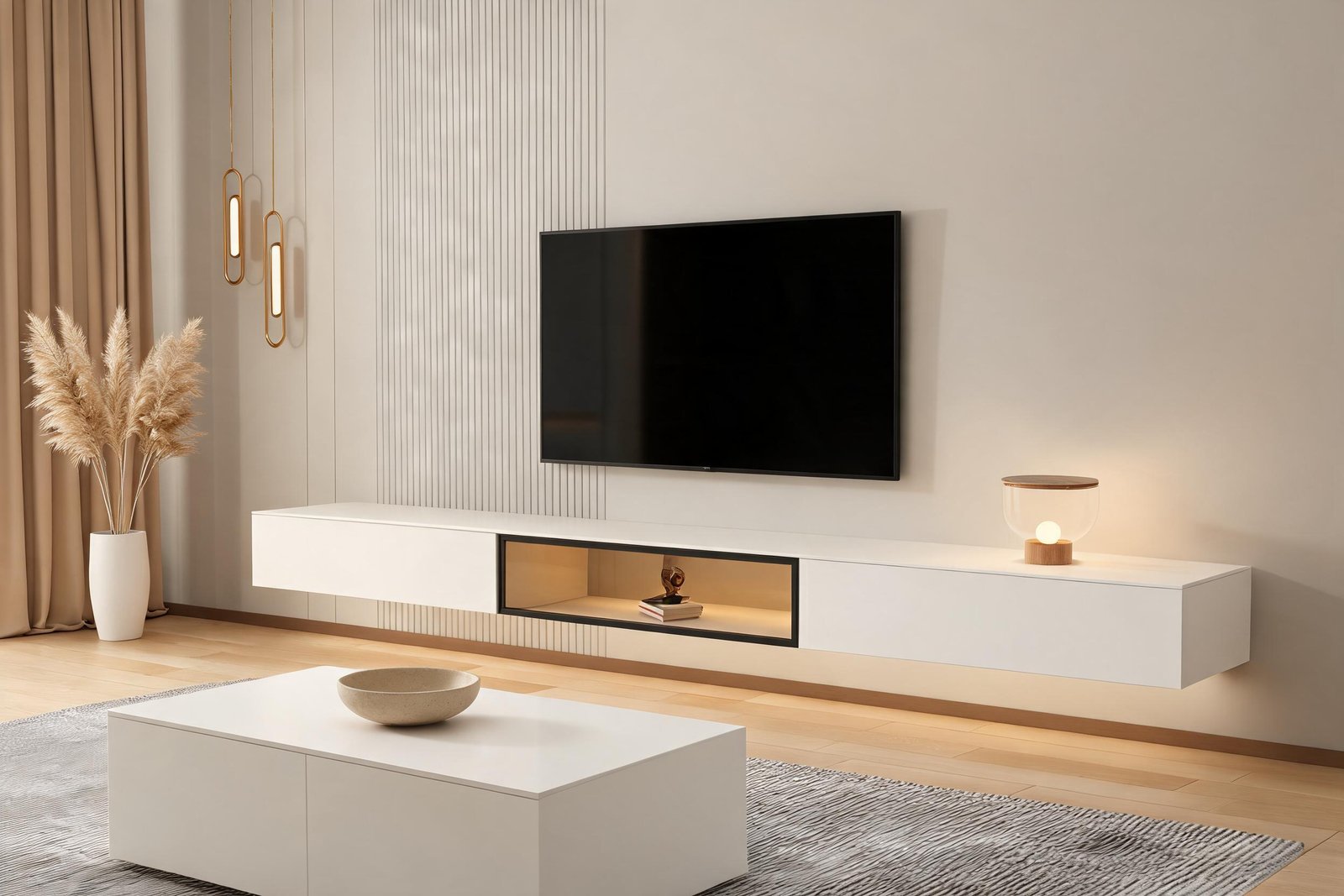
A second strip under the floating console, pointed down at the wall, reinforces the floating effect by washing the wall in a soft pool of light. A strip pointed forward at the viewer does not, because it flattens the shadow gap that makes the whole thing appear to hover. This is close to bias lighting done on the cheap, though the screen guidance from SMPTE is about 10 percent of the peak white luminance of the screen.
How to Style a TV Stand With a Hidden Light Source
The trick with any hidden source on a tv stand with led lights is restraint. Mine runs at about 40 percent of its maximum output in the evening and drops to 10 percent for films, and at that level the shadow gap under the slab is what you notice, not the light itself. The honest limit is that all of this is a few watts of accent. On a very large 240 cm console, the interior light is a detail rather than the light source for the room. A 240 cm console also needs proper wall fixings into studs or masonry.
By the end of the evening the picture I want is always the same. A low warm band washing the back panel and a narrow pool of light on the wall below the slab, with one other warm lamp in the room. When a tv stand with led lights is set that low, it stops looking like furniture with a light in it and starts looking like part of the room.
How to Style a TV Stand With LED Lights in Five Steps
This is the order I follow on my own console now.
- Choose one color temperature for the whole room and write the number down, because 2700K on the tv stand with led lights and cool ceiling spots will never sit together.
- Move the strip to the back of the compartment and fit a diffused channel so the glow washes the panel instead of showing dotted diodes through the glass.
- Set a bright 3000K daylight scene and a low 2700K evening scene, then add a movie night setting with the interior strip dimmed or off.
- Add a downward strip under the floating base to wash the wall and strengthen the shadow gap, and never point a strip forward at the viewer.
- Dim the interior light below the room brightness for films so the glass door does not mirror the screen, then raise it when the screen is off.
Frequently Asked Questions
How Bright Should LED TV Stand Lights Be for Movie Night?
Keep the interior strip at its lowest setting, or switch it off. When the compartment is brighter than the room, the glass door mirrors the screen and you see a pale rectangle floating over the picture. A faint warm glow from the back panel is enough to keep a tv stand with led lights visible without distracting from the film.
What Color Temperature Works Best for a TV Stand With LED Lights?
A warm white strip between 2700K and 3000K suits a living room best. That range keeps the media wall warm and calm through the evening. Anything at 4000K or above starts to read as an office or a clinic rather than a room you relax in. Pick one number and match your ceiling bulbs to it.
Do LED TV Stand Lights Use Much Electricity?
Not much. A built in accent strip draws only a few watts, so running it every evening for a few hours costs very little. That low draw is also why it cannot light a whole room, so treat a tv stand with led lights as an accent rather than the main light source.
Can a glass door make the interior light look worse?
It can. Clear glass shows every exposed diode as a bright dot, and it mirrors the screen when the interior is brighter than the room. A diffused strip tucked at the back behind a lip fixes the dotted look, and dimming the strip below room brightness fixes the reflection. Both changes take minutes.
What Is the Best TV Stand With LED Lights Scene for Daytime?
Use a brighter warm setting, around 3000K, with the room lights on and daylight doing most of the work. In daylight the interior strip almost disappears, so you are mainly looking at the panel and the shadow gap. Save the low 2700K setting for the evening.
Making the Console Look Deliberate, Not Accidental
The whole point of tuning a tv stand with led lights is that nobody should notice the light at all. They should notice a warm wall and a clean shadow gap. For the wider setup, read our guide on how to hide TV cables here, which pairs well with any of these lighting scenes.
Start with one warm number, hide the source, and dim it at night. That is the whole method behind the best tv stand with led lights look I have managed in three years of living with mine.
