

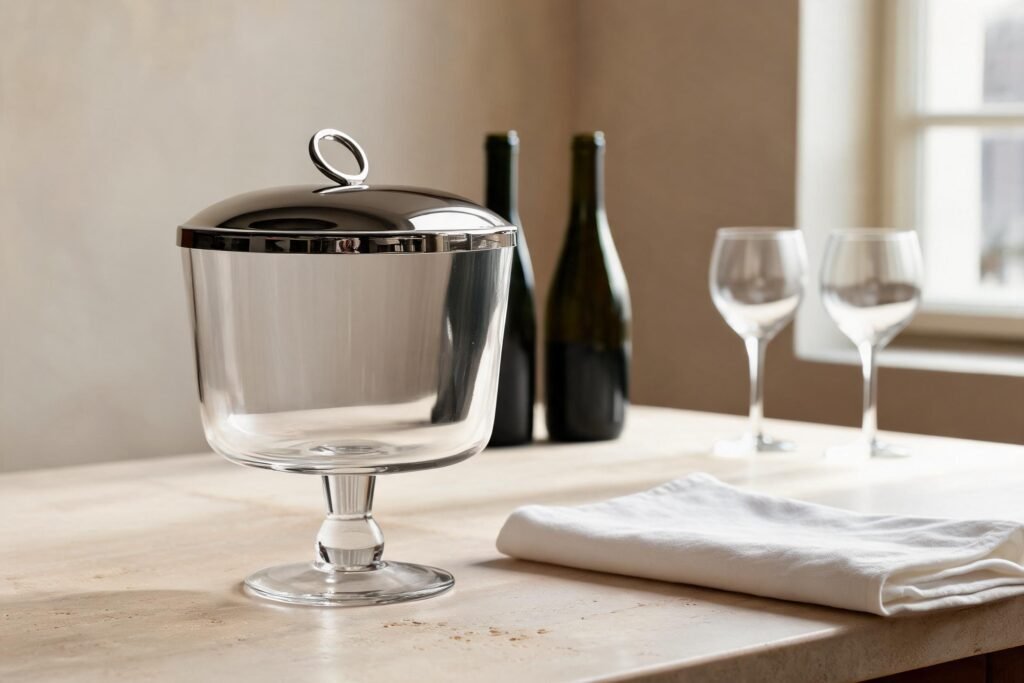
A glass ice bucket and a mirror polished steel one look like the same object in two finishes. They are not the same job. The difference shows up twenty minutes into a party, when one has left a ring of water on the sideboard and the other still has ice you can hear moving under a lid. Three numbers settle it, and none of them appear on a product page: how fast each material moves heat, how cold the outer wall runs against the dew point of the room, and how much warm air the mouth takes in every time somebody reaches for a cube.
Short answer: a glass ice bucket insulates better through the wall, roughly ninety times better than a single wall steel one of typical thickness, but most heat enters at the mouth, so the lid matters more than the material. Glass shows the ice and sweats less. Steel survives a hard floor and carries with one hand.
Why the Wall Decides Less Than You Think
Ice melts when heat reaches it, and heat crosses a wall by conduction. Borosilicate conducts about 1.05 W/(m·K) and stainless steel about 17 W/(m·K) in the standard thermal conductivity tables, so steel moves room heat into the ice roughly sixteen times faster for the same wall thickness. Wall thickness then multiplies that gap again, which is why the honest figure on a finished glass ice bucket is closer to ninety.
Metals carry heat with free electrons. A steel spoon left in hot soup is warm at the handle within seconds for that reason. Glass has no free electrons to move, so heat travels by vibration of the lattice instead, a slower route with no short cut through the material. That is the whole physics behind the insulation claim on any glass ice bucket, and it is a real effect rather than marketing. The wall is a slow door, not a barrier.
Divide conductivity by wall thickness and the difference gets concrete. A borosilicate bowl with a wall about four millimetres thick works out near 260 W/(m²·K). A stainless wall under one millimetre thick works out near 24,000 W/(m²·K) on the same temperature difference. The practical result: a glass ice bucket keeps its outside surface close to room temperature while a steel one is cold to the touch within a minute of filling.
Then the part that stops steel from being useless. Ice does not sit against the wall for long. It stacks toward the middle, and the gaps between cubes are air, which conducts at about 0.026 W/(m·K), worse than either material by orders of magnitude. A full bucket of either kind holds ice for an evening. The mouth is the leak that matters: an open 20 cm circle lets warm room air slide over the load, and lifting a lid pushes a fresh parcel of it inside.
What the material really changes is the edge of the load. Ice touching steel melts first, so the cubes near the wall soften while the middle is still hard. The same happens inside a glass ice bucket, but you can see it happening through the bowl, and that visibility turns out to be worth more in service than an insulation figure nobody can hold in their hand.
Footprint and Bottle Fit Come Before the Material
Measure the surface first. A bucket 27 cm across takes 27 cm of a 60 cm counter and needs about 6 cm behind it for the lid to lift and rest, which leaves 33 cm for glasses. Bowl depth, not total height, decides whether a bottle stands, and both materials hit the same limit: a 30 cm wine bottle will not stand upright in a 20 cm bucket.
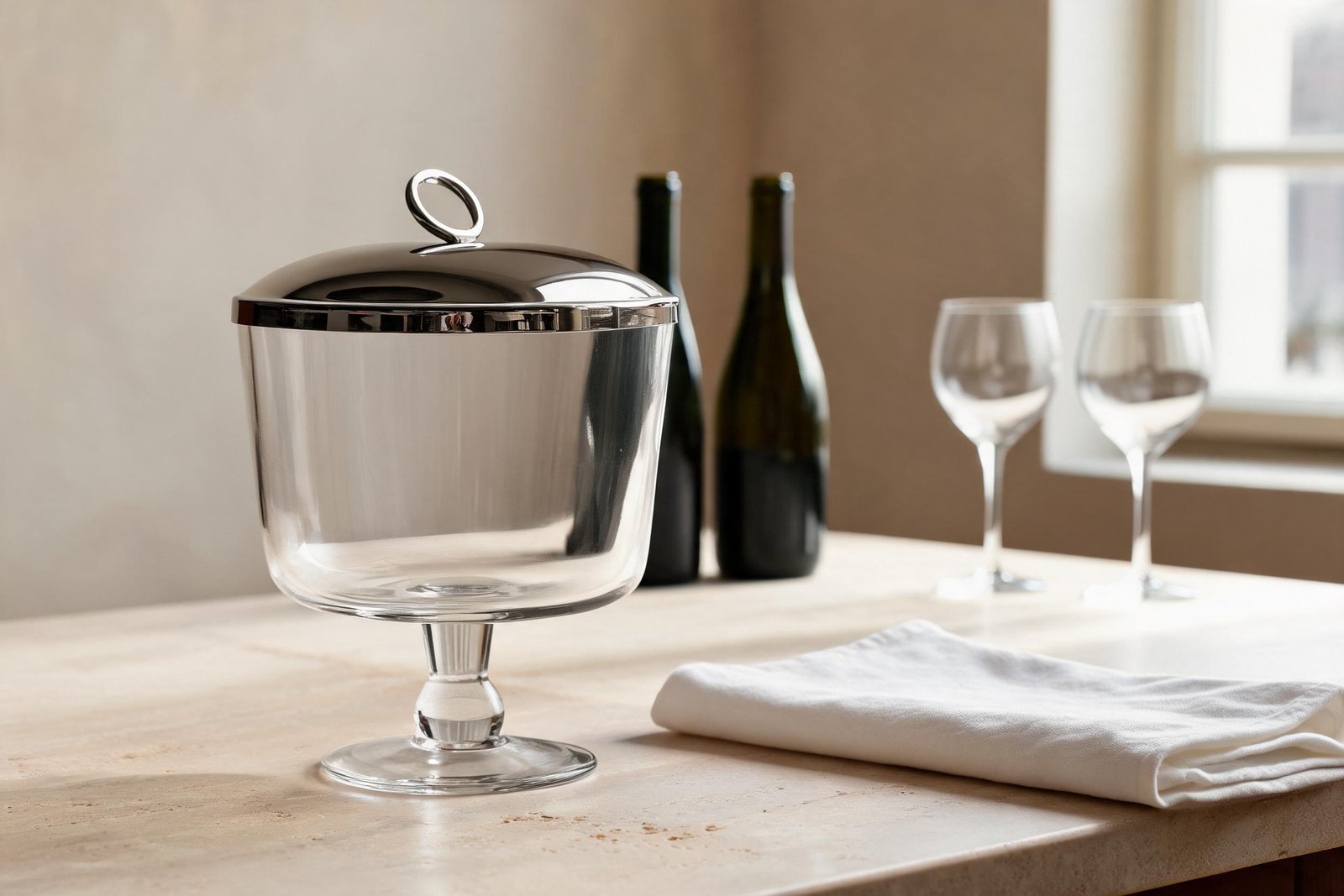
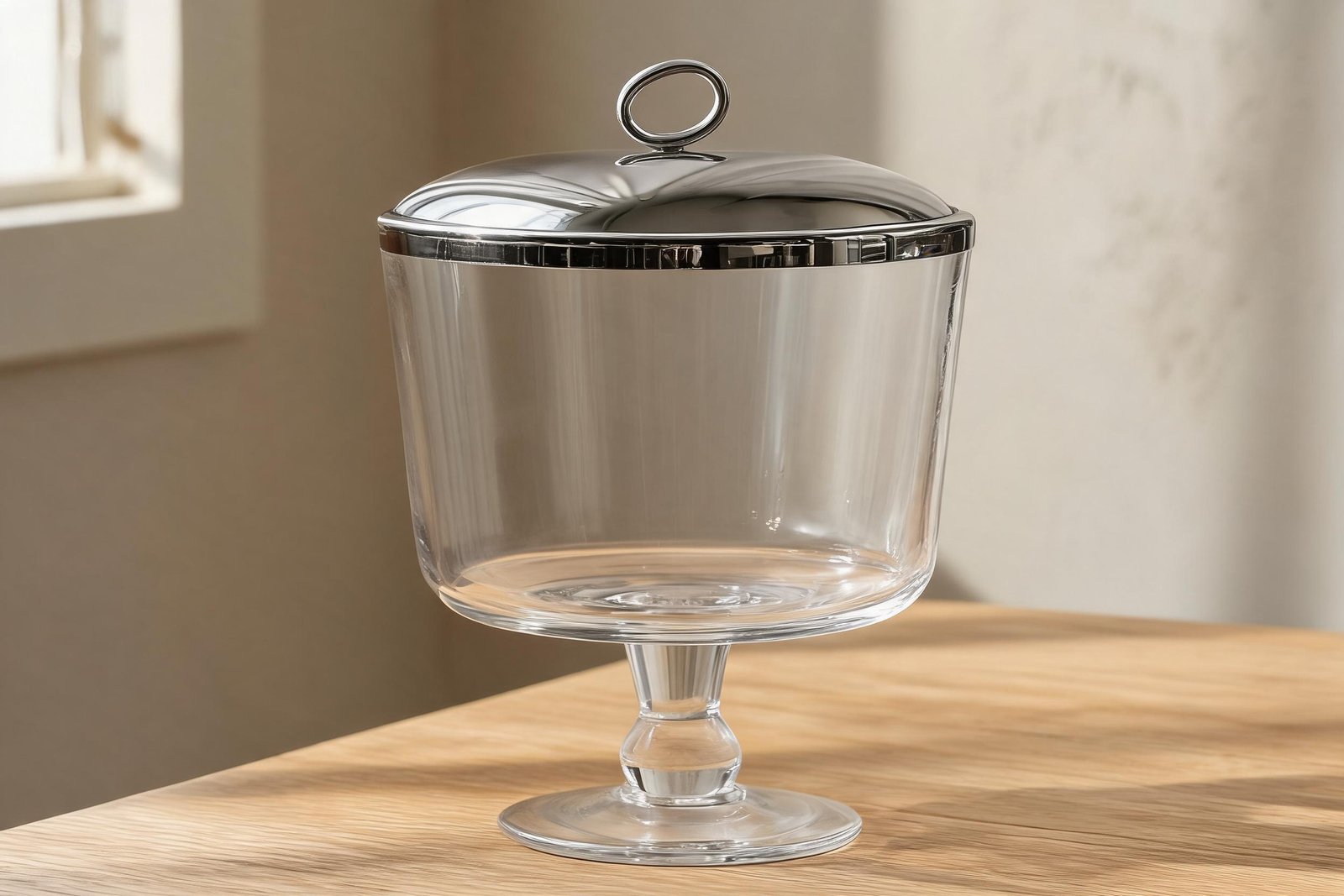
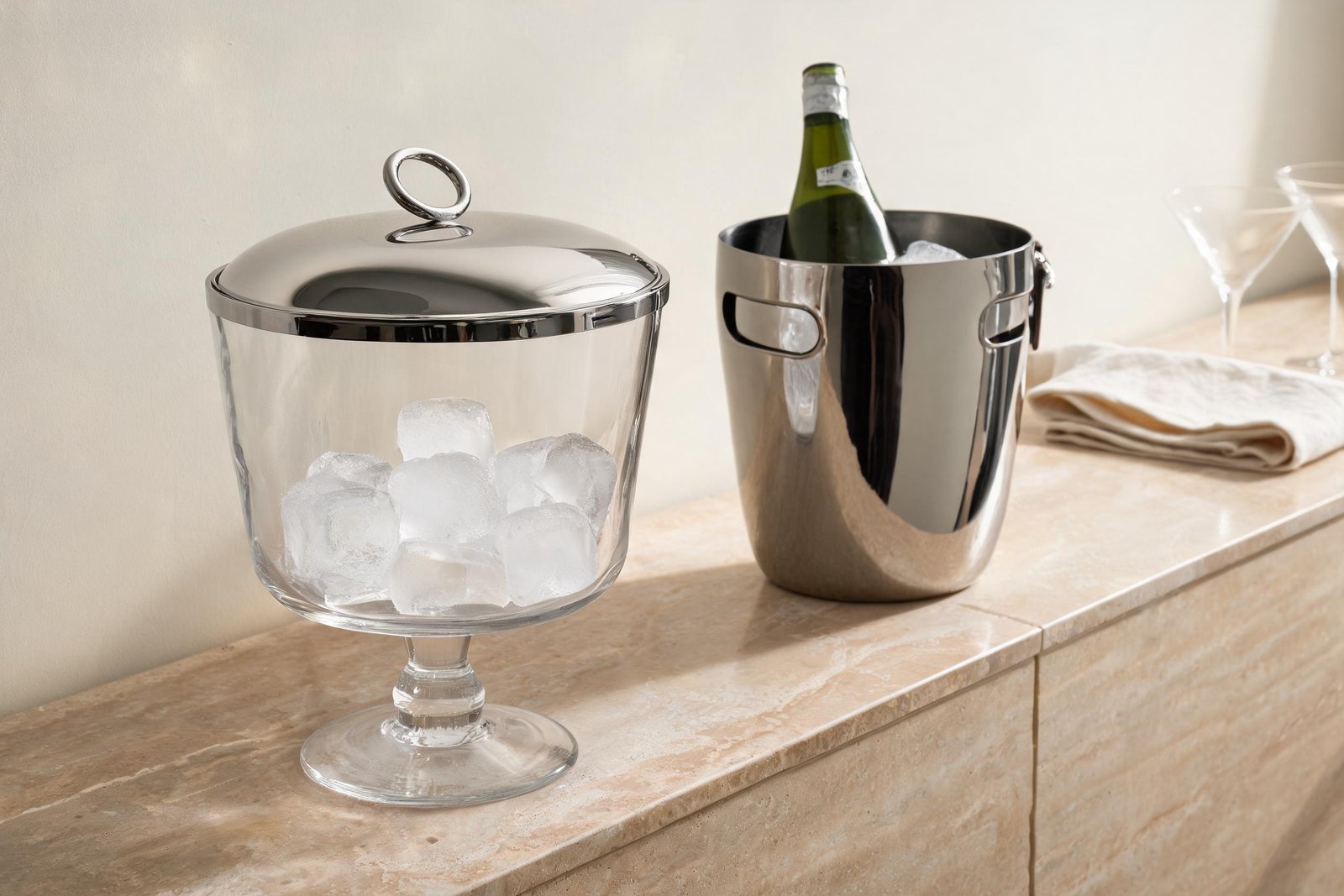
The glass ice bucket sold on this page is 27 cm across and 20 cm tall, a clear bowl on a short thick stem above a flat glass foot. Wide mouth, shallow working depth, a shape typical of a stemmed glass ice bucket. A 750 ml bottle measures roughly 2.75 to 3.5 inches across and 11.5 to 13 inches tall, so in a bowl this wide it lies at an angle with the shoulder under the ice and the neck clear. That is how it serves, and it is also why a bucket like this cannot replace a tall champagne cooler when a bottle has to stand.
Width decides where the thing can live. A standard bar cart carries 41 to 51 cm of shelf depth, so a bucket 27 cm wide leaves about 20 cm of working room and no margin for a tray beside it. The full breakdown by guest count and litre capacity sits in the guide to ice bucket sizes, and the shelf height checks are in the bar cart fit guide.
Carrying is the second consequence of width. A bucket two thirds full of ice weighs several kilos, and a glass ice bucket gives you nothing to grip but the bowl or the foot, so it takes two hands and a surface within a step of the table. Steel models usually carry a recessed slot handle on each side, which is enough for one hand at a time. Neither should be carried up a staircase full.
Does a Glass Ice Bucket Keep Ice Colder Than Steel?
No, not in the way buyers expect. A glass ice bucket insulates better through the wall, but an open glass bowl and an open steel bucket lose ice at similar rates because most heat arrives through the mouth. Where glass genuinely wins is the outer wall, which stays warmer, sweats less and lets you read the ice level without lifting a lid, so a glass ice bucket on a sideboard tells you at a glance how much is left.
The confusion begins with touch. Steel feels colder than glass at the same temperature because it pulls heat out of skin faster, and that sensation gets read as “keeps cold”. It is the same property read backwards. A material that drains heat from your hand quickly is a material that drains heat from the room into your ice quickly.
What actually lengthens a load, in rough order of effect: the lid staying on, large cubes instead of crushed ice, draining the meltwater instead of letting the ice sit in it, and starting with ice straight from a freezer. Cube size is the one most people miss, and inside a glass ice bucket the effect is easy to watch. A 5 cm cube has far less surface area per gram than the same weight of crushed ice, and surface area is where melting happens. Meltwater is the second: water conducts at about 0.6 W/(m·K) against air’s 0.026, so ice standing in its own melt sits in a warm bath, and the bottom of the bucket goes to slush first.
For scale on the material itself, one manufacturer’s laboratory figures put a single wall 0.5 mm stainless bucket at about two and a half hours to half melted ice in a 22 °C room, and a double wall vacuum version at eighteen hours, with repeated lid lifting costing up to forty percent of that hold time. Those are maker numbers rather than an independent test, and they describe a vacuum bucket, so read them as direction: the wall material is a small lever, the vacuum gap is a large one, and the lid is free.
Ice Bucket Condensation on the Table, Explained by Dew Point
A bucket sweats when its outer surface drops below the dew point of the room, and water then condenses out of the air onto it. At 22 °C and 60 percent relative humidity the dew point is about 13.9 °C. Any wall holding ice runs far below that, so a ring of water under a glass ice bucket is physics rather than a fault.
The dew point moves with the room. At 20 °C and 60 percent humidity it sits near 12 °C, at 24 °C and 55 percent near 14.4 °C, and a warm kitchen in summer pushes it higher. Any surface colder than that number collects water. Because a single wall steel bucket pulls its outer skin closer to the ice temperature than a glass ice bucket does, steel sweats more and sooner, and a steel bucket with no lid sweeps coldest of all as cold air spills over the rim.
The ring is a small problem with expensive consequences. Water sits under the base and works into whatever the bucket stands on: oiled oak goes cloudy, travertine and marble take a stain that does not lift, and a linen runner wicks water sideways long before anyone notices. A tray with a lip, a coaster, or a folded cloth under the bucket catches all of it, and keeping the bucket out of direct sun and away from a warm draught slows the rate at which the wall cools and fresh air arrives to condense.
That ring is not a steel-only problem. The bowl of a glass ice bucket stays warmer, but its flat foot touches the table across the whole area, so the ring comes out smaller and tighter rather than absent. Anyone who has set a cold bottle on a wooden table without a coaster knows what comes next.
What Borosilicate Means on a Glass Ice Bucket in Daily Use
Borosilicate expands about 3.3 × 10⁻⁶ per kelvin, roughly a third of ordinary soda-lime glass, and it tolerates temperature differences of about 166 °C without fracturing, as the material data on borosilicate glass sets out. Ice dropped into a room-temperature bowl will not crack it, and a warm rinse afterwards will not either. The rim stays the weak point, and a chip there ends the working life sooner than any crack.
That expansion figure is why cheap glass buckets fail. Soda-lime glass expands about three times as much for the same temperature change, so the outside and inside of a thick wall want to grow by different amounts and the stress lands at the thickest section, usually the base or the rim. A chunky cheap bucket is more likely to crack than a thinner borosilicate one, which is not the intuition most shoppers bring to a glass ice bucket. Borosilicate also carries less green in the body, so the ice reads clear rather than tinted, and the walls stay optically clean after years of washing.
The advantage has limits worth stating. Borosilicate is annealed rather than tempered, so it resists thermal shock and not impact: a knock on stone can still take a piece out of the rim, and a drop on tile ends it. Pouring boiling water into a cold bowl is a test not worth running even if the glass survives.
A Glass Ice Bucket With Lid and Tongs: What the Lid Actually Does
The lid closes the mouth, which is the largest heat leak on any bucket, and keeps the ice out of standing meltwater. Tongs keep hands out of the bowl, so the ice stays drier and the glass stays clear of fingerprints. Neither part changes how fast the wall conducts, and both are service tools rather than insulation.
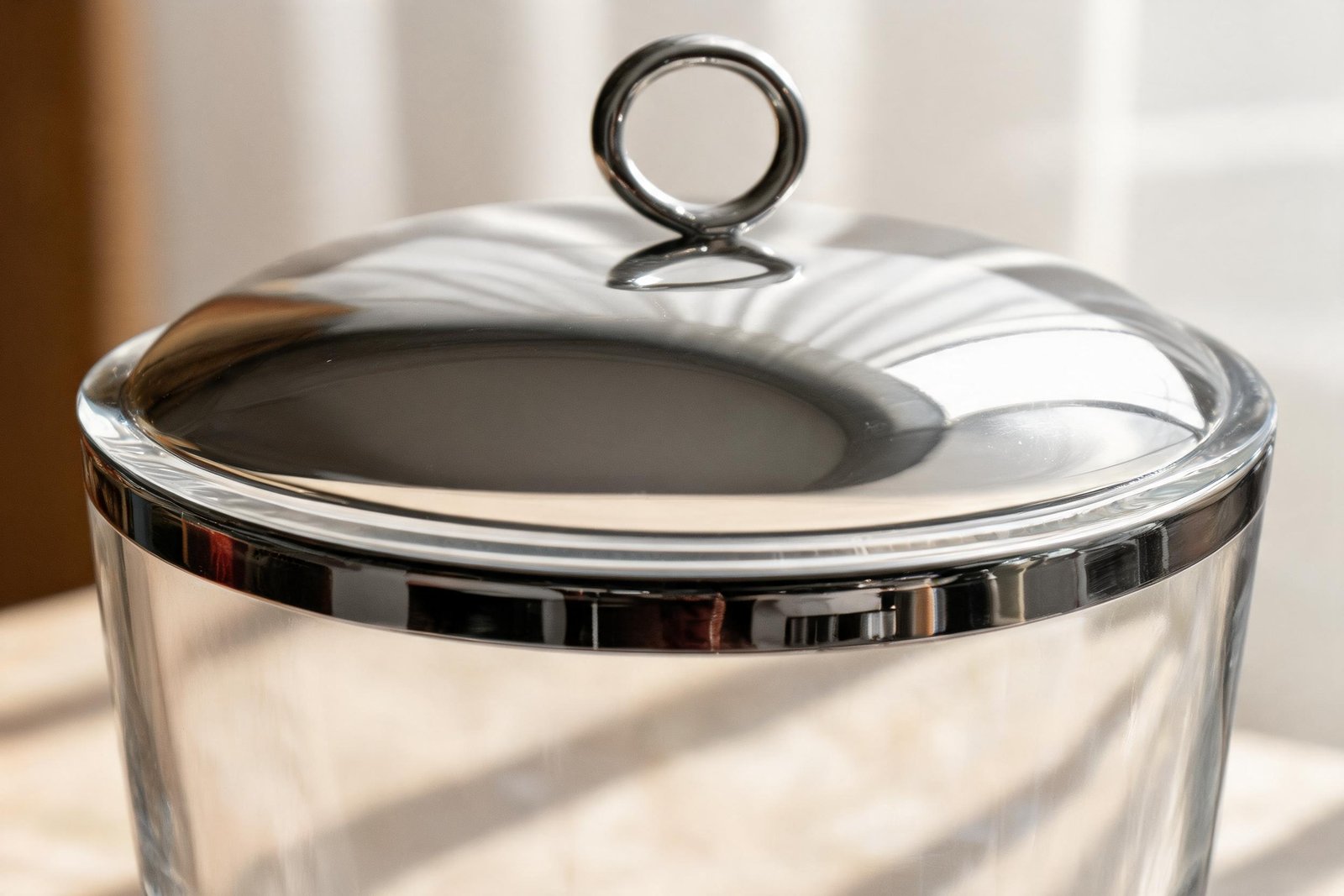
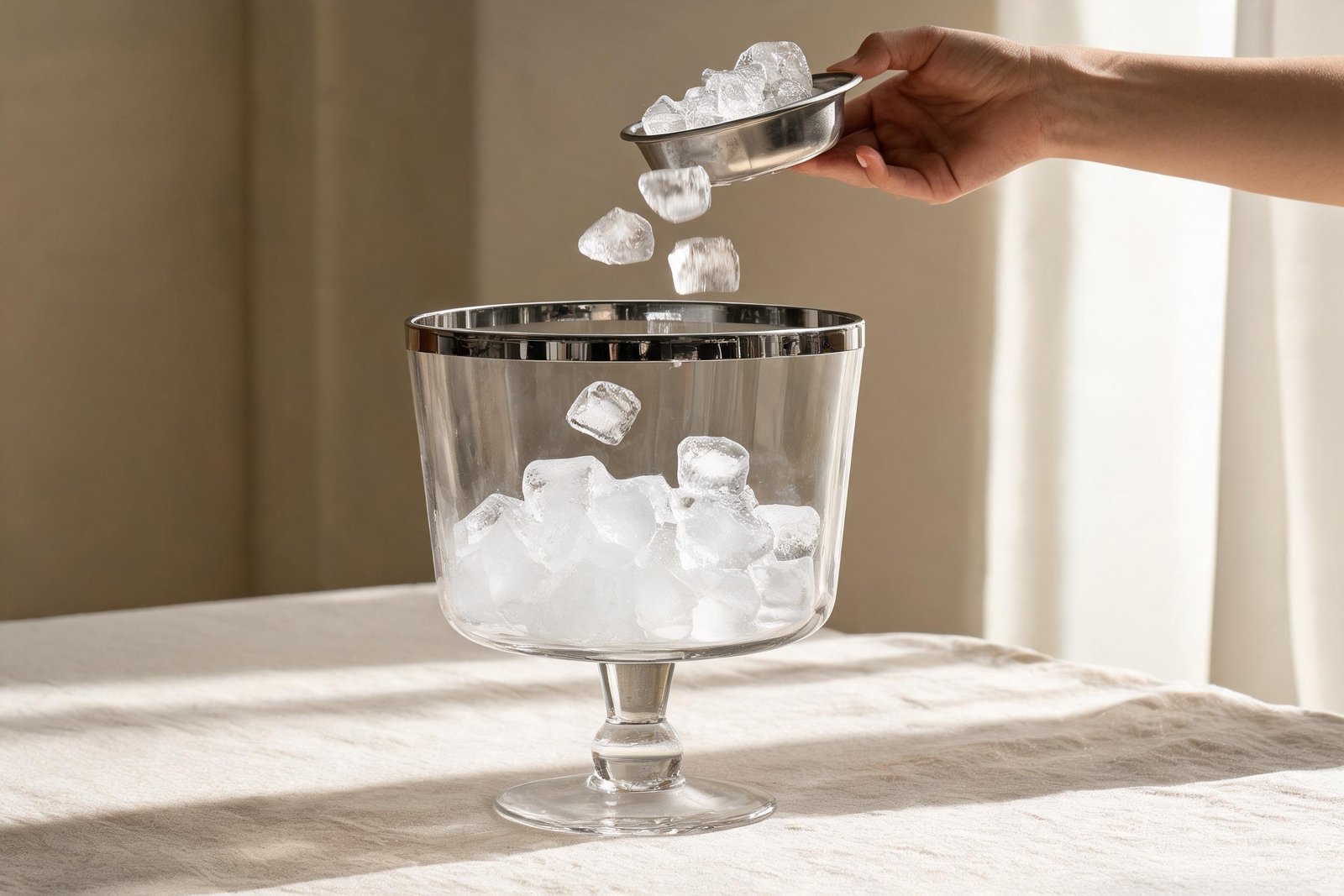
A lid also stops ice taking on the smell of the room, which matters in an open kitchen. Ice surface is porous and picks up odours quickly; an open bucket next to a roasting tray tastes of the roasting tray by the second hour. The dome on this one is not only decorative: cold air sits under it instead of sliding off sideways, and the upright ring knob gives a lift point that does not require touching a polished face. Tongs are the part buyers underestimate, because a scoop packs ice against the wall while tongs lift single cubes and leave air between them, which slows the melt.
Where Each Material Fails
Glass fails by chipping and breaking, which is the price of a glass ice bucket in a busy room. A knock on a stone worktop or a tiled floor ends it, a full glass ice bucket is heavy enough to slip out of wet hands, and there is no handle to catch it by. Steel fails by showing everything: water spots on the mirror, fingerprints, dents on a thin wall, and an ice level you cannot read without lifting the lid. None of that applies to a glass ice bucket, which hides nothing and forgives less than it looks.
The exclusions are worth stating plainly. Neither material suits a four hour garden party in July, where a vacuum insulated cooler holds ice all afternoon and neither a glass bowl nor a single wall steel bucket will. Neither suits a house with small children and a stone patio, where a glass ice bucket is a breakage waiting for a busy afternoon. Glass is the wrong choice for anyone who knows they will not hand wash a footed bowl after every use; steel is the wrong choice for anyone who wants the bottle label visible from across the room.
Maintenance splits the two more than durability does. A mirror polished wall shows every mark and needs drying rather than air drying, a two minute job after each use. Glass shows water spots as well, but a rinse and a cloth lifts them. Both end up hand washed in practice, one more forgiving than the other.
Glass vs Stainless Steel Ice Bucket, Side by Side
The table compares a lidless single wall steel bucket with a borosilicate glass ice bucket carrying a steel dome lid, which is the pair most buyers weigh at this price. Read the rows in order: the first two decide behaviour on the table, the middle rows decide what owning it feels like.
| What it decides | Glass with a steel lid | Mirror stainless steel |
|---|---|---|
| Heat through the wall | About 1.05 W/(m·K) through a wall a few millimetres thick | About 17 W/(m·K) through a wall under one millimetre thick |
| Outer wall temperature | Warmer, sweats later and less | Colder, sweats within minutes |
| Lid, an ice bucket with lid against an open pail | Dome lid over the mouth, ring knob on top | Open at the rim, no lid on most models |
| Reading the ice level | Visible through the bowl | Hidden, needs the lid lifted or a hand in the bucket |
| Breakage and dents | Chips at the rim, cracks if dropped on stone | Dents instead of breaks, rim can bend if struck |
| Carrying a full load | Two hands around the bowl or the foot | One hand on a recessed slot handle |
| Cleaning routine | Rinse, soft sponge, cloth dry | Wipe, then dry fully to avoid water spots |
| A 750 ml bottle | Lies at an angle in a 27 cm bowl, label visible | Lies at an angle in a 24 cm bucket, label hidden by the wall |
| Best room for it | Dining room, sideboard, indoor entertaining | Bar cart, covered terrace, hotel style service |
How to Choose in Five Checks
Work through these in order, because each one removes an option before the next becomes relevant. Most buyers leave the glass ice bucket question until last, which is how buckets end up stored in a cupboard instead of used.
- Measure the surface and the space behind it. A bucket 27 cm wide plus 6 cm for the lid is 33 cm of a 60 cm counter. Under 20 cm of depth in front of a wall is a no for anything this wide.
- Convert guests into ice. About 1.5 lb per person covers chilling and glasses across a two hour window, and the bucket holds less than the total because it gets refilled. The litres to guests conversion is in the capacity guide.
- Decide whether the mouth gets a lid. A lid is the cheapest gain in hold time and the feature most often missing from a steel bucket bought on looks.
- Decide what you want to look at during service. Ice and bottle labels through the wall of a glass ice bucket, or a mirror wall reflecting the room while hiding everything inside it.
- Pick the cleaning routine you will keep. A rinse and a wipe once a week suits glass. A mirror wall left wet for a week needs more than a cloth.
The Two Buckets Here, and Who Each Suits
Two buckets in the range answer different versions of the question. One is a borosilicate glass ice bucket with a mirror steel dome lid, a steel band around the mouth and a pair of tongs, 27 cm across and 20 cm tall. The other is mirror polished stainless steel, open at the top, with a recessed slot handle each side, 24 cm across in the French size and 25 cm in the European one.
The glass ice bucket is the one for a dining room where the table is the show and the ice is part of it. At 27 cm it wants a sideboard or a generous table rather than a bar cart shelf, and the short stem lifts the bowl so light comes up through the glass. The steel bucket is the bar cart, covered terrace and kitchen island choice, where a bucket has to be grabbed with one hand and survive being set down hard. It has no lid, so it wants a full load and a two hour window rather than an all evening service, which is the main thing a glass ice bucket does better.
Shop the glass ice bucket with lid and tongs (JX-SSIB-125) here for $298, the 27 × 20 cm set with the mirror dome lid and tongs. See the mirror steel ice bucket (JX-SSIB-126) here at $188, in either the French or the European proportion. The product page carries the current price, the full specification and the care notes, and the rest of the range sits in the stainless steel collection.
Questions Buyers Ask Before Choosing
Which ice bucket material is best for parties?
Steel where the bucket moves around, glass where it stays on one table. A steel bucket survives being set down on stone and carries with one hand. Through the wall of a glass ice bucket the ice level reads from across the room without a lid lift. Beyond three hours outdoors, neither is the right tool and a vacuum cooler is.
Can a glass ice bucket go in the freezer?
A borosilicate one can. It handles the drop without stress and a chilled bowl slows the first melt. Leave the lid off while it chills so moist air does not freeze onto the glass, and do not move it from the freezer straight into hot water. Soda-lime glass buckets should not be chilled this way.
Is a glass ice bucket with lid and tongs worth it?
It is worth it if the bucket stays indoors and the table is part of the hosting. Visible ice, a warmer outer wall and a clearer look are real advantages, and the lid and tongs are the two parts that extend a load. It is not worth it if the bucket travels to a patio or gets washed in a hurry.
Is a glass ice bucket for champagne a good fit?
It works for a bottle served at the table rather than one that must stand upright. A 27 cm bowl takes a 750 ml bottle lying at an angle with the shoulder buried, which chills the wine properly. A sparkling bottle that has to stay vertical and be poured from the bucket needs a tall cooler instead.
How long does ice last in an ice bucket?
Expect roughly two to three hours before half the ice has melted in a 22 °C room, in either material, with a lid on and the bucket opened a few times an hour. Steel with no lid and constant scooping sits at the short end. A double wall vacuum bucket is a different category and runs far longer.
How do you keep an ice bucket from sweating on the table?
Put something under it. A tray with a lip, a coaster or a folded cloth catches water before it reaches the wood, and keeping the bucket out of sun and away from warm draughts slows the condensation. A lid helps as well, because cold air spilling over the rim is what cools the wall fastest.
Back to the title question: a glass ice bucket is the better insulator on paper and the better object to look at on a table, while steel is the tougher thing to own and the easier one to carry. The wall decides small things like how fast the outside sweats; the lid, the cube size and how often somebody lifts it decide the big one, which is whether ice is still there when the last guest wants some. For a bucket that will live on a dining table indoors, the lidded glass ice bucket is the more rewarding object, and the guest count rules in the ice bucket size guide cover the loads it will actually carry.
