

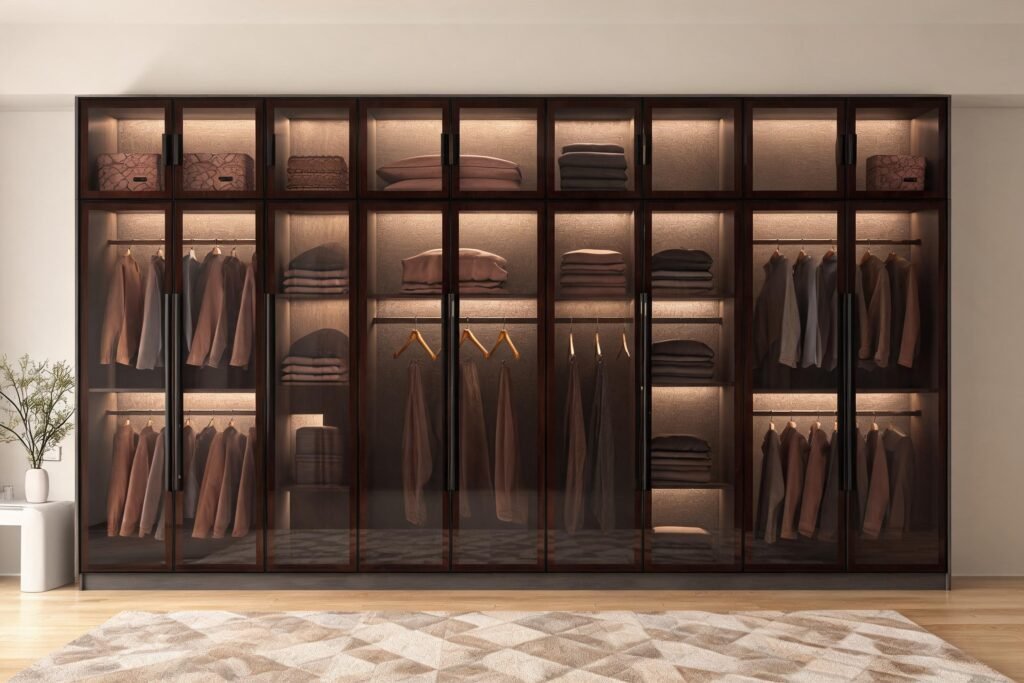
A wardrobe with LED lights is the easiest way to make a dark bedroom wall look expensive, and the easiest way to make it look cheap if the light is wrong. I have unpacked and re-lit a few of these now, including one 242 cm run of glass doors that I had to align twice, and the mistakes are always the same three: too cool a light, a strip you can see, and a switch you have to hunt for. A wardrobe with LED lights is worth paying for only if those three are solved.
What to Check Before You Buy a Wardrobe With LED Lights
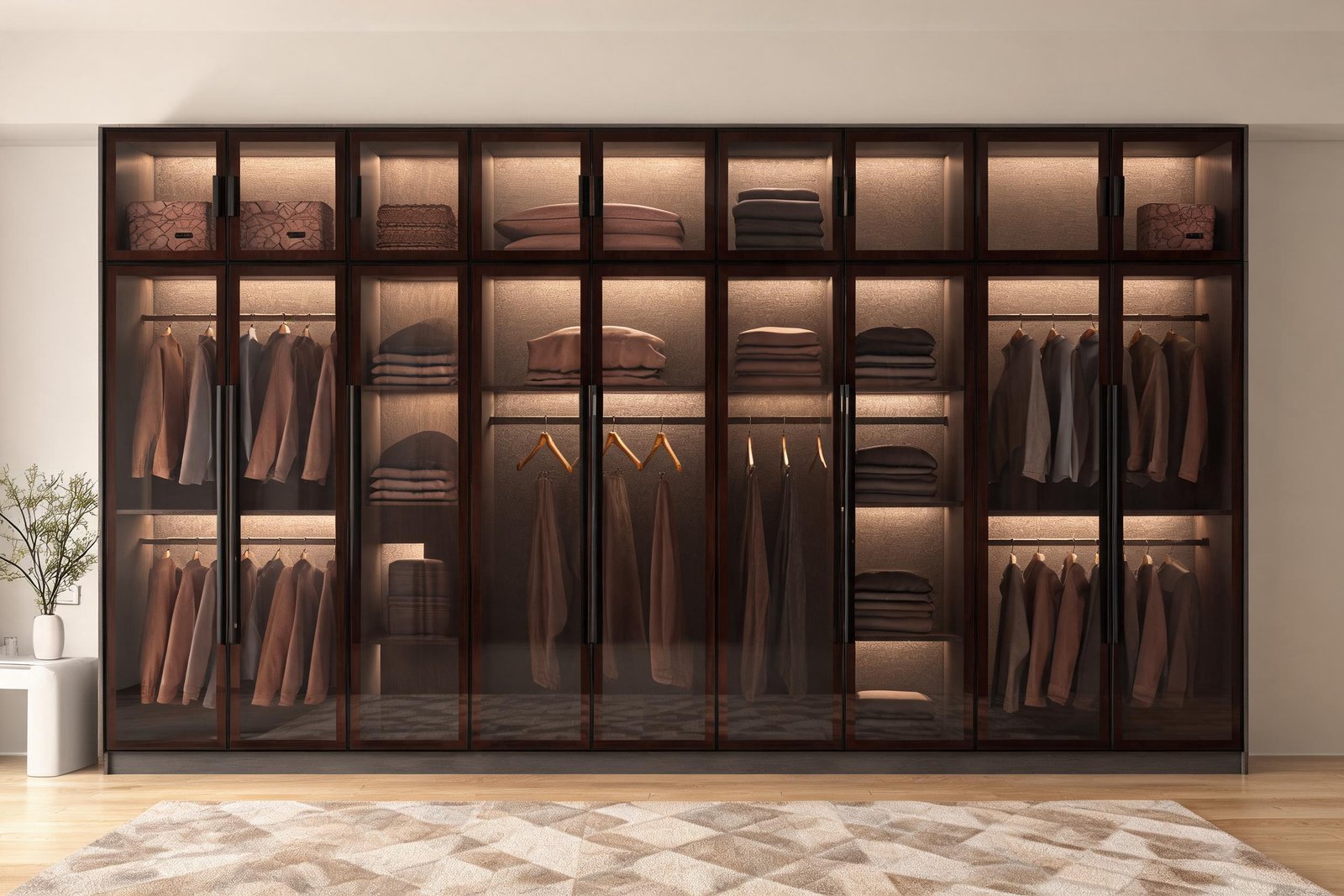
Look for three things on the spec sheet: a colour temperature between 2700K and 3000K, a diffused strip hidden behind a shelf lip or inside the frame, and a touch or door-activated switch. A wardrobe with LED lights that ticks all three reads as built-in joinery rather than a cabinet with a torch taped inside.
Most people shop the panel colour first and the light last, which is backwards. On a wardrobe with LED lights the light is the only part you notice at night, and it is the hardest thing to fix later. Anything above 4000K turns a bedroom into a changing room, and a bare exposed strip throws visible dots across the hanging rail instead of washing the clothes evenly.
The second thing to check is where the strip actually sits. On a glass door wardrobe with LED lighting, the strip normally runs along the interior back panel or under each shelf, so the light travels forward towards the glass and lights what is inside rather than glaring at you through it. On a solid panel door the strip sits under the shelf lip, and you rarely see the source at all unless you open the door.
Third, count the sections on a wardrobe with LED lights. A three-metre run of glass doors with one lit compartment looks unfinished next to the same run lit across every bay. If the pricing works per section, price the light into every section you plan to buy, not just the middle one.
How to Light a Wardrobe So Clothes Actually Look Right
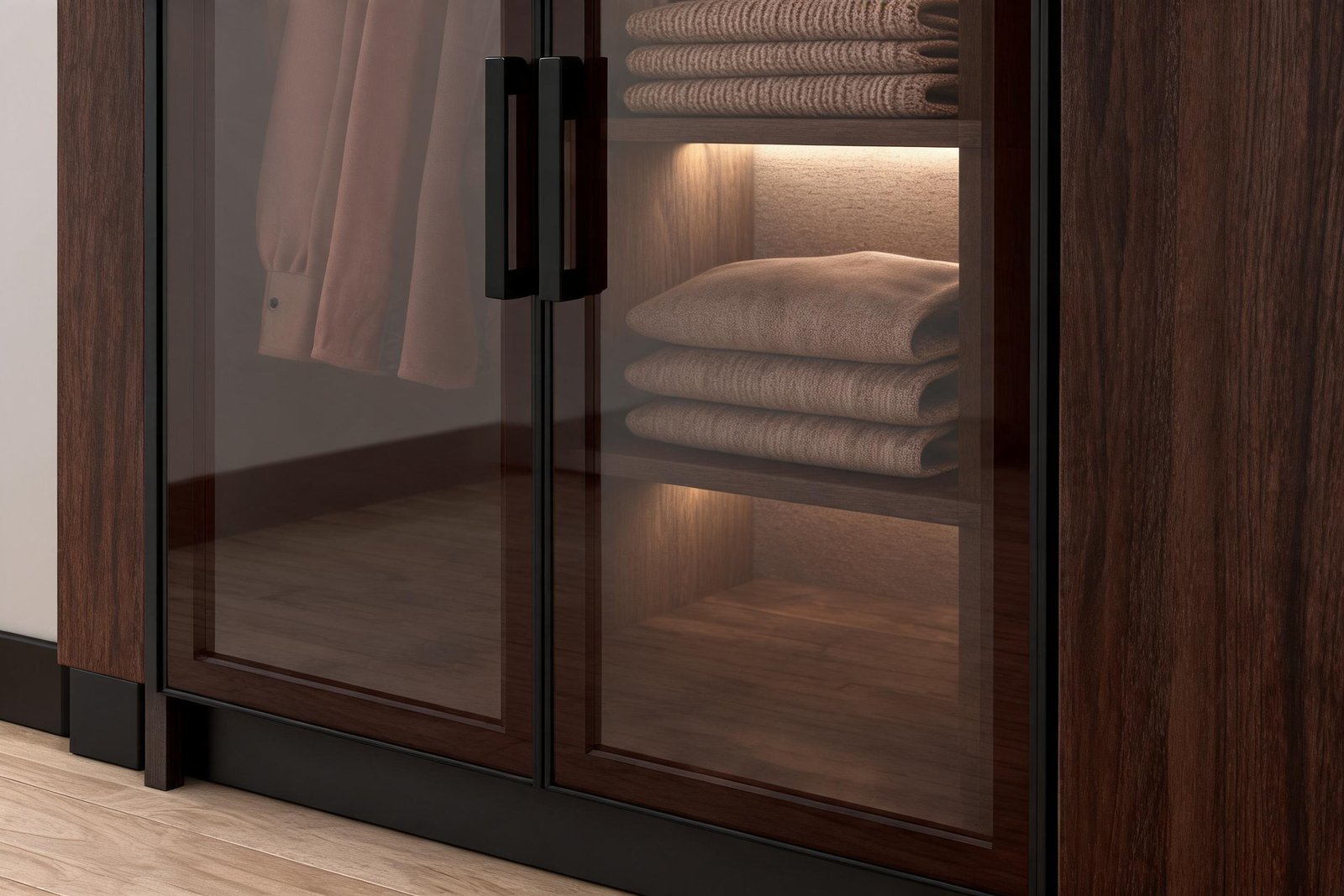
The light on a wardrobe with LED lights should come from the side and from the front, never from a single point above. A vertical strip set into the interior corner of a bay lights shirt collars and hems, while a horizontal strip under a shelf flattens everything below it into one tone.
Nearly every mistake I see on a wardrobe with LED lights comes from treating it like a room. It is a box, and the light has to come out of the box. If you stand three feet away and cannot tell which side of the shirt you are looking at, the bay is under-lit. If the back panel is a bright rectangle and the clothes are silhouettes, the strip is too far back and too strong.
Two practical rules for a wardrobe with LED lights have held up for me. Keep the strip at least 4 cm off the back panel so the light grazes the contents instead of the wall behind them, and put one strip per shelf level rather than one per cabinet. A 190 cm tall section with three shelves is happier with three short strips than one long one down the middle.
The last thing to think about on a wardrobe with LED lights is the glass. Tinted glass softens interior light into a warm haze that suits bedrooms; clear low-iron glass shows the contents almost perfectly and shows the strip too. If the wardrobe has clear glass, hide the diodes properly or the reflection in the glass will be the brightest thing in the room.
Wardrobe Lighting Ideas That Do Not Need an Electrician
You do not need to touch the house wiring to light a wardrobe with LED lights. Battery and rechargeable LED bars, magnetic strips and USB sensor lights all sit inside the cabinet and are gone in an afternoon.
- Rechargeable motion sensor bars. One per bay, stuck under the shelf, charged twice a year. Best for rented rooms where drilling into a wall is not happening.
- A single vertical corner strip on the door hinge side. It reads as part of the wardrobe because it disappears when the door is shut.
- Warm 2700K under-shelf pucks. Cheapest way to lift a dark shelf of folded knitwear. They are not bright enough to light a whole closet.
- A sensor switch on the door edge. The light comes on when the door opens, which is the entire point of interior lighting.
- Mirror and LED together. On a hinged door, a full-height mirror with a warm strip behind the frame makes a small bedroom feel wider and lights the face for dressing.
Can a Cheap Wardrobe With LED Lights Look Expensive?
Yes, if the strip is hidden and the colour temperature matches the room. What shows on a wardrobe with LED lights is the fitting, not the price tag, and a well-hidden strip in a mid-priced piece beats an exposed one in an expensive piece.
Do You Need a Wardrobe With LED Lights in Every Bay?
Light every section you look into, and leave the ones you do not. A wardrobe with LED lights only looks deliberate when the lit bays are the bays you open every day.
Nothing on that list needs a switch plate, and most of it can move with you when you move house. That is also the honest limitation: battery light is dimmer than a wired strip, and you will notice it on a dark winter morning. Use it as accent lighting and keep the ceiling light for the room.
How to Add Lights to a Wardrobe Without Drilling
- Empty the bay and clean the surface. Adhesive LEDs fail on dusty laminate, and a wiped shelf holds a strip for years.
- Test the light before you stick anything. Hold the bar where you want it on the wardrobe with LED lights, close the door, then look at the result. Move it once rather than three times.
- Run the bar along the front third of the shelf, not the back wall. Light from the front of the shelf lights the clothes; light from the back lights the panel.
- Clip the cable or route it into the rear gap. Most wardrobes have a few millimetres of clearance behind the back panel and a channel at the top.
- Fix the sensor to the door, not the carcass. The switch should trigger on door movement, and a door-mounted sensor works on both hinged and sliding doors.
- Check the door clearance. A strip that is 8 mm tall is fine on a shelf, but on the inside of a door it can foul the frame. Measure the gap first.
If you would rather not think about any of this, the alternative is buying a wardrobe with LED lights already fitted. Our 190 cm glass door wardrobe comes with the interior LED lighting wired as part of the carcass: see the Glass Door Wardrobe with Integrated LED Lighting here. It is the version I would put in a bedroom where the wardrobe is the feature rather than the storage nobody looks at.
Glass Door Wardrobe With Lights: What Changes
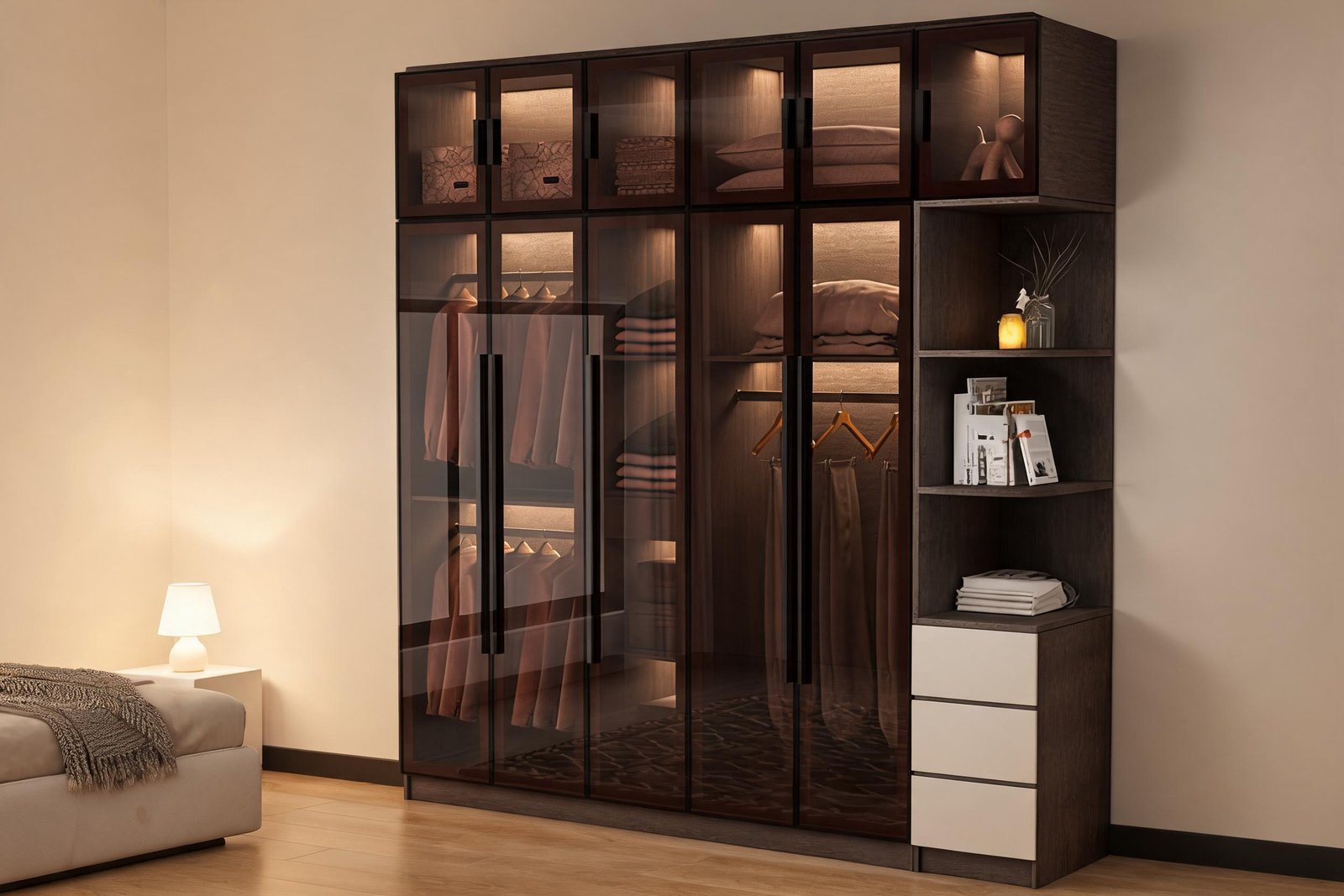
Glass changes the job of the light on a wardrobe with LED lights. Behind a panel door, the LED is only for the person opening it. Behind glass, the light is also part of the room, and it has to hold up when someone is looking at the wardrobe from across the bedroom.
That is why almost every glass door wardrobe with lights uses a diffused strip rather than visible diodes, and why a wardrobe with LED lights behind glass needs the colour temperature checked twice. Warm light behind tinted glass reads as a warm glow from a distance. Cool light behind clear glass reads as a display fridge. There is no middle ground once the doors are glass.
The second change is glare control. Smoked or grey tinted glass hides the inside of the wardrobe during the day and shows only a soft glow at night, which is the look most people are chasing. Clear glass shows everything: the neat shelves and the two jumpers you threw in an hour ago. If you want the lit display look, tinted glass is doing half the work, and the frame colour is doing the rest. Dark frames on dark timber disappear into a dim bedroom; gold or white frames hold their own against a pale wall.
One detail worth checking on a glass door wardrobe is the glass spec itself. Tempered 3C glass is the standard for full-height doors because it is heavy and safe when it breaks, and doors that are heavier than standard panel doors need hinges rated for the weight. That weight is also why this kind of wardrobe sits in the premium part of a range. You are paying for glass, lighting and hardware, not just panels.
Colour Temperature: 2700K, 3000K or 4000K?
With a wardrobe with LED lights, match the strip to the ceiling light and keep it one step warmer.
- 2700K is candle-warm and forgiving. It makes timber grain and knitwear look expensive and slightly hides a messy shelf. My default for a bedroom.
- 3000K is the safe middle. Bright enough to find a black sock, warm enough to read as evening light. Good for walk-in rooms.
- 4000K and above is task light. It is right in a laundry or a garage, and it makes a bedroom wardrobe look like an office locker.
If the ceiling bulbs are 3000K and the wardrobe is 4000K, the difference is obvious and it never stops looking wrong. Buy the wardrobe light to match the room you already have. The color temperature entry on Wikipedia is a useful reference if you want the numbers behind the names.
On running costs, the strip in a wardrobe with LED lights draws a few watts. Leaving it on every evening for three hours costs less in a year than one takeaway coffee, and the US Department of Energy overview of LED lighting explains why the draw stays that low. That is also the limitation: a few watts cannot light a whole room, so treat the interior strip as an accent and keep the ceiling light doing the main work.
Wiring, Switches and the Small Details
A wardrobe with LED lights normally switches on the frame, and a touch switch is the easiest to live with because the light stays on while you are choosing clothes. Door-activated switches are better for a closed wardrobe you open a dozen times a day and worse if you like to leave the door open. On a tall 242 cm unit, a switch near the middle of the frame is reachable without stretching, and one near the floor is not.
Wired lighting inside a wardrobe is normally low voltage and comes with the piece, so there is nothing to configure beyond the plug. Where people go wrong is cable management, not wiring. Route the feed behind the back panel or through the top channel, leave a service loop, and check that the sliding door or the hinge does not cross the cable.
If the wardrobe is glass fronted and lit, clean the glass with a microfibre cloth and a plain glass cleaner. Damp marks on the inside of the door are the one thing that makes a lit wardrobe look tired, and they are visible the moment the strip comes on.
Wardrobe With LED Lights: Questions I Get Asked
Is 3000K too warm for a walk-in wardrobe? No. 3000K is the middle setting most people settle on for a wardrobe with LED lights, and it stays comfortable when you are choosing clothes in the evening.
Can I add LED lights to a wardrobe I already own? Yes. A wardrobe with LED lights does not have to be bought that way, because rechargeable and USB strips will do it. You will not match the even wash of a factory build, but you will fix a dark bay in an afternoon.
Do wardrobe LED lights need a transformer? Wired interior strips run on a low-voltage driver supplied with the wardrobe. Battery and USB strips have nothing to install.
Does interior LED lighting damage clothes? No. Low-wattage LED emits very little heat, which is one reason people fit it right above folded knitwear.
Are glass door wardrobes harder to keep clean? The glass needs a wipe every few weeks on a wardrobe with LED lights, because the glow shows every mark. The contents are more visible, so most people keep them tidier than a panelled wardrobe.
What I Would Buy, and Why
If the wardrobe is the main piece in the bedroom, buy a wardrobe with LED lights built in and skip the retrofit: shop the 95 inch Glass Door Wardrobe with Integrated LED Lighting. It comes in widths from 80 cm to 242 cm, so the same lighting design scales from a small spare room to a full wall, and the interior strip is already routed, switched and diffused.
If you prefer warm timber and a gold frame, the corner version uses the same lighting layout in a different finish: see the Golden Framed Glass Wardrobe with LED lighting here. For the whole category, including panel door models without glass, browse our wardrobes collection. And if your current wardrobe is fine but chaotic, the layout rules in this guide to how to organize a wardrobe are worth reading before you spend anything on light.
